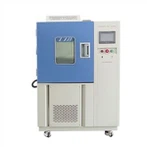
Ozone testing for cables is a test to determine a rubber or elastomer's resistance to ozone degradation. The test methodology for ASTM D1171 requires an Ozone test chamber capable of generating a controlled amount of ozone, a means for circulating ozonized air under controlled conditions of humidity and temperature, and a means for determination of ozone concentration.
Test standard: ASTM D1171
Test Procedure
Sample under 40 + / - 1 ℃, ozone under pressure to 50 + 5 mpa exposed 72 h, unless to test both sides to negotiate each other test conditions. Samples should be in 46 h, 22 h, 70 h from the test chamber to observe crack series.
Sample preparation
Fix a chalk line on the sample, marking the middle distance 190 mm (7.5 inch), from the end of the 32 mm (1. 25 inches). The sample volume into ring shape, overlapping 19 mm (7. 5 inches) into the handle shape, at a chalk line to tie it with copper wire. Hang the sample on the mandrel until it is full
After the specified test duration, the test pieces are removed from the test chamber and examined with normal or corrected vision without magnification and should be free from cracks and the ozone concentration is measured directly with an ozone meter. The required ozone concentration will be specified in the relevant cable standard.
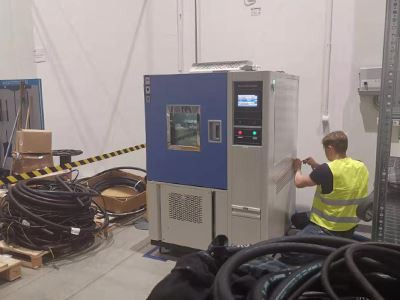 |
Poland customer purchased ozone test chamber in 2019 to test cables |
Working Principle of Ozone Testing for Cables
Ozone testing for cables is designed to evaluate the resistance of cable insulation and jacketing materials to ozone-induced degradation under controlled environmental conditions. The test is conducted using an ozone test chamber that generates and maintains a specified ozone concentration, temperature, and humidity to simulate long-term exposure in real-world environments.
During the test, cable samples are placed inside the chamber and exposed to ozone at controlled concentrations, typically ranging from low to high PPHM levels. Depending on the test standard and application, samples may be tested under static conditions or dynamic conditions. In static testing, cables are held at a fixed elongation, while in dynamic testing, samples are continuously rotated and stretched to simulate mechanical stress such as bending, twisting, and tension encountered during actual service.
|
|
 |
| Workroom | |
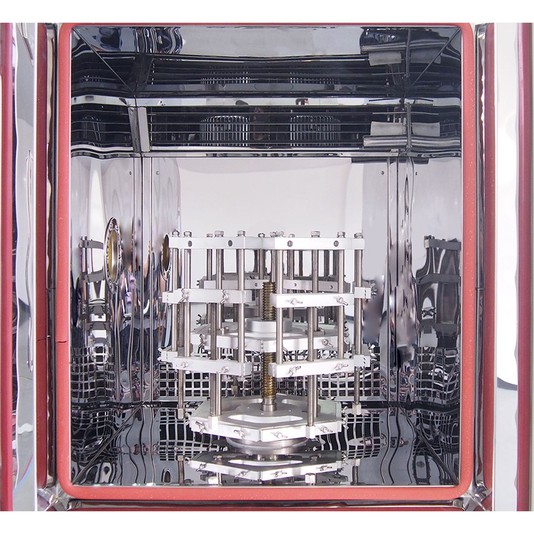
LIB's ozone testing system combines 360° rotational exposure with adjustable elongation (5%–80%), ensuring uniform ozone contact on all cable surfaces. Temperature and humidity are precisely controlled to accelerate aging reactions without introducing uncontrolled variables. Embedded sensors continuously monitor ozone concentration, airflow, temperature, and humidity, ensuring stable and repeatable test conditions throughout the testing cycle.
Over the test duration, ozone reacts with unsaturated bonds in rubber and elastomeric materials, leading to surface cracking, hardening, or loss of elasticity. After exposure, cable samples are visually inspected and mechanically evaluated to assess cracking resistance, material integrity, and overall durability. This process enables manufacturers to predict long-term performance, optimize material formulations, and verify compliance with international cable testing standards.
|
Ozone Concentration |
1–1000 PPHM |
|
Temperature |
0–100°C |
|
Humidity |
30–98% RH |
|
Control Interface |
Programmable color PID touchscreen controller |
|
Connectivity |
Ethernet connection and PC link |
|
Sensors |
Embedded sensors for temperature, humidity, and ozone levels |
Advantages of Ozone Testing for Cables
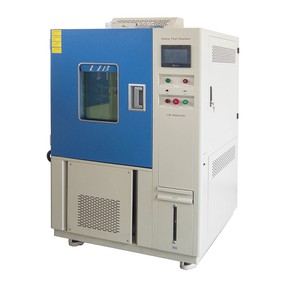
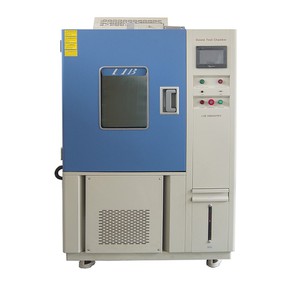
1. Realistic Simulation of Mechanical Stress
LIB's ozone test chambers integrate both static and dynamic sample holders, with 360° rotation and adjustable stretching (5%–80%), accurately simulating real-world mechanical stresses such as bending, twisting, and tension. This ensures even ozone exposure and provides more comprehensive, realistic test results.
2. Precision Control of Testing Conditions
Advanced control systems monitor and regulate ozone concentration (1–1000 PPHM), temperature (0–100°C), and humidity (30–98% RH) with high accuracy. Embedded sensors maintain stable and repeatable conditions, guaranteeing consistent, reliable data for quality assurance and R&D purposes.
3. Enhanced Safety and Environmental Compliance
Equipped with activated carbon filtration and exhaust gas treatment systems, LIB's ozone test chambers neutralize residual ozone before release, ensuring operator safety and compliance with environmental standards, including ISO 14001. Energy-efficient airflow control and low-noise operation further enhance sustainable testing practices.
4. Versatility and Customization
The equipment accommodates a wide range of cable sizes and types, supporting customized sample holders and test procedures. Multiple chamber sizes (250L–1000L) allow testing from small-scale components to larger assemblies, making it suitable for diverse industrial applications.
5. Reliable Support and Service
LIB provides global technical support, a 3-year warranty, lifelong maintenance, and rapid spare parts availability. Customized solutions and professional guidance ensure that testing is accurate, efficient, and aligned with international standards.
》》》For more technical information aninfo@libtestchamber.comd details about our Ozone Test Chamber, please feel free to email us at info@libtestchamber.com.
Ozone Testing for Cables FAQs
Q1: May I ask what material is used for the door seal of the Ozone Test Chamber?
A1: The door seal of the Ozone Test Chamber is usually made of hard silicone rubber. Silicone provides excellent aging resistance and ozone resistance, typically ensuring a service life of around 5 years. This ensures that the chamber maintains a reliable seal during long-term testing.
Q2: May I ask if the sealing material of the Ozone Test Chamber is the same as that of the SO₂ Noxious Gas Corrosion Test Chamber?
A2: Yes, both chambers generally use hard silicone rubber as the sealing material. The main difference is that SO₂ testing requires higher safety standards due to the gas's strong toxicity. Therefore, the sealing performance of SO₂ chambers is verified more rigorously, often using a pressurization test of 0.2 MPa to ensure reliability.
Q3: May I ask what is the maximum stretching capacity of the sample rack in the Ozone Test Chamber?
A3: The ozone sample rack can stretch rubber and other test samples within a range of 5% to 50%, depending on the testing requirements. The equipment typically supports two types of testing: one for static stretching and another for dynamic stretching, meeting the needs of different aging experiments.
Q4: May I ask what is the stretching speed?
A4: The stretching speed of the ozone sample rack ranges from 1 cm/min to 10 cm/min and is adjustable. For standard ozone test specimens, a slower stretching speed is usually preferred during the test to ensure experimental stability and accurate results.
Q5: May I ask whether the inner workroom of the Ozone Test Chamber made of 304 stainless steel can resist corrosion for long-term use? Why is fiberglass not used?
A5: Ozone does not corrode 304 stainless steel, so the inner workroom can maintain excellent corrosion resistance over long-term use. Compared with fiberglass, stainless steel offers additional advantages: it has a refined appearance, is easy to clean and maintain, resists aging and deformation, and has a longer overall service life. For these reasons, stainless steel is typically chosen over fiberglass in the design of ozone test chambers.
Contact LIB Industry today to receive professional guidance, detailed technical documentation, and a customized ozone testing solution tailored to your standards and applications.