In our daily life, we often come into contact with disposable batteries and secondary batteries. Disposable batteries are also known as primary batteries, that is, batteries that can not be recharged, such as lithium primary batteries, dry batteries, etc. Secondary batteries are rechargeable batteries, commonly known as lithium-ion batteries.
Secondary battery for rechargeable battery, its performance mainly includes these aspects: voltage, internal resistance, capacity, internal pressure, self-discharge rate, cycle life, sealing performance, appearance, and other performance such as overcharge, overdischarge, weldability, corrosion resistance, etc.


In this article, we will take lithium battery as an example to briefly introduce some of its common reliability tests.
Battery Test Standards
The formulation or revision of lithium-ion battery standards are very active, which is also the market for lithium-ion battery safety performance requirements continue to improve the need. On the other hand, it also brings more severe challenges to battery manufacturers, which require battery manufacturers to constantly improve the level of design, production and testing.
At present, the common test standards for lithium batteries are IEC 61960, IEC 60086-4, IEC 62133, JIS C 8714, UL 1642, UL 2054.
Common Lithium Battery Reliability Test Items
1. Cycle Life Test
Lithium-ion batteries are known for their high energy density and long service life, making them an ideal choice for many electronic devices. However, like all batteries, they will eventually lose their ability to hold a charge over time. This degradation is known as the cycle life of the battery, and it is an important factor to consider when designing and testing battery systems.
Cycle life testing is the process of subjecting a battery to repeated charge and discharge cycles until it reaches its end of life. This testing can be conducted in a laboratory setting or in actual use conditions, depending on the intended application of the battery. Several factors can affect the cycle life of lithium-ion batteries, including temperature, charge rate, and depth of discharge. To ensure accurate test results, it is important to control these factors during the testing process.

2. High Temperature Test
At present, lithium-ion battery safety standards mainly include international standards (such as IEC standards), national or regional standards (such as JIS, CB, EN standards, etc.) and industry standards (such as UL, IEEE, SJ, QB standards, etc.). In these existing standards, the prescribed test methods at high temperature mainly include heat abuse test, temperature cycle test and high temperature placement test.
- Heat Abuse Test
The heat abuse test method stipulated by IEC 62133:2002 is to put the fully charged battery stabilized at room temperature into a constant temperature and humidity chamber with natural or circulating air convection. The test chamber is heated up to 130℃±2℃ at the rate of 5℃/min±2℃/min. Keep this temperature, stop the test after 10 min, check whether the battery is on fire or explosion. The heat abuse test of IEC 62133 is adopted by JIS C8712, YD 1268, UL 1642 and other domestic and foreign standards. Heat abuse test is generally used to assess the safety of the battery cell when placed at high temperature. The battery sample is in a fully charged state during the test, and the sample is not charged or discharged during the test.
- Temperature Cycle Test
The temperature cycle test method stipulated by IEC 62281:2004 is to place the battery cell or battery pack in an environment of 75℃ for at least 6h, and then in an environment of -40℃ for at least 6h. The conversion time between different temperatures is not more than 30 min, and a total of 10 temperature cycles are carried out. After the test, the sample shall not catch fire or explode, and shall not have quality loss and voltage loss. The temperature cycle test of IEC 62281 is quoted from UN 38.3, and the test method is also adopted by EN 62281, CB 21966 and other domestic and foreign standards. Temperature cycle test is generally used to simulate the safety of a battery cell or battery pack under the condition of multiple alternating temperature changes during transportation. During the test, the battery sample was in a fully charged state, and the sample was not charged or discharged during the test.
- High Temperature Stress Relief Test
The test method for the elimination of high temperature stress (the ability of molded case to withstand high temperature) stipulated in IEC 62133:2002 is to place the battery pack in an environment with a temperature of 70 °C ±2 °C for 7h. After the test, the battery pack housing should not undergo physical deformation that would expose the internal composition. The stress relief test of IEC 62133 is adopted by EN 62133, JIS C8712 and other standards.
High temperature stress relief test is generally used to test the ability of a battery pack housing to maintain integrity in a high temperature environment. During the test, the battery pack sample is in full charge state, and no charge or discharge is carried out during the test.
Based on the high temperature related tests in domestic and foreign lithium-ion battery standards, the heat abuse test is aimed at the battery core's ability to withstand high temperature, the temperature cycle is to simulate the temperature change in the process of transportation, and the high temperature stress relief test is only used to assess the molded shell's ability to withstand high temperature. The samples are fully charged at the time of these tests, and no charge or discharge is performed during the tests.
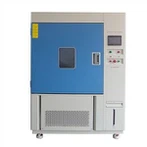
LIB Stability Testing Chamber and Thermal Shock Chamber can fully support the temperature tests described above.

Stability Testing Chamber

Thermal Shock Chamber
3. Immersion Test
As the power source of electric vehicle, the safety of lithium-ion power battery system directly affects the safety of the whole vehicle. The power battery system should meet the IP67 standard or higher waterproof requirements when leaving the factory, but the sealing performance of parts is difficult to ensure that such a high waterproof level is maintained in the whole life cycle, and there may be the risk of water.
Battery system flooding test method:
- Remove the top cover of the battery pack, connect with the vehicle wiring harness in the actual vehicle assembly state, and communicate with the upper machine;
- Completely sink the battery system into salt water (mass concentration is less than 3.5% of seawater concentration, but may be high in some areas), and continue to observe the failure characteristics of the battery system for about 10 min (longer if possible);
- When the failure characteristics are stable, lift the battery pack out of the water to observe whether the saltwater soaked battery system appears in smoke, fire and other phenomena in the atmosphere;
- Treat the battery system according to the test condition (brine soaking), and the soaking test is over.

IPX78

IPX78