A car wash worker aims an 80 °C pressure washer at a running electric vehicle. A dairy plant hoses down a control panel with steaming water every single shift. A wind turbine hub sits exposed to hot spray during cleaning cycles 30 meters above the ground. None of these products can afford to fail the moment water meets heat and pressure - and that is exactly the scenario IPX9K testing was built to reproduce.
This article explains what High Pressure High Temperature Water Jets IPX9K Test Equipment actually does, which IEC 60529 requirements it must satisfy, why US buyers keep choosing LIB's version for its water-saving performance, how IPX9K compares with IPX6K, and the practical questions customers ask before placing an order.
IEC 60529 Testing Standards Behind IPX9K Equipment
The Standards IPX9K Equipment Must Meet
IPX9K is defined in IEC 60529 Annex R and echoed in ISO 20653 and DIN 40050-9, the automotive-grade version of the same test. To earn the rating, a chamber must spray water at 80 °C ± 5 °C through a nozzle at 8,000–10,000 kPa, delivering a flow rate of 14–16 L/min. The nozzle is held 100–150 mm from the specimen and swept across four fixed angles - 0°, 30°, 60°, and 90° - for 30 seconds each, while the specimen rotates on a turntable at roughly 5 r/min. LIB's IPX9K chambers are built to hold every one of these figures within tolerance, because a reading that drifts by even a few kPa or a few degrees can invalidate the whole certification.
How LIB's IPX9K Chamber Works
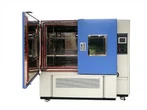
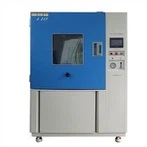
Inside the chamber, a dedicated water tank feeds a high-pressure pump through stainless-steel piping. A heating tube and PT100-style temperature sensor, both mounted inside the tank, bring the water up to the required 80 °C and hold it there while a PID controller reads the loop continuously. From the tank, water passes through a flow meter and pressure gauge before reaching the spray nozzle, so operators can confirm the 8,000–10,000 kPa and 14–16 L/min figures in real time on the touchscreen. A float ball inside the tank protects the pump from running dry, and an automatic water-inlet valve tops up the tank whenever the level drops. The specimen sits on a motorized turntable that tilts and spins to guarantee even exposure across every surface, while a built-in waterproof power feed lets the sample stay energized during the test - so engineers see exactly how the product performs under load, not just whether it stays dry.
Maintenance Guide for Long-Term Accuracy
Because IPX9K testing runs at extreme pressure and heat, routine upkeep is what keeps results repeatable. Nozzles should be cleaned regularly to prevent clogging, and connection pipes checked for loose fittings or cross-knotting, which can stop water flow entirely. The water tank needs draining and cleaning of internal impurities monthly, and the float ball should be wiped clean on the same schedule. The heating tube and temperature sensor deserve a full functional check twice a year - if the controller display shows "- -", the sensor connection is usually the culprit. Pressure meters, solid-state relays, solenoid valves, and circuit boards should be blown free of dust and have their screws re-tightened during periodic service, and the door's sealing strip - which hardens with age - should be replaced roughly every two years to prevent leakage during a test.
Why US Customers Trust LIB's Water-Saving IPX9K Performance
After running side-by-side product performance tests, US customers consistently point to a handful of measurable advantages in LIB's IPX9K equipment:
Water-Saving Design – a closed-loop recirculation and filtration system reuses treated water, cutting fresh-water consumption and lowering utility costs on every test cycle.
High Accuracy – pressure, temperature, and flow are each held within tight tolerance of the IEC 60529 targets (80 °C ± 5 °C, 8,000–10,000 kPa, 14–16 L/min), so certification data holds up under audit.
Proven Stability – PID-controlled heating and stainless-steel construction keep readings consistent test after test, run after run.
Certified Compliance – chambers are built to CE, IEC, and CSA safety requirements, satisfying North American and international auditors without extra retrofitting.
Strong Cost-Effectiveness – lower water use, fewer replacement parts, and long service intervals bring down total cost of ownership.
High Safety Standards – over-temperature, low-water, door-open, and power-failure interlocks protect both operators and specimens.
Full Customization – nozzle configuration, spray angle, and pressure range can be tailored to a customer's specific product line and test protocol.
IPX9K vs. IPX6K: Key Differences and How to Choose
Both ratings involve powerful water jets, but they simulate very different real-world conditions and are frequently confused during procurement.
| Parameter | IPX9K | IPX6K |
|---|---|---|
| Water temperature | 80 °C ± 5 °C | Ambient (unheated) |
| Pressure | 8,000–10,000 kPa | Approx. 100 kPa nominal |
| Flow rate | 14–16 L/min | Approx. 100 L/min |
| Nozzle distance | 100–150 mm | Approx. 3 m |
| Spray duration | 30 seconds per angle (4 angles) | Minimum 3 minutes, 1 min/m² of surface |
| Reference standards | IEC 60529 Annex R, ISO 20653, DIN 40050-9 | IEC 60529, ISO 20653 |
| Typical use case | Engine bays, EV components, industrial cleaning equipment, hot-wash environments | Marine decks, outdoor enclosures, heavy rain and powerful jet exposure |
If a product will ever be sprayed with hot water at close range - pressure washers, steam cleaning, automotive underbody wash - IPX9K is the correct choice. If the concern is powerful but cool water from a distance, such as deck equipment or storm-driven jets, IPX6K is sufficient. Many manufacturers choose a combined chamber capable of both ratings, since it consolidates equipment footprint and covers a wider certification scope in a single investment.
FAQs on High Pressure High Temperature Water Jets IPX9K Test Equipment
Does the chamber require special installation? No special foundation is needed; the unit ships on lockable, height-adjustable castors and only requires a water and power connection plus proper drainage.
What certifications come with the equipment? Every chamber is built to comply with IEC 60529, ISO 20653, DIN 40050-9, CE, and CSA requirements, and test reports can be exported in CSV or PDF format for audit trails.
Can nozzle configuration be customized for our product line? Yes - nozzle count, spray angle, and pressure range can be configured to match a customer's specific test protocol.
What does after-sales service include? Standard coverage includes a multi-year parts and labor warranty, English-speaking technical support, and on-site installation guidance where needed.
How long does shipping take, and are spare parts available? Lead times vary by configuration, and spare parts are stocked regionally so replacements typically arrive within one to two weeks rather than requiring a full return-to-factory cycle.
Contact LIB Industry for a customized IPX9K design, a live demonstration, or to schedule delivery of your next high pressure high temperature water jet test chamber.