
When paints, plastics, textiles, and artist materials are exposed to sunlight, color fading and surface degradation are inevitable. However, outdoor exposure tests often take months or even years, and results vary with weather, season and region. A Light Fastness Test Instrument accelerates this process by reproducing real sunlight, temperature and humidity cycles in a controlled chamber, enabling reliable test data in weeks instead of years.
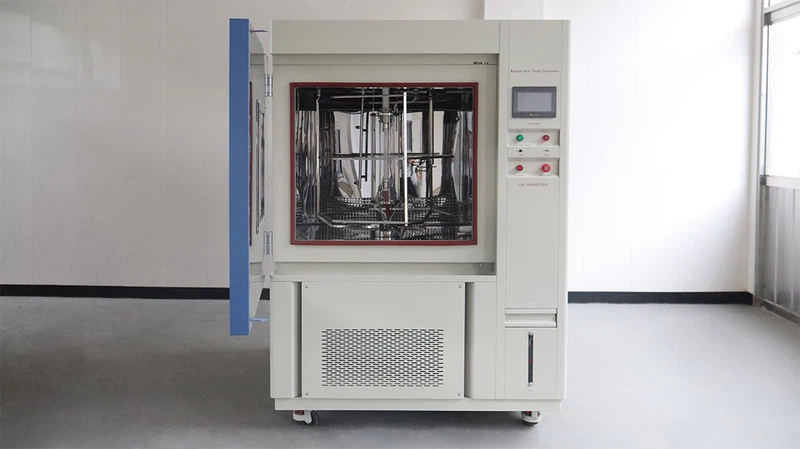
LIB Light Fastness Test Instrument is engineered for accurate color fading evaluation under xenon-arc or UV irradiation. It simulates the spectral power distribution of natural daylight, while measuring color retention, gloss decay, cracking, chalking, and aging response with full compliance to ASTM G155, ASTM D6695, ISO 11341, ISO 105, ISO 4892-2, D7869 & IEC 60068.
1. What Does a Light Fastness Test Instrument Evaluate?
A Light Fastness Test Instrument is designed to assess how well materials such as textiles, plastics, coatings, prints, leather, dyes, and pigments retain color and physical integrity when exposed to artificial sunlight or UV radiation. This evaluation is critical because sunlight-especially UV wavelengths between 300–400 nm-can trigger photochemical reactions, leading to pigment fading, polymer chain degradation, surface chalking, and gloss reduction.
During testing, samples are subjected to controlled irradiation, temperature, and humidity conditions to simulate months or even years of natural outdoor aging within a short period. By comparing pre- and post-exposure results, researchers gain insight into a material's light-induced durability.
Typical evaluation indicators include:
- color difference to quantify fading levels
- Gloss retention or gloss loss rate
- Yellowing index change for white or light-colored materials
- Surface cracking, chalking, or powdering degree
- Tensile strength loss or brittleness increase
- Appearance change such as discoloration, dullness, and texture degradation
The test helps manufacturers:
Compare lightfastness performance among different pigments or formulations
Validate product quality before mass production or market release
Predict outdoor service life, weatherability, and long-term stability
Optimize UV stabilizers, anti-yellowing additives, and protective coatings
Light fastness levels are classified using reference standards such as ISO Blue Wool Scale, typically graded from Level 1 (very poor) to Level 8 (excellent). For industrial coatings and automotive materials, a sample that maintains color difference < 1.7 after 96 hours of xenon arc exposure is generally considered high-performance, demonstrating resistance to fading and photo-aging.
》》》For more technical information and details about our Light Fastness Test Instrument, please feel free to email us at info@libtestchamber.com.
2. Standard Test Methods for Lightfastness of Colorants Used in Artist Materials
International standards define how exposure intensity, spectral distribution, water spray, humidity and temperature should be controlled:
| Standard | Focus | Key Requirements |
|---|---|---|
| ASTM D6695 / ISO 11341 | Xenon arc exposure for coatings | 340 nm @ 0.51 W/m²·nm or 420 nm @ 1.10 W/m²·nm; alternating illumination + spray cycles |
| Protocol ① | 340 nm weathering | 102 min continuous light + 18 min water spray |
| Protocol ② | 420 nm window-glass light | Continuous illumination without interruption |
| ASTM G155 | General xenon aging exposure | Light, spray & darkness cycles, humidity control, real-weather simulation |
| ISO 105 / ISO 4892-2 | Textile & polymer fastness grading | Uses blue wool reference scale Grade 1–8 |
| ASTM D7869 | Harsh climate durability | High-temperature & high-humidity outdoor simulation (Florida-type exposure) |
| IEC 60068 | Component climate reliability | Thermal-UV combined stress evaluation |
These standards ensure that test results are comparable across laboratories, making them essential for certification, product warranty validation and quality control.
|
|
|


3. LIB Light Fastness Test Instrument Procedure for Lightfastness of Colorants
The LIB xenon light fastness tester simulates natural sunlight aging using a 4500W/6500W xenon-arc lamp, programmable temperature–humidity control, and optional spray/condensation cycling. This method accurately evaluates the fading resistance, color stability, and weatherability of colorants under long-term UV exposure.
|
Sample holder |
Adjustable speed, 1r /min |
|
Chamber Type |
Rotating Holder |
|
Irradiation Source |
4500w water-cooled xenon arc lamp with inner quartz and outer borosilicate filter |
|
Irradiance Range |
35~150 W/㎡ |
|
Bandwidth Measurement |
280~800 nm |
|
Chamber Temperature Range |
Ambient~ 100 ℃ ±2 ℃ |
|
Black Panel Temperature |
BPT 35 ~ 85 ℃ ±2 ℃ |
|
Humidity Range |
50 % ~ 98 % RH |
|
Water Spray Cycle |
1~9999 H 59 M (Adjustable) |
Step 1: Sample Preparation & Mounting
Cut samples to required size and mount them on the rotating specimen rack for uniform exposure.
• Standard fixture thickness: 3 cm; optional customization up to 11 cm
Advantage: Large loading space & adjustable holders allow various material types and thicknesses.
|
|
|
| Workroom |
Hanging specimen |


Step 2: Parameter Configuration
Set irradiance, black panel temperature, humidity, and cycle conditions according to ASTM/ISO standards.
• Temperature range: 35–85°C (±2°C)
• Humidity control: 50–98%RH
Advantage: Precise environmental control ensures high repeatability and compliance with global test methods.
Step 3: Xenon Lamp Exposure
Start xenon-arc illumination to simulate full-spectrum sunlight (280–800 nm).
• Optional water spray, condensation, day/night cycling
Advantage: Realistic outdoor aging reproduction reduces testing time while improving accuracy.
|
|
|


xenon lamp and filters
Step 4: Monitoring & Data Logging
Record irradiance, chamber temperature, humidity, and exposure duration in real time.
• Data export through Ethernet/USB
Advantage: Continuous monitoring enables traceable results and cross-laboratory comparison.
 |
|
| Control system | Rain spray system |

Step 5: Performance Evaluation
Measure color difference, gloss retention, and visible defects before/after exposure.
• >30% gloss loss or cracking indicates notable degradation
Advantage: Quantitative evaluation provides clear quality benchmarks for R&D and QC departments.
》》》To receive customized solutions and pricing for the Light Fastness Test Instrument, please contact us at info@libtestchamber.com.
4. FAQs on Light Fastness Test Instrument
1. Xenon lamps are gas discharge lamps. What are gas discharge lamps? What is their principle?
Gas discharge lamp is a light source that emits light using a gas discharge principle. Inside a sealed chamber at controlled pressure, voltage is applied between electrodes to ionize the gas. This produces high-temperature plasma, generating visible light output.
2. The xenon lamp tube has a quartz inner layer and a borosilicate outer filter. Does this mean the inner wall is quartz and the outer wall is borosilicate? How should "filter" be understood here?
The discharge arc is contained in a quartz tube to withstand high temperature and pressure. The outer borosilicate layer serves as an optical filter, which controls spectrum transmission to match test standards. It is not the lamp itself, but an external filtering structure designed to shape light output to 280–800 nm for test compliance.
3. The lamp tube has a lifespan of 1600 hours. Is there a way to extend it?
1600 hours is the standard xenon lamp lifespan. While it can run longer, irradiance gradually decreases, affecting test accuracy. To maintain precision, replacement is recommended once rated hours are reached.
4. What is the maximum sample thickness for the standard rotating xenon lamp rack? What about for customized racks?
Standard rotating racks support 3 cm sample thickness. Custom racks can reach up to 11 cm, suitable for larger or structured samples.
5. If the test chamber is not fully loaded and there are gaps, will it affect humidity inside?
No. Even with empty space, humidity uniformity remains stable thanks to internal airflow and circulation systems ensuring consistent distribution.
LIB delivers full-spectrum xenon weathering solutions including UV, salt spray, climate and IP waterproof chambers, supporting R&D verification, accelerated outdoor simulation, and QC certification. Contact LIB for a customized program that fits your testing workflow.
Any customization can be made. LIB offers a 3-year warranty and lifetime service. Any issues that cannot be resolved during the warranty period will be replaced free of charge. 24/7 English-speaking after-sales team. Fast shipping within 7-15 days.
Contact LIB Industry to develop a professional and efficient solution tailored to your specific standards and stringent requirements.


