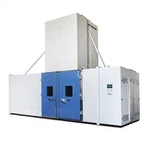
Stability chambers play a crucial role in various industries, from pharmaceuticals to food production. These specialized environments are designed to maintain precise temperature and humidity conditions, allowing researchers and manufacturers to assess the long-term stability of their products. In this comprehensive guide, we'll delve into the intricacies of temperature and humidity control within stability test chambers, exploring their importance, applications, and the technology behind these essential tools.

What is Stability Test Chamber
-
The Purpose of Stability Testing
Stability testing is a vital process in product development and quality control. It involves subjecting products to controlled environmental conditions over extended periods to evaluate their shelf life, efficacy, and safety. Stability test chambers are the cornerstone of this process, providing consistent and reproducible conditions for accurate assessments.
-
Key Components of a Stability Chamber
A stability test chamber comprises several sophisticated components working in harmony to maintain precise environmental conditions. These include temperature control systems, humidity generators, air circulation mechanisms, and advanced sensors for continuous monitoring. The synergy of these elements ensures the chamber can replicate a wide range of environmental scenarios.
-
The Importance of Accurate Environmental Control
Maintaining accurate temperature and humidity levels is paramount in stability testing. Even minor fluctuations can significantly impact test results, potentially leading to erroneous conclusions about a product's stability. High-quality stability chambers are engineered to minimize these variations, ensuring the reliability and reproducibility of test data.
Temperature Control in Stability Chambers

-
Temperature Ranges and Precision
Stability test chambers are designed to maintain a broad spectrum of temperatures, accommodating conditions from below freezing to temperatures exceeding 60 °C. This range allows for versatile testing across various industries, including pharmaceuticals and electronics. The precision of temperature control within these chambers is highly refined, typically maintaining accuracy within ±0.1 °C to ±0.5 °C.
This level of precision ensures that stability studies are conducted under consistent and reliable conditions, which is crucial for obtaining valid results and ensuring product quality. The exact specifications for temperature control depend on the chamber's design and the specific requirements of the stability testing protocol.
-
Temperature Uniformity and Stability
Uniform temperature distribution is essential for accurate and reliable stability testing. Advanced stability chambers use sophisticated air circulation systems and strategically positioned heating and cooling elements to achieve consistent temperature across the entire chamber. This careful design ensures that there are no significant temperature fluctuations or gradients, which is vital for precise testing outcomes. The uniformity is maintained continuously over long periods, from several months to years, depending on the duration of the stability study. This capability supports extensive long-term research and ensures that the test conditions remain stable throughout the study.
-
Temperature Cycling and Ramping
Certain stability studies necessitate simulating temperature fluctuations or gradual changes to mimic real-world conditions. Modern stability test chambers are equipped with advanced programming capabilities that enable temperature cycling and ramping. These functions allow researchers to create dynamic environmental conditions by varying temperatures over time, either in cycles or gradual shifts.
This feature is particularly beneficial for assessing how products react to temperature changes during storage or transportation, providing valuable insights into their stability and performance under more variable conditions. Such simulations help ensure that products maintain their quality and efficacy even when exposed to fluctuating temperatures.
Humidity Control in Stability Chambers

-
Humidity Generation and Regulation
Controlling humidity within a stability chamber involves sophisticated humidity generation systems. These may include steam generators, ultrasonic humidifiers, or other technologies capable of precisely regulating relative humidity levels. The humidity control range in stability chambers typically spans from 20% to 95% relative humidity, with some advanced models offering even broader ranges.
-
Humidity Uniformity and Stability
Much like temperature control, maintaining uniform humidity throughout the chamber is essential for accurate stability testing. This is achieved through careful design of air circulation patterns and strategic placement of humidity sensors. Stability test chambers are engineered to maintain consistent humidity levels over extended periods, ensuring the reliability of long-term stability studies.
-
Dew Point Control and Condensation Prevention
In stability testing, preventing unwanted condensation is crucial, especially when testing moisture-sensitive products. Advanced stability chambers incorporate dew point control mechanisms to prevent condensation on chamber surfaces or test samples. This feature is particularly important when testing at high humidity levels or when conducting temperature cycling studies that may approach the dew point.
The advantages of LIB Stability Chambers

|
Name |
Stability Chambers | ||||||||
|
Model |
TH-100 |
TH-225 |
TH-500 |
TH-800 |
TH-1000 |
||||
|
Internal dimension (mm) |
400*500*500 |
500*600*750 |
700*800*900 |
800*1000*1000 |
1000*1000*1000 |
||||
|
Overall dimension (mm) |
860*1050*1620 |
960*1150*1860 |
1180*1350*2010 |
1280*1550*2110 |
1500*1550*2110 |
||||
|
Capacity |
100L |
225L |
500L |
800L |
1000L |
||||
|
Temperature range |
-20℃ ~+150 ℃ |
||||||||
|
Low type |
A: -40℃ B:-70℃ C -86℃ |
||||||||
|
Huimidity Range |
20%-98%RH |
||||||||
|
Temperature deviation |
± 2.0 ℃ |
||||||||
|
Heating rate |
3 ℃ / min |
||||||||
|
Cooling rate |
1 ℃ / min |
||||||||
|
Controller |
Programmable color LCD touch screen controller, Multi-language interface, Ethernet , USB |
||||||||
|
Refrigerant |
Environment friendly refrigerant |
||||||||
|
Exterior material |
Steel Plate with protective coating |
||||||||
|
Interior material |
SUS304 stainless steel |
||||||||
|
Standard configuration |
1 Cable hole (Φ 50) with plug; 2 shelves |
||||||||
1. Reliable Data You Can Trust
LIB stability chambers are designed to deliver consistent and repeatable environmental conditions for long-term testing. With high-precision PT100 sensors and advanced PID control, temperature stability can reach ±0.5°C while humidity remains within ±2.5% RH. This level of accuracy ensures that every stability study-whether short-term screening or 1000-hour testing-produces dependable, audit-ready data.
2. Excellent Uniformity for Consistent Results
Uniform environmental distribution is critical in stability testing. LIB chambers use optimized airflow systems with multi-directional circulation to maintain minimal variation throughout the chamber. This ensures that all samples, regardless of placement, are exposed to the same conditions-eliminating inconsistencies and reducing the need for repeat tests.
3. Built for Long-Term Operation
Stability testing often runs for weeks or even months. LIB chambers are constructed with SUS304 stainless steel interiors for corrosion resistance and easy cleaning, combined with durable coated steel exteriors. Their robust structure supports continuous operation with minimal maintenance, making them ideal for demanding laboratory environments.
4. Flexible and Application-Oriented Design
Every lab has unique testing requirements. LIB stability chambers offer customizable shelving, cable ports, and internal configurations to accommodate different sample sizes and test setups. Users can store multiple test programs with multi-step profiles, allowing quick switching between different stability protocols without reconfiguration.
5. Easy Operation and Fast Setup
Designed with user convenience in mind, LIB chambers feature an intuitive touchscreen interface with multi-language support. Pre-programmed test cycles and real-time monitoring simplify operation, while plug-and-play installation allows users to start testing quickly without complex setup procedures.
6. Efficient Performance for Faster Testing
With controlled heating and cooling rates, LIB chambers help reduce test cycle times while maintaining stable conditions during long-duration holds. This improves overall testing efficiency and helps laboratories meet tight development and validation deadlines.
Conclusion
Understanding the intricacies of temperature and humidity control in stability test chambers is essential for anyone involved in product development, quality assurance, or regulatory compliance. These sophisticated instruments provide the controlled environment necessary for conducting accurate and reliable stability studies across various industries.
By maintaining precise temperature and humidity conditions, stability chambers enable researchers and manufacturers to gain valuable insights into product behavior over time. This information is crucial for determining shelf life, optimizing formulations, and ensuring product safety and efficacy throughout its intended lifespan.
If you're looking to enhance your stability testing capabilities or require custom solutions for your specific testing needs, don't hesitate to reach out to our team of experts. We're here to help you find the perfect Stability Test Chamber for your applications. Contact us at info@libtestchamber.com to discuss your requirements and discover how our advanced stability chambers can support your research and quality control efforts.