Modern laboratories are shrinking, but test requirements are growing tougher.  Electronics are expected to survive desert heat, freezing transport, tropical humidity, and long-term storage-all before they ever reach a customer. Engineers and QA teams no longer have the luxury of waiting months for natural exposure or dedicating entire rooms to large environmental chambers.
In academic and university research environments, repeatability and operational stability are critical. During routine laboratory use, researchers need assurance that environmental conditions remain precise and consistent over time. Following regular operation, a Swiss university laboratory user noted, "The last time I was working with the chamber, it was functioning very well." This reflects the expectations of academic institutions: dependable performance, accurate control, and minimal operational intervention.
LIB's Mini Climatic Chamber is designed exactly for this reality. By combining laboratory-grade sensors, advanced PID control, and uniform airflow inside a compact enclosure, it delivers the same environmental accuracy expected from stand-in or walk-in chambers-scaled perfectly for R&D labs, electronics testing, and small-batch qualification work.
Working Principle of a Mini Climatic Chamber
A Mini Climatic Chamber controls temperature and humidity through tightly coordinated heating, cooling, humidification, and airflow systems. LIB Mini Climatic Chambers cover a temperature range from –86 °C to +150 °C and a humidity range from 10 % to 98 % RH, enabling simulation of nearly all real-world climatic conditions.
Accurate control starts with precision sensing and closed-loop regulation. High-accuracy PT100 Class A temperature sensors provide up to 0.001 °C resolution, while advanced PID algorithms continuously compare real-time values with setpoints. The controller automatically adjusts compressor-based cooling, electric heating elements, and humidification output to maintain ±0.5 °C temperature stability and ±2 %–2.5 % RH humidity accuracy.
Uniformity is ensured through optimized airflow design. Dual centrifugal fans and precision-engineered baffles circulate conditioned air evenly throughout the chamber. This eliminates hot-cold or wet-dry zones, ensuring every sample experiences identical exposure-critical for repeatability and standard compliance.
These controlled conditions support a wide range of industries and standards. LIB Mini Climatic Chambers are widely used for electronics, batteries, automotive components, photovoltaic modules, luminaires, and materials testing, fully supporting standards such as IEC 60068-2-30, IEC 61215, SAE J2334, VW 80000, IEC 62717, and battery standards including UL 2580, IEC 62660-2, UL 1642, and IEC 62133.
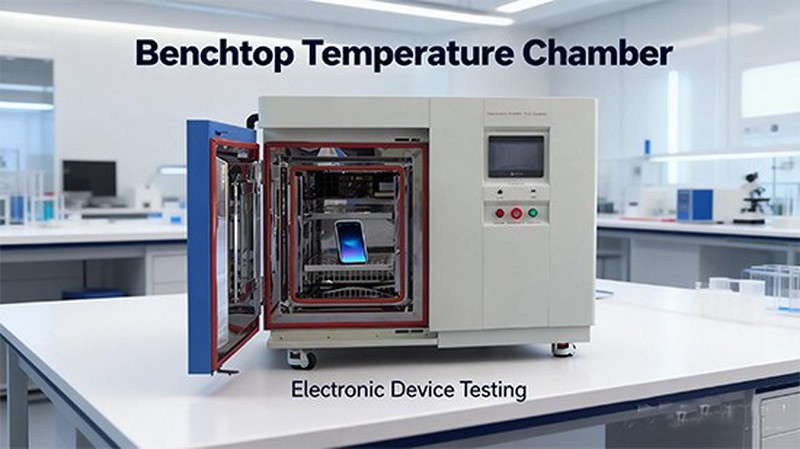
Climatic Chamber for Thermal test
1. Small Benchtop Temperature Humidity Chamber
2. High-Precision Walk in Temperature Chamber
3. Temperature and Humidity Aging Chamber
4. Durable Lab Vacuum Drying Oven
5. Energy-Efficient Battery Thermal Test Chamber
6. Programmable 2-Zone And 3-Zone Vertical Thermal Shock Test Chamber
Real-World Electronics Testing with a LIB Mini Climatic Chamber
Electronics reliability testing requires controlled, repeatable environmental stress-not guesswork.
Using a LIB Mini Climatic Chamber, engineers can reproduce real operating and storage conditions while closely monitoring performance changes, degradation, or failure points.
|
|
|
|||||
| Model | TH-50 | TH-80 | ||||
| Internal dimension (mm) |
320x350x450 |
400x400x500 | ||||
| Overall dimension (mm) | 800x1050x950 | 900×1100×1000 | ||||
| Temperature range | -86 ℃ ~+150 ℃ | |||||
| Temperature fluctuations | ± 0.5 ℃ | |||||
| Humidity Range | 10%/20%~95 % | |||||
| Temperature deviation | ± 2.0 ℃ | |||||
| Temperature Sensor | PTR Platinum Resistance PT100Ω/MV A-class | |||||
| Temperature Resolution | ± 0.001 ℃ | |||||
| Exterior Material | Steel Plate with A protective coating | |||||
| Interior Material | SUS 304 stainless steel | |||||


Step 1: Program realistic thermal and humidity profiles.
Instead of manual adjustment, engineers create automated test programs using the 7-inch color touchscreen controller, supporting up to 120 programs with 100 steps each.
LIB advantage: Complex cycles such as temperature ramp + humidity soak + recovery can run unattended with precise ramp rates of 1 °C/min cooling and 3 °C/min heating, improving efficiency and consistency.
Step 2: Execute accelerated thermal cycling and damp heat tests.
Thermal cycling tests and damp heat exposure are conducted according to IEC 60068-2-30, SAE J2334, or VW 80000, simulating condensation, corrosion, and fatigue.
LIB advantage: Stable airflow and ±2 % RH humidity control prevent false failures caused by uneven moisture distribution.
Step 3: Perform humidity freeze and low-temperature stress tests.
Humidity freeze and sub-zero storage simulations validate PCB coatings, solder joints, and connector seals.
LIB advantage: Low-temperature capability down to –86 °C allows true cold-soak testing beyond standard climatic limits.
Step 4: Collect traceable data for compliance and reporting.
Temperature, humidity, ramp rates, and event logs are recorded continuously via Ethernet or USB.
LIB advantage: One-click data export supports ISO/IEC-compliant documentation for audits, certifications, and customer reports.
Mini vs. Stand-In vs. Walk-In Climatic Chambers
Mini Climatic Chambers excel in speed, efficiency, and accessibility.
They are ideal for R&D labs, electronics benches, and pilot production, offering fast setup, low power consumption, and whisper-quiet operation at ≤60–65 dBA.
Stand-in chambers balance capacity and performance.
They support larger sample sizes but require dedicated floor space and higher energy usage, making them better suited for centralized QA labs.
Walk-in chambers are designed for large assemblies and mass testing.
While essential for vehicles or oversized systems, they involve higher installation costs, longer stabilization times, and lower flexibility for rapid iteration.
|
|
|
|
|
|---|---|---|---|
 |
 |
 |
|
| Name | Small Climatic Test Chamber | Standing Climatic Test Chamber | Walk-In Climatic Test |
| Capacity |
TH-50: 800x1050x950 mm TH-80: 900×1100×1000mm |
Capacity: 100L; 225L; 500L; 800L; 1000L |
>20m³ |
| Throughput | Ideal for small components, sensors, boards | Subassemblies or mid-volume batches |
Bulk testing of items or vehicles as a whole |
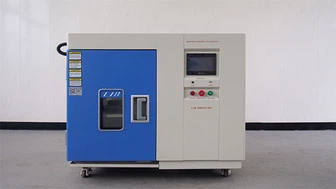


For early-stage development and frequent testing, Mini Climatic Chambers provide the highest return on investment.
They deliver laboratory-grade accuracy without the operational burden of larger systems.
FAQs on the Climatic Chamber
1. What is the maximum temperature change rate?
Standard ramp rates are 5–10 °C/min, but LIB supports customized fast-change designs up to 20 °C/min or higher, depending on application requirements.
2. Does the chamber measure dew point temperature?
LIB Mini Climatic Chambers primarily control relative humidity (RH). Dew point is not measured directly but can be calculated externally if required.
3. Will custom cable ports or viewing windows delay delivery?
Standard test ports and viewing windows do not affect delivery time. Optical glass windows typically add 5–10 days, even for customized designs.
4. How is the chamber calibrated?
Factory calibration includes multi-point temperature calibration using 9 distributed probes and humidity calibration via dry-wet bulb comparison, ensuring uniformity and accuracy before shipment.
5. How often should the silicone sealing ring be replaced?
LIB recommends replacement every 3 years to maintain airtight performance. With proper maintenance, the chamber itself can operate reliably for up to 20 years.
LIB Mini Climatic Chambers combine compact design, precise control, and full standards compliance to help laboratories test faster, smarter, and more reliably. Whether you're validating electronics, batteries, or materials, LIB delivers the performance you need-right on your benchtop.
Contact LIB Industry today to discover how our Mini Climatic Chambers can streamline your R&D, QA, and production testing workflows with speed, accuracy, and confidence.