In recent years, the country strongly advocates the use of green energy. Solar energy, as one of the renewable and clean energy sources, has been the focus of the country. The territory of photovoltaic power stations is also expanding.
The photovoltaic module is an important part of the photovoltaic power generation system, its long-term operation process will produce many problems, including material corrosion, water vapor erosion, wind and hail to the photovoltaic module mechanical damage, mechanical damage in the installation process, thermal offset, ultraviolet radiation caused by its attenuation and photovoltaic module parts aging. Therefore, the reliability and decay rate of photovoltaic modules during operation has become one of the most concerning problems in the photovoltaic industry.
1. What Is A Photovoltaic Panel
In order to understand the factors that affect the power generation efficiency of photovoltaic modules, we must first understand what photovoltaic modules are. A solar cell module (also called a solar panel) is the core part of a solar power system that converts the sun's energy into electricity, either to a battery for storage or as a direct energy supply to propel a load. The main materials of photovoltaic modules include toughened glass, EVA, battery sheet, backplane, aluminum alloy, junction box, and silicone. The mainstream photovoltaic panels on the market are divided into monocrystalline silicon solar cells, polycrystalline silicon solar cells, and amorphous silicon solar cells.

2. What Is The Environmental Aging Test Of PV Modules
Photovoltaic modules need to undergo a number of tests to complete the quality test, such as insulation test, pressure test, power test, performance test, fire test, crosslinking degree test, pulse test, reliability test, load analysis test, aging test, infrared test, thermal cycle test, ammonia corrosion test, etc. We're going to focus today on the aging test.
The aging test is used to test the photoelectric characteristics of solar cell modules to see the declining loss when they are exposed to high humidity and high ultraviolet radiation. Generally speaking, the environmental aging test is to understand the influence of outdoor comprehensive environmental factors on photovoltaic modules and materials and to verify the anti-decay ability of photovoltaic panels through the accelerated aging test.


3. Why Do PV Modules Need Environmental Aging Tests
For photovoltaic panels, especially monocrystalline silicon photovoltaic panels, the price is relatively high.
From the user's point of view, the user must hope that the photovoltaic panels purchased will have a long service life, stable power generation and small maintenance costs. From the perspective of the use of photovoltaic panels, it is arranged outdoors, generally, after installation will not be easily moved. Then it needs to constantly experience a variety of complex outdoor weather changes, such as the temperature difference and humidity difference between day and night, long-term high-intensity UV exposure, rain erosion, and sand caused by wear and tear. From the design point of view, the general design service life of photovoltaic panels is 20-25 years, so whether to achieve the initial design goals, is also the concern of manufacturers and consumers. An accelerated aging test is designed to solve these problems.
4. What Are The Items Included In The Environmental Aging Test Of PV Modules
- Temperature and humidity test
There are three test points for the temperature and humidity test of photovoltaic panels.
Thermal cycling: The temperature of the work room where the test piece was located was lowered from normal temperature to - 40℃, maintained at this temperature for a period of time, then heated up to 85℃, maintained at this temperature for a period of time, and then cooled down to - 40℃, there is a total of 100 cycles.
Humidity freeze cycle: From 85% relative humidity, 85℃ to -40 ℃, and then to 85 ℃, a total of 10 cycles.
Heat RH testing: 1000 hours at 85% relative humidity and 85℃
At LIB Industry, we can provide you with a professional temperature and humidity test chamber. The cooling rate of our PV Modules Test Chamber is fast, which can shorten the test time to the greatest extent without affecting the experimental results. The photovoltaic panel of this machine is placed upright and the height can be adjusted, which is our patent.


PV Environmental Test Chamber
- UV Weathering Test
Our UV Weathering Test Chamber can simulate different environments of temperature, humidity, illumination, spray, and condensation to accelerate the aging test equipment of test materials. Simple operation, you can link to the Internet, and you can archive experimental data, to avoid long-term test interruption caused by experimental data loss. In general, the role of the UV lamp source, which simulates sunlight, in the accelerated aging test of photovoltaic panels is obvious.
If you are interested, you can contact us, we will arrange the most professional program for you. Accelerated aging of laboratory equipment.


UV Weathering Resistance Test Chamber
- Dustproof test
During the use of photovoltaic modules, under the alternating action of water vapor and high temperature, it is difficult to maintain a long-time seal. In the case of no quality problems in each component, the tightness of the photovoltaic panel will also affect its quality and life. For the tightness of photovoltaic panels, we can use the Ingress protection test chamber test, divided into Dust Test Chamber and Water Spray Test Chamber. The dustproof and waterproof ability of photovoltaic modules is strictly tested.
Dust test chamber, mainly to test the tightness of the photovoltaic panel. Sand and dust testing of photovoltaic panels in advance can effectively reduce the sand and dust invasion problem that may occur in the subsequent use of photovoltaic panels caused by equipment stratification.
- Waterproofing test
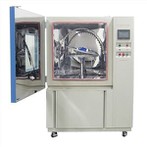
The water spray test is also an important test. For the waterproof performance of photovoltaic panels and the overall sealing have a very important reference significance. For the panels, in particular, water resistance is crucial. The water inside the photovoltaic panel may affect the photoelectric conversion of some areas of the photovoltaic panel or even lead to the abandonment of the entire photovoltaic panel. This test is therefore essential.

Dustproof Testing Machine

Water Ingress Testing Machine
We provide professional dust test chamber and water spray test chamber, if you are interested in this, please do not hesitate to contact us.