Classification
It's mainly divided into two types.
1. Storage battery, for pure electric vehicles
2. Fuel cell, it's dedicated to fuel cell electric vehicles

Test Standard: IEC 62660-2
■Thermal Test
This test is performed to characterize cell responses to high-temperature environment.
a) Adjust the SOC of the cell to 100% for BEV application, and to 80% for HEV application.
b) The cell, stabilized at room temperature, shall be placed in a gravity or circulating air-convection oven. The oven temperature shall be raised at a rate of 5K/min to a temperature of 130℃±2K. The cell shall remain at this temperature for 30 min before the test is discontinued.
Note-If necessary, to prevent deformation, the cell may be maintained during the test in a manner that does not violate the test purpose. The manner to prevent deformation should be representative of cells inside battery systems and battery packs.
■Temperature cycling
This test is performed to characterize thermal durability of a cell by exposing at a low and high temperature environment alternately to cause expansion and contraction of cell components.
a) Adjust the SOC of the cell to 100% for BEV application, and to 80% for HEV application.
b) Perform the temperature cycling in accordance with ISO 16750-4 as shown in Table 4 the minimum operating temperature shall be -40℃ or Tmin specified by the cell manufacturer and the maximum operating temperature shall be 85℃ or Tmax specified by the cell manufacturer. Perform 30 test cycles as specified.
Table 4
Cumulative time min | Temperature ℃ |
0 | 25 |
60 | Tmin |
150 | Tmin |
210 | 25 |
300 | Tmax |
410 | Tmax |
480 | 25 |
Test Standard: UL1642-2015 Clause 17
A battery is to be heated in a gravity convection or circulating air oven with an initial temperature of 20±5℃(68±9℉). The temperature of the oven is to be raised at a rate of 5±2℃(9±3.6℉) per minute to a temperature of 130±2℃ (266±3.6℉)and remain for 10 min. The sample shall return to room temperature (20±5℃) and then be examined. For batteries specified for temperatures above 100℃(212℉), the conditioning temperature shall be increased from 130±2℃(266±3.6℉), to 30±2℃(86±3.6℉) above the manufacturers maximum specified temperature. For a battery of lithium metal chemistry, the conditioning temperature shall be increased to a maximum of 170±2℃(338±3.6℉).
Test Standard: UL 1642-2015 Clause 18
■Temperature cycling test
a) Raising the chamber-temperature to 70±3℃(158±5℉) within 30 min and maintaining this temperature for 4h.
b) Reducing the chamber temperature to 20±3℃(68±5℉) within 30 min and maintaining this temperature for 2h.
c) Reducing the chamber temperature to -40±3℃(-40±5℉) within 30 min and maintaining this temperature for 4h.
d) Raising the chamber temperature to 20±3℃(68±5℉) within 30 min.
e) Repeating the sequence for a further 9 cycles.
f) After the 10th cycle, storing the batteries for a minimum of 24h, at a temperature of 20±5℃(68±9℉) prior to examination.
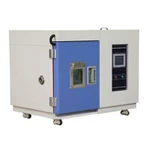
LIB comprehensive environmental test chambers can perform this thermal and temeprature test, Please find temperature test chamber model TH-500 and thermal shock chamber TS-162.