
Outdoor exposure testing is slow, unpredictable, and expensive. Sunlight intensity varies by season and latitude, rainfall is irregular, and temperature and humidity fluctuate daily. Waiting one to three years to determine whether a plastic cracks, a coating fades, or a cable sheath embrittles is simply not realistic for modern product development.
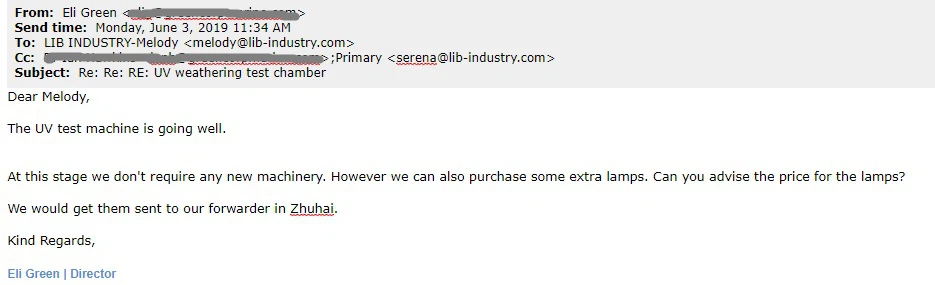
That is why manufacturers turn to accelerated UV aging solutions they can trust. One of our Australian customers, Eli Green, Director, shared his experience after installing the LIB UV Weathering Test Chamber: "The UV test machine is going well." The system has been operating reliably in daily testing, delivering consistent results to the point that no additional equipment was needed-only extra UV lamps to support ongoing test demand. This real-world feedback reflects the chamber's stability, durability, and suitability for long-term use.
The LIB UV Aging Test Chamber is designed to answer one core question: how a material will perform after long-term outdoor exposure. By strictly complying with international standards such as ASTM G151, ASTM G154, ASTM D4329, ISO 4892-1, and related methods, LIB provides UV aging results with strong, repeatable correlation to natural weathering-while reducing testing time from years to weeks.
How UV Aging Test Chambers Simulate Natural Outdoor Weathering
UV aging test chambers accelerate real outdoor damage instead of copying time exactly. They do not try to simulate one outdoor year hour by hour. Instead, they focus on the main factors that actually cause materials to age outdoors and apply them in a controlled, intensified way so results appear much faster.
UV test results are strongly correlated with outdoor weathering, not based on simple time conversion. According to ASTM G151 and ISO 4892-1, about 17 hours of standardized UV exposure can represent roughly one year of typical outdoor aging for many polymer materials. The exact relationship depends on material formulation, color, additives, and environment, but this approach is widely used to compare durability efficiently.
UV aging chambers simulate the most destructive outdoor conditions. They reproduce UV radiation (290–400 nm) that breaks polymer chains and causes fading and embrittlement, elevated temperatures up to 90 °C that speed up aging reactions, high humidity and condensation above 95 % RH that mimic dew, and water spray cycles that recreate rain and repeated wet–dry stress.
International standards ensure laboratory aging looks like real outdoor failure. Standards such as ASTM D4329 and ASTM G154 are designed so that materials fail in the lab the same way they do outdoors-through cracking, discoloration, surface chalking, and loss of mechanical strength.
In summary, UV aging chambers reliably predict outdoor performance when used correctly. When the appropriate standard, UV lamp type, and test cycle are selected, UV aging test results show a close and practical correlation with natural outdoor weathering.

The Working Principle Behind UV Aging Test Chambers
Understanding correlation starts with understanding how the chamber works.
UV light source selection
LIB UV chambers use 8 fluorescent UV lamps (40 W each) with selectable types:
1. UVA-340 (295–365 nm) – best match to natural sunlight UV, ideal for outdoor products
2. UVB-313 (280–315 nm) – higher energy, faster degradation for accelerated screening
3. UVB-351 (300–350 nm) – simulates UV passing through window glass
These lamps meet the spectral requirements of ASTM G154 and ISO 4892-3, ensuring repeatability across labs.
Controlled irradiance
Irradiance is adjustable from 0.3 to 20 W/m², allowing precise alignment with test methods such as:
1. ASTM G154 Cycle 1, 2, or 4
2. ASTM D4329 for plastics and cable insulation
3. Uniform lamp spacing of ~5 cm and a 50 mm specimen-to-lamp distance ensure consistent exposure across all samples.
Temperature and moisture coupling
UV damage alone is not enough. LIB chambers combine:
|
Black Panel Temperature (BPT) |
35–80 °C (ASTM G154 compliant) |
|
Chamber Temperature |
Ambient to 90 °C ±2 °C |
|
Humidity |
≥95 % RH |
|
Water Spray Cycles |
1 min to 9999 h 59 min, using 10 precision nozzles |
This combination recreates the real synergy between sunlight, heat, moisture, and rain-key to matching outdoor degradation behavior.
Real Application Case: Packaging UV Aging Test Using ASTM G154 with LIB UV Aging Test Chamber
 |
 |
|
Model |
UV-SI-260 |
|
Internal Dimension (mm) |
450*1170*500 |
|
Overall Dimension (mm) |
680*1300*1500 |
|
Irradiation Source |
Fluorescent UV lamps (8) - 40 W |
|
Temperature Range |
Ambient ~ 90 ℃ ±2℃ |
|
Black Panel Temperature (BPT) |
35 ~ 80 ℃ |
|
Humidity Range |
≥95% RH |
|
Bandwidth |
290 ~ 400 nm |
|
Irradiance Control |
0.3~20 W/㎡ |
|
Distance of Specimen and lamp |
50 mm |
|
Heating Element |
Nichrome heater |
|
Controller |
Programmable color LCD touch screen controller |
|
Ethernet connection, PC Link,USB |
|
|
Water Supply System |
Automatic water supply, Water purification system |
|
Interior Material |
SUS304 stainless steel |
1. Test Standard and Method Selection
In this case, the packaging material is tested according to ASTM G154 – Fluorescent UV Exposure of Nonmetallic Materials, a widely adopted standard for evaluating UV resistance of plastics, films, and printed packaging surfaces. The test focuses on accelerated UV exposure combined with temperature and moisture to assess discoloration, surface degradation, and mechanical stability after outdoor aging.
LIB Advantage:
LIB UV Aging Test Chambers are fully designed around ASTM G154 requirements, ensuring correct lamp type selection (UVA-340), spectral distribution, irradiance stability, and repeatable test conditions accepted by third-party laboratories.
|
|
|
 |


2. UV Exposure and Irradiance Control
The chamber operates using UVA-340 lamps, providing a wavelength range of 290–400 nm, closely matching the UV portion of natural sunlight. Irradiance is set according to ASTM G154 requirements and maintained at a constant level throughout the exposure cycle to ensure uniform aging of packaging materials.
LIB Advantage:
With precise irradiance control from 0.3 to 20 W/m² and uniform lamp spacing (~5 cm), LIB ensures consistent UV exposure across all packaging samples, eliminating edge effects and uneven fading.

3. Temperature Control During UV Cycle
During UV exposure, the Black Panel Temperature (BPT) is controlled within the ASTM G154 recommended range, typically between 50 °C and 70 °C, to simulate the surface temperature of packaging materials under sunlight.
LIB Advantage:
LIB's multi-point temperature sensing combined with a PID control system maintains BPT stability within ±2 °C, ensuring repeatable thermal stress conditions that directly influence polymer aging behavior.
4. Condensation and Moisture Simulation
To simulate nighttime dew and moisture absorption, the test includes controlled high-humidity or condensation cycles following UV exposure. Relative humidity is maintained at ≥95 % RH, accelerating moisture-related degradation such as surface whitening or loss of adhesion in printed packaging layers.
LIB Advantage:
The integrated humidity and condensation control system allows seamless switching between UV and moisture cycles without manual intervention, ensuring stable and reproducible wet-aging conditions.
5. Water Spray and Wet–Dry Cycling
For packaging intended for outdoor storage or transportation, optional water spray cycles are introduced to replicate rain exposure and repeated wet–dry stress. Spray duration and intervals are programmable according to the selected ASTM G154 cycle.
LIB Advantage:
LIB's automatic water supply and filtration system supports continuous spray operation for over 3 days without external water connection, while enabling water recycling to reduce operating costs and maintenance.
|
|
|
| Four current displays | Water spray system |


6. Long-Term Continuous Testing and Stability
The packaging UV aging test typically runs continuously for several hundred hours, representing extended outdoor exposure within a short laboratory timeframe.
LIB Advantage:
With UV lamp life up to 5000 hours, corrosion-resistant SUS304 interior, and stable airflow design, LIB chambers are built for long-duration, uninterrupted testing with minimal downtime.
7. Data Monitoring and Test Documentation
Throughout the ASTM G154 test, key parameters such as UV irradiance, BPT, chamber temperature, humidity, and spray cycles are continuously monitored and recorded. All data are exported upon test completion for performance evaluation and reporting.
LIB Advantage:
The programmable PID touchscreen controller supports up to 120 programs with 99 segments each, while USB and Ethernet interfaces enable real-time monitoring and ASTM/ISO-compliant data export, simplifying quality audits and customer validation.
8. Test Outcome and Practical Value
After completing the ASTM G154 UV aging cycle, packaging materials are evaluated for color change, surface cracking, print durability, and material integrity. The results provide a reliable prediction of packaging performance under long-term outdoor exposure.
LIB Advantage:
By strictly following ASTM G154 methodology and maintaining precise environmental control, LIB UV Aging Test Chambers deliver highly correlated, repeatable results, helping packaging manufacturers optimize material selection, reduce failure risk, and accelerate product validation.
FAQs on the UV Aging Test Chamber
Q1: Can UV aging fully replace outdoor exposure testing?
No. UV aging does not replicate every environmental variable (pollution, biological growth, mechanical stress). However, for material comparison, quality control, and lifetime prediction, ASTM-based UV testing shows strong correlation with outdoor results.
Q2: Is there a fixed conversion between test hours and outdoor years?
There is no universal formula. Under ASTM G151 / ISO 4892-1 conditions, ~17 hours ≈ 1 outdoor year is a common engineering reference, but material formulation always matters.
Q3: Which lamp type should I choose?
Outdoor plastics, coatings, cables → UVA-340
Fast screening or worst-case aging → UVB-313
Indoor or window-exposed products → UVB-351
Q4: Can the chamber run continuously for long tests?
Yes. LIB UV chambers are designed for 24/7 operation, with stable temperature control, water recycling, and safety protections.
Q5: What industries benefit most from UV aging tests?
Plastics, coatings, cables, automotive interiors, textiles, construction materials, and electronics-any product exposed to sunlight, heat, and moisture.
Contact LIB Industry to build a professional, standards-compliant UV aging test solution tailored to your materials, products, and accelerated weathering requirements.


