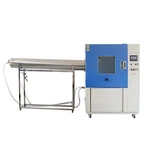
A battery pack that passed every bench test can still fail six months into service, once it has lived through hundreds of real-world hot-cold cycles that a slow chamber never reproduced. That gap between "passed in the lab" and "failed in the field" is exactly what a Rapid Thermal Cycling Chamber is built to close, and picking the wrong one - too slow, out of spec, or impossible to service - can cost a lab months of re-testing down the line.
This article walks through how LIB Industry's Rapid Thermal Cycling Chamber controls temperature, which standards it is built to satisfy, how it compares with a conventional thermal cycling chamber, and what a real customer experienced after putting one to work, so you can specify the right chamber the first time.
Reliable Temperature Control With LIB Rapid Thermal Cycling Chamber
How the LIB Rapid Thermal Cycling Chamber Works
Inside the chamber, a closed-loop PID controller reads PT100 Class A sensors accurate to ±0.001 °C and continuously adjusts a dual-stage compressor and Nichrome-alloy heating system to hold temperature within ±0.5 °C of setpoint. Standard units ramp at 5 °C/min or 15 °C/min, with a 20 °C/min configuration available on request, across a working range of roughly –40 °C to +170 °C (or down to –70 °C/–86 °C on low-temperature variants). Multi-directional centrifugal fans push conditioned air evenly through the workspace so that a small connector and a full battery module sitting side by side experience the same ramp at the same moment, keeping chamber-wide deviation under ±2.0 °C even during the fastest transitions.
Standards the Rapid Thermal Cycling Chamber Meets
Because rapid cycling is used to qualify everything from PCBs to EV battery packs, the chamber is designed against the standards those industries actually audit to:
| Standard | Applies To | Typical Rate / Requirement |
|---|---|---|
| IEC 60068-2-14 | General component thermal cycling | 1–15 °C/min, dwell 30 min–2 h per extreme |
| ISO 16750-4 | Automotive electrical/electronic components | Ramp to ±40 °C swing, multiple cycles |
| VW 80000 | Automotive electronics + vibration-thermal combined tests | Combined thermal/vibration cycling |
| UL 2580 | Battery pack safety | Thermal cycling before/after abuse tests |
| IEC 62133 / UN38.3 | Lithium battery transport & safety | Cycling between temperature extremes, ≥6 cycles |
| GB/T 2423.22 | Chinese national thermal cycling standard | Rate and dwell aligned with IEC 60068-2-14 |
IEC 60068 Test Method for Thermal Cycling
IEC 60068-2-14 (Test N: Change of Temperature) is the method most labs reference when specifying a Rapid Thermal Cycling Chamber, and it defines two distinct approaches. Test Na is the rapid-change method, typically executed with a transfer time of around 10 seconds or less between hot and cold zones, with samples usually held at each temperature extreme for about 30 minutes before the next transfer. Test Nb instead specifies a controlled rate of change - commonly 1 °C/min to 5 °C/min, though LIB's chambers extend this up to 15–20 °C/min for accelerated schedules - letting engineers dial in a gentler, single-chamber ramp when a sudden shock isn't representative of the real-world failure mode being studied. Choosing between Na-style rapid transfer and Nb-style controlled ramp usually comes down to whether the failure mechanism you're chasing is thermal shock or gradual fatigue
LIB Popular Temperature Chambers


Space-Saving Laboratory Design, Precise Temperature and Humidity Control

Easy Access for Large Test Specimens, High-Capacity Environmental Simulation

Combined Climatic and Vibration Testing, Reduced Testing Time and Improved Correlation


Up to 20°C/min Temperature Ramp Rates, Accelerated Product Reliability Validation.
A UK Customer's Experience With the Rapid Thermal Cycling Chamber
A UK-based manufacturer brought in an LIB Industry Rapid Thermal Cycling Chamber to run ongoing product performance testing on their electronic assemblies, needing a chamber that could keep pace with a demanding release schedule without compromising safety or repeatability. A few things stood out to them once the unit was running:
Certified safety on every unit - CE, IEC, and CSA compliance meant no extra internal sign-off was needed before the chamber went live on the floor.
High testing accuracy - ±0.5 °C stability gave their QA team confidence that a failed sample failed because of the product, not the chamber.
Strong cost-to-performance ratio - full-spec fast-ramp capability without the premium price tag of legacy brands.
Free customization - shelving, cable ports, and program limits were configured to their exact test protocol at no extra charge.
3-year warranty and lifetime technical support - long-term peace of mind instead of a ticking service clock.
On-site training - their operators were running complex multi-stage programs confidently within a day.
In their own words:
"Hello Karen, Our chamber and drying ovens are working excellently thank you, we are very happy with them. We would be happy to act as a reference for you should any of your potential customers want one."
| Model | TR5-100 | TR5-225 | TR5-500 | TR5-800 | TR5-1000 |
| Internal Dimension (mm) | 400*500*500 | 500*600*750 | 700*800*900 | 800*1000*1000 | 1000*1000*1000 |
| Overall Dimension (mm) | 900*1050*1620 | 1000*1140*1870 | 1200*1340*2020 | 1300*1540*2120 | 1500*1540*2140 |
| Interior Volume | 100L | 225L | 500L | 800L | 1000L |
| Heat load | 1000W | ||||
| A : -20℃ ~ +150 ℃ | |||||
| Temperature Range | B : -40℃ ~ +150 ℃ | ||||
| C: -70℃ ~ +150 ℃ | |||||
| Temperature Fluctuation | ± 0.5 ℃ | ||||
| Temperature Deviation | ± 2.0 ℃ | ||||
| Cooling Rate | 5 ℃/min | ||||
| Heating Rate | 5 ℃/min | ||||
| Controller | Programmable color LCD touch screen controller, Multi-language interface, Ethernet , USB | ||||
| Cooling System | Mechanical compression refrigeration system | ||||
| Exterior Material | Steel Plate with protective coating | ||||
| Interior Material | SUS304 stainless steel | ||||
Rapid Thermal Cycling Chamber vs Thermal Cycling Chamber: How to Choose
Not every application needs the fastest ramp rate available - but many labs pay for it anyway, or worse, under-spec and discover the gap mid-project. The table below breaks down where each type fits.
| Feature |
|
|
|---|---|---|
| Ramp rate | 5–20 °C/min | Typically 1–3 °C/min |
| Temperature range | –70 °C to +170 °C | –40 °C to +150 °C |
| Best for | Battery abuse testing, ADAS electronics, solder-joint fatigue | General material aging, long-dwell qualification |
| Standards typically referenced | IEC 60068-2-14 (Na/Nb), UL 2580, VW 80000 | IEC 60068-2-1/2, GB/T 2423.1/2 |
| Test cycle time | Minutes to reach setpoint | Tens of minutes to reach setpoint |
| Typical cost | Higher (compressor, insulation, controller upgrades) | Lower |


If your test plan involves battery thermal-runaway screening, automotive ECU qualification, or any protocol citing IEC 60068-2-14 Test Na, a Rapid Thermal Cycling Chamber is the right call. If you're running long-duration aging or damp-heat soak tests where the ramp itself isn't the variable being measured, a standard chamber will do the job at a lower cost.
FAQs on the Rapid Thermal Cycling Chamber
Q1: What's the fastest ramp rate LIB Industry can build, and can it be customized above 15 °C/min?
Standard units ship at 5 °C/min or 15 °C/min. A 20 °C/min configuration is available as a custom build, engineered around your specific chamber volume and load.
Q2: How long does installation take, and is on-site setup included?
Chambers arrive on leveling castors with power and water pre-integrated; most labs are running their first test within two hours of delivery, and on-site training is available.
Q3: What does the warranty and after-sales service cover?
LIB Industry provides a 3-year warranty plus lifetime technical support, with spare parts and remote troubleshooting available so downtime stays minimal.
Q4: How is the chamber shipped, and what lead time should I plan for?
Chambers are shipped by sea or air depending on size and urgency, with standard lead times quoted at order confirmation; expedited production is available for time-sensitive projects.
Q5: Can the chamber be customized for battery or explosion-proof testing?
Yes - explosion-proof inner chambers, smoke detection, automatic exhaust, and sprinkler systems can be added to meet UL 2580 and IEC 62133 battery abuse testing requirements.
Contact Us for Your Test Chamber Needs
If you're in the market for a thermal cycling or battery test chamber, whether it's a Rapid Thermal Cycling Chamber, a Standard Thermal Cycling Chamber, a Temperature Humidity Vibration Chamber, or a Drive-In Controlled Climatic Environmental Chamber, don't hesitate to reach out.
Reference
LIB Industry Technical Team - Technical information, testing methods, product specifications, and application guidance for thermal cycling and environmental test equipment.