Extreme temperature changes can destroy electronic circuits, crack materials,  and weaken seals within seconds. In real-world environments, components may move from −40 °C outdoor conditions to +120 °C operating temperatures in a very short time. Without proper testing, these rapid changes can lead to product failure, safety risks, and costly recalls. That is why laboratories in the automotive, aerospace, electronics, and semiconductor industries rely on thermal shock testing to verify reliability before products reach the market.
LIB Thermal Shock Chambers are designed to reproduce these sudden temperature transitions with precision and repeatability. With air-to-air shock transitions in ≤3 seconds, temperature ranges from −75 °C to +220 °C, and compliance with international standards such as IEC 60068-2-14, MIL-STD-810, JESD22-A104, and LV124, LIB chambers allow engineers to simulate the harshest environmental conditions directly inside the laboratory.
In practical applications, laboratories around the world rely on LIB chambers for reliable performance. A laboratory in Russia using the LIB T-100B Thermal Shock Chamber recently confirmed that after filling the refrigerant, the system operated perfectly and delivered stable testing results. Feedback from the technical team indicated that the chamber has been running reliably during operation, demonstrating the durability and dependable performance of LIB environmental testing equipment.
What is a Thermal Shock Chamber?
A thermal shock chamber is a testing system designed to expose products to extremely rapid temperature changes. The purpose is to evaluate whether materials, electronic components, or assemblies can withstand sudden thermal stress without cracking, deformation, or performance failure.
Thermal shock testing exists because real-world temperature changes can happen instantly. For example, an automotive ECU heated to +150 °C near the engine may suddenly be splashed by 0–4 °C water, or an aerospace component may transition rapidly between cold high-altitude conditions and warm ground environments. Thermal shock chambers recreate these events in a controlled laboratory environment.
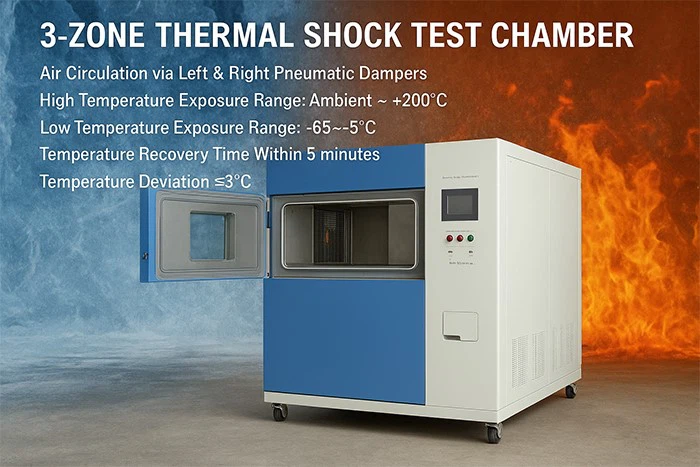
The working principle is based on rapid temperature transfer between hot and cold zones. In a typical air-to-air thermal shock chamber, the test basket automatically moves the samples between chambers at different temperatures. The transfer time is typically ≤3 seconds, and the system recovers to the programmed temperature in ≤5 minutes, ensuring each test cycle remains accurate and repeatable.
The benefit of thermal shock testing is reliable durability verification. By repeating temperature cycles dozens or hundreds of times, engineers can identify weaknesses in solder joints, connectors, coatings, seals, or structural materials before products are released.
What Are the Differences Between LIB Air-to-Air, Air-to-Liquid, and Liquid-to-Liquid Thermal Shock Chambers?
Different industries require different types of thermal shock equipment. International standards such as IEC 60068-2-14, MIL-STD-810 Method 503, and JESD22-A106 specify temperature shock testing methods, but the equipment structure may vary.
The three most common designs are air-to-air, air-to-liquid, and liquid-to-liquid thermal shock chambers.
| Type | Temperature Range | Transfer Time | Advantages | Typical Applications |
|---|---|---|---|---|
|
Air-to-Air Thermal Shock Chamber |
−70 °C to +200 °C | ≤3 s | Most common, easy operation, precise control | Electronics, automotive, aerospace |
| Air-to-Liquid Thermal Shock Chamber | −65 °C to +200 °C | ≤2 s | Faster heat transfer than air | Specialized material testing |
| Liquid-to-Liquid Thermal Shock Chamber | −80 °C to +200 °C | ≤1 s | Strongest thermal stress | Military and semiconductor testing |
Air-to-Air Thermal Shock Chambers are the most widely used type. They use two temperature zones (hot and cold) with independent heating and cooling systems. Samples move between the zones, creating rapid temperature transitions while maintaining accurate environmental control.
Air-to-Liquid systems increase heat transfer efficiency. The sample moves from air into a liquid bath, which accelerates cooling or heating. These systems are used when stronger thermal stress is required.
Liquid-to-Liquid chambers produce the fastest temperature changes. Because liquids transfer heat much faster than air, they can create extremely severe thermal shocks. These systems are typically used in military, semiconductor, and high-reliability aerospace testing.
|
|
 |
 |
| Air-to-Air Thermal Shock Chamber | Air-to-Liquid Thermal Shock Chamber | Liquid-to-Liquid Thermal Shock Chamber |

What Maintenance Is Required for a LIB Thermal Shock Chamber?
|
|
|
|||||||||
|
Model |
TSI-038 |
|||||||||
|
Basket Useful Dimensions (mm) |
2400*1200*1300 D*W*H |
|||||||||
|
Salt Water Tank Dimensions (mm) |
3000*2000*1600 D*W*H |
|||||||||
|
Overall Dimension (mm) |
3600*2800*3800 D*W*H |
|||||||||
|
Loading Capacity |
200 kg |
|||||||||
|
Parameters |
Pre-heat Room |
Upper limit Temperature |
+220℃ |
|||||||
|
Heating Time |
Ambient ~ + 180℃, within 30 minutes |
|||||||||
|
Splash Water |
Splash Water Temperature |
0 to +4 ℃ (Adjustable) |
||||||||
|
Cycle Duration |
30 minutes |
|||||||||
|
Splash Nozzle |
Water Flow Rate |
3 to 4 liters per splash nozzle |
||||||||
| Number |
4 pieces |
|||||||||
|
Distance between nozzle and DUT |
300 to 350 mm |
|||||||||
|
Splashing Time |
3 seconds |
|||||||||
|
Number of cycles |
100 |
|||||||||
| Controller | Programmable color LCD touch screen controller | |||||||||
| Cooling system | Mechanical compression refrigeration system | |||||||||
| Exterior material | A3 Steel Plate with protective coating | |||||||||
| Viewing window | Interior lighting , double-layer thermo stability silicone rubber sealing | |||||||||


|
|
|
|
Test Basket Test area can slide between the cold and hot Chambers to complete the test of samples in extremely cold and extremely hot environments |
The Controller Programmable color controller, more convenient operation,Now with Mobile App,USB and RS-232,RS-485 |
|
|
|
|
Cable Hole The test hole is located above the basket, allowing the cable to pass through and energize the sample |
Castor 4 casters with brake, easy to move, adjustable height, good fixity |


1. Regular maintenance ensures stable and reliable thermal shock testing. Environmental chambers operate under extreme conditions, so routine inspection prevents performance loss and equipment failure.
2. Heating system inspection ensures consistent temperature performance. Every six months, technicians should check the heating strips, circulation fan motors, and temperature sensors. Damaged heating elements or loose wiring can cause inaccurate temperature control.
3. Cooling system maintenance keeps refrigeration stable. The condenser and compressor should be cleaned regularly using pressurized air to remove dust. The refrigerant pressure should normally remain between 15–25 bar during operation. If pressure falls below 5 bar, additional refrigerant may be required.
4. Electrical system checks prevent control failures. Controllers, relays, and circuit boards should be inspected periodically. Cleaning dust and tightening connections ensures stable signal transmission and prevents unexpected shutdowns.
5. Mechanical components also require periodic inspection. Door locks, sealing strips, and test-hole rubber plugs should be checked for aging or air leakage. Replacing seals approximately every two years helps maintain chamber insulation and temperature stability.
With proper maintenance, a thermal shock chamber can operate reliably for many years while maintaining precise testing conditions.
FAQs on Thermal Shock Chambers
Q1: How is a thermal shock chamber calibrated?
Calibration is performed using 9 temperature sensors distributed evenly across the chamber. The system measures the average temperature and compares it with the programmed value. If deviations occur, hardware adjustments are made to ensure accurate readings and uniform temperature distribution.
Q2: What is the transfer time of a thermal shock chamber?
In most LIB two-zone systems, the transfer time between hot and cold chambers is less than 5 seconds, with many models achieving ≤3 seconds.
Q3: What is the temperature recovery time?
After each transfer cycle, the chamber typically returns to the programmed temperature within less than 5 minutes, ensuring continuous testing without long interruptions.
Q4: Do test samples need to be fixed during testing?
In most two-zone thermal shock chambers, samples are placed inside a basket transfer system. The movement is smooth and controlled, so additional fixation is usually unnecessary.
Q5: What standards require thermal shock testing?
Common international standards include:
IEC 60068-2-14 Environmental Testing
MIL-STD-810 Thermal Shock Method
JESD22 Semiconductor Reliability Testing
LV124 Automotive Electronic Component Testing
Any customization can be made. LIB offers a 3-year warranty and lifetime service. Any issues that cannot be resolved during the warranty period will be replaced free of charge. 24/7 English-speaking after-sales team. Fast shipping within 7-15 days.
If you are planning to purchase a reliable thermal shock chamber or need a customized testing solution for your laboratory, contact LIB Industry today to learn more about our advanced environmental simulation systems.