Modern vehicles rely heavily on electronic components that operate close to engines, power electronics, and high-temperature zones. These components can heat up to over 120 °C during normal driving, then suddenly encounter cold water when a vehicle passes through puddles, rain, or snowmelt. This rapid temperature change creates severe thermal stress that cannot be detected by conventional temperature cycling tests.
The LIB LV124 K-12 Temperature Shock and Splash Water Test Chamber is specifically developed to recreate this exact real-world failure scenario in a controlled laboratory environment. By combining high-temperature exposure up to +150 °C with instant cold splash water at 0–4 °C, the chamber allows engineers to detect sealing weaknesses, material fatigue, and functional instability before products enter mass production.
Overview of the LV124 K-12 Temperature Shock and Splash Water Test
What real environment does the test simulate?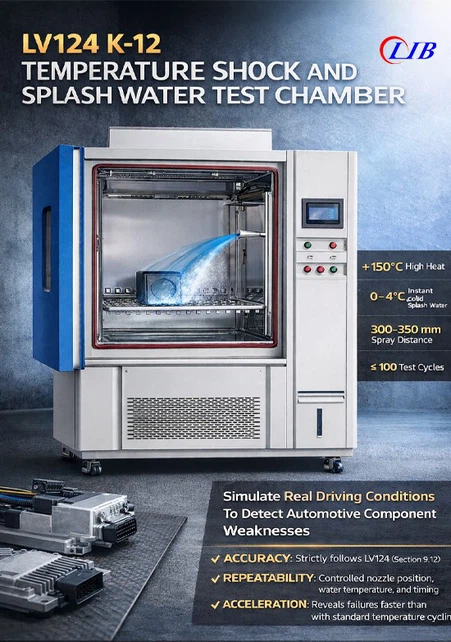
The LV124 K-12 test is defined in LV124, Section 9.12, a core automotive electrical and electronic validation standard widely adopted by European OEMs and Tier-1 suppliers. This test simulates a hot component suddenly cooled by cold water, such as:
1. Driving through deep puddles after highway operation
2. Rainwater splashing onto hot under-hood electronics
3. Snowmelt contacting heated power modules or housings
In real vehicles, this condition produces instant surface temperature drops of tens of degrees within seconds, causing expansion-contraction stress, micro-cracks, seal failure, and moisture ingress.
Typical application scenarios
The LV124 K-12 Temperature Shock and Splash Water Test is commonly applied to:
1. Engine Control Units (ECUs)
2. Power electronics and inverters
3. Sensors and actuators
4. Connectors and wiring housings
5. Battery management modules
These components must survive repeated exposure without loss of function, leakage, or electrical failure.
Benefits for researchers and engineers
For test engineers, the LV124 K-12 method delivers three critical advantages:
1. Accuracy: All parameters strictly follow LV124 Section 9.12
2. Repeatability: Controlled nozzle distance, water temperature, and timing
3. Acceleration: Failure mechanisms appear faster than with standard temperature cycling
This makes the test ideal for early-stage design validation and final qualification.

Temperature and water test chambers
LV124 K-12 Temperature Shock and Splash Water Test Procedure and Evaluation Points
The LV124 K-12 temperature shock and splash water test is intended to verify the functional reliability and sealing integrity of automotive electronic components under sudden and extreme thermal stress. The procedure simulates real driving conditions in which hot components are exposed to cold water, such as during rain, puddle splash, or snowmelt contact.

----from LV124 standard
Test Procedure
Step 1: Heating Phase
The device under test (DUT) is placed inside the test chamber and heated from ambient temperature to the specified high temperature, which may reach up to +150 °C. The DUT is held at this temperature until thermal stabilization is achieved to ensure uniform heating of the housing and internal components.
Step 2: Cold Splash Water Application
Once the target temperature is stabilized, cold water with a controlled temperature of 0–4 °C is sprayed directly onto the DUT. The splash duration is 3 seconds per cycle, with a water volume of 3–4 liters, creating an immediate and severe thermal shock on the component surface.
Step 3: Controlled Impact Conditions
During the splash process, the distance between the spray nozzle and the DUT is maintained at 300–350 mm to ensure consistent water impact and repeatability. The spray direction and flow rate are controlled to match LV124 test conditions and avoid uncontrolled cooling effects.
Step 4: Cycle Completion and Repetition
Each complete test cycle has a duration of approximately 30 minutes, including heating, stabilization, and splash exposure. The test is repeated for up to 100 cycles, depending on the validation requirements. Throughout the test, the DUT is typically operated in intermittent functional mode, as defined by LV124, to monitor performance during and after thermal shock events.
Evaluation and Result Assessment
After all test cycles are completed, the DUT undergoes a detailed evaluation. Visual inspection is performed to identify any signs of housing deformation, cracking, or water traces that may indicate moisture ingress. Electrical performance is then compared with pre-test reference values to detect functional degradation, instability, or abnormal behavior.
| Step | Parameter | Time / Value | Description |
|---|---|---|---|
| 1 | t₁ | 30 min | Heating + stabilization at high temperature (up to +150 °C), splash OFF |
| 2 | t₂ | 14:57 min (897 s) | DUT operated in intermittent mode, temperature stabilized |
| 3 | t₃ | 3 s | Cold splash water applied (0–4 °C, 3–4 L) |
| 4 | Nozzle distance | 300–350 mm | Controlled spray impact during splash |
| 5 | Cycles | ≤ 100 | Repeat full cycle per LV124 requirement |
Functional operation under rated conditions is verified to ensure that the DUT continues to perform as specified. In addition, insulation resistance and electrical continuity measurements are carried out to detect internal damage caused by rapid temperature changes or moisture exposure. Any deviation from the original performance criteria is considered a potential design weakness and must be addressed before the component can be approved for vehicle integration or mass production.
》》》For more technical information and details about our LV124 K-12 Temperature Shock and Splash Water Test Chamber, please feel free to email us at info@libtestchamber.com.
Advantages of the LIB LV124 K-12 Temperature Shock and Splash Water Test Chamber
|
|
|
|
Name |
LV124 K-12 Temperature Shock and Splash Water Test Chamber |
|
Model |
T-1000A |
|
Internal Dimension (mm) |
1000 [D] × 1000 [W] × 1000 [H] |
|
Exterior Dimension (mm) |
2000 [D] × 1200 [W] × 2200 [H] |
|
Interior Volume (L) |
1000 |
|
Temperature Range |
Ambient ~ +150 °C |
|
Splash Water Temperature |
0 ~ 4 °C |
|
Splash Water Time |
3 seconds, adjustable |
|
Water Flow Rate |
3–4 L per splash/nozzle |
|
Distance from Nozzle to DUT |
300–350 mm |
|
Number of Cycles |
100 |
|
Number of DUTs |
6 |
|
DUT Operating Mode |
Intermitting (per Figure 30) |
|
Test Cycle Duration |
30 minutes |
|
Heating Element |
Nichrome heater |
|
Temperature Sensor |
PT-100 Class A |
|
Cooling System |
Mechanical compression refrigeration, French TECUMSEH compressor |
|
Air Circulation |
Centrifugal wind fan |
|
Controller |
Programmable color LCD touch screen, Ethernet, USB |
|
Safety Devices |
Over-temperature; Over-current; Refrigerant high-pressure; Earth leakage protection |
|
Exterior Material |
Steel plate with protective coating |
|
Interior Material |
SUS304 stainless steel |
|
Thermal Insulation |
Polyurethane foam and insulation cotton |
|
Observation Window |
Interior lighting, double-layer thermo stability silicone rubber sealing |
|
Standard Configuration |
1 cable hole (Φ100 mm) with plug |

|
|
|
|
|
|
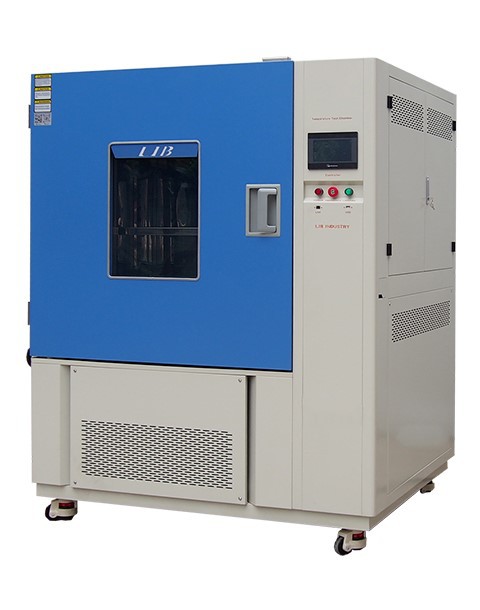
| Robust Workroom | Cable Hole | Temperature Sensor | PID controller, USB,and PC link |


1. Full Compliance With LV124 Section 9.12
The LIB LV124 K-12 Temperature Shock and Splash Water Test Chamber is engineered in strict accordance with LV124 Section 9.12. Splash water temperature is precisely controlled at 0–4 °C, with an accurate 3-second splash duration, a regulated water volume of 3–4 L per cycle, and a fixed nozzle distance of 300–350 mm. This high level of control eliminates test variability and ensures full acceptance by OEM and Tier-1 validation teams.
2. Realistic Thermal Shock Capability
With a maximum heating temperature of +150 °C, the chamber reproduces real operating stress conditions. When low-temperature splash water directly contacts a heated DUT, it creates an instantaneous and severe thermal shock, offering a far more realistic and demanding test than gradual cooling methods.
3. Integrated Cold Splash Water System
The chamber features a fully integrated cold splash water system, eliminating dependence on external water supplies. A built-in water tank, mechanical refrigeration system with a French TECUMSEH compressor, and closed-loop circulation with filtration ensure stable and consistent water temperature throughout long-duration test programs.
4. Stable Air Circulation And Temperature Uniformity
A high-efficiency centrifugal air circulation fan ensures uniform temperature distribution within the 1000-liter test space. This stable airflow improves test consistency and reliability, especially when multiple samples are tested simultaneously.
5. Robust Construction For Wet Testing
Designed for demanding wet test environments, the chamber interior is made of corrosion-resistant SUS304 stainless steel, while the exterior uses durable coated steel plate. Water and electrical systems are physically separated to enhance operational safety and long-term reliability.
6. Intelligent Control And Data Management
The system is equipped with a 7-inch programmable color touch screen for intuitive operation. It supports multi-step programmable test profiles, Ethernet and USB connectivity, and long-term data storage of up to 365 days, with test results easily exportable in CSV format.
》》》To receive comprehensive and customized solutions and pricing for the LV124 K-12 Test Chambers, please contact us at info@libtestchamber.com.
Customization and After-Sales Service for LV124 K-12 Test Chambers
1. Flexible Customization
LIB provides flexible customization options to meet diverse testing requirements, including nozzle configuration, cable access ports (Φ100 mm standard), DUT mounting fixtures, and customized test logic and cycle programming. All modifications are carefully designed to ensure full compliance with LV124 K-12 requirements.
2. Factory Inspection And Quality Assurance
Before 7-15 days fast shipment, every LIB T-1000A LV124 K-12 test chamber undergoes a rigorous inspection and quality assurance process in compliance with CE, RoHS, and ISO standards. The procedure includes a 72-hour Factory Acceptance Test (FAT), verification of temperature accuracy and stability, electrical safety and functional checks, and full traceability of key components. A complete inspection report with detailed photos is provided to ensure conformity, safety, and reliable performance upon delivery.

3. Warranty And Long-Term Support
LIB offers a 3-year warranty starting from the date of dispatch, along with lifetime technical support. During the warranty period, free spare parts and international shipping are provided. On-site service is available when required, and if the chamber cannot be restored to proper operation, LIB guarantees replacement with a new unit at no additional cost.
Contact LIB Industry to learn how the LV124 K-12 Temperature Shock and Splash Water Test Chamber can improve your automotive component validation process and ensure compliance with LV124, ISO 16750, and OEM qualification requirements.