MIL-STD-810H is a standardized test method that is employed by the military and other organizations to evaluate the ruggedness and durability of equipment under harsh environmental conditions. This test method consists of a series of laboratory and field tests that simulate a wide range of climatic, mechanical, and electrical stresses and strains that equipment may encounter during its lifetime.
The main applications of MIL-STD-810H testing include military and defense equipment, aerospace equipment, automotive components, and consumer electronics, among others. This test method is particularly useful in assessing the resilience of electronic equipment, such as smartphones and computers, to extreme temperatures, humidity, vibration, shock, and other environmental factors.
LIB MIL-STD-810H Test Chambers deliver laboratory-precision simulations of these extreme conditions. By replicating standardized MIL-STD-810H test methods, including Methods 506.7 (Rain) and 510.7/510.8 (Blowing Dust and Sand), these chambers provide repeatable, controlled testing to evaluate durability, sealing integrity, and operational performance. With programmable airflow, particle concentration, and test cycles, these systems offer engineers and QA teams the ability to confidently certify equipment for real-world deployment.
By subjecting equipment to rigorous testing, manufacturers can ensure that their products meet the required standards of quality and reliability. Moreover, MIL-STD-810H testing enables manufacturers to identify potential weaknesses or design flaws in their products and address them before they reach the market.
1. Specific testing requirements and procedures
The specific testing requirements and procedures of MIL-STD-810H vary depending on the equipment being tested, but there are basic procedures that are common to all equipment. The following are some key requirements and procedures:
1. Environmental testing: This involves exposing the equipment to various environmental conditions such as heat, cold, humidity, altitude, salt fog, and rain. The equipment is usually placed in a test chamber, and the conditions are gradually increased until the equipment reaches its limit.
2. Vibration testing: This involves subjecting the equipment to continuous and random vibrations at different frequencies and amplitudes. The vibrations are applied to the equipment while it is mounted on a shaker table.
3. Shock testing: This involves sudden and forceful impacts to the equipment, simulating real-life situations such as drops, collisions, and explosions. The equipment is typically placed on a shock table, and different levels of shock are applied.
4. Electrical testing: This involves testing the equipment's electrical and electromagnetic compatibility to ensure that it can operate in various environments without interference.
5. Chemical testing: This involves exposing the equipment to various chemicals and solvents to ensure that it can withstand them without corroding or degrading.
2. Interpretation of Rain Test Requirements in MIL-STD-810H
Rain testing evaluates how equipment withstands exposure to water in storage, transport, or operational environments. It simulates rainfall, wind-driven rain, and water drip conditions.
There are three main rain procedures:
Procedure I – Rain and Blowing Rain: Simulates outdoor exposure to wind-driven rain, with wind speeds from near 0 to over 18 m/s and water droplet diameters of 500–4500 μm. This is suitable for equipment that cannot shield itself from rainfall.
Procedure II – Exaggerated: For large equipment (shelter-size) that cannot fit in standard rain setups. It applies high-coverage sprays to verify water resistance under extreme conditions.
Procedure III – Drip: Tests potential water damage from condensation or leakage from above. It is designed for equipment that generally avoids direct rainfall but may experience dripping water.
Rain Test Key Data Table
| Procedure | Water Droplet Size (μm) | Wind Speed (m/s) | Coverage | Notes |
|---|---|---|---|---|
| I – Rain & Blowing Rain | 500–4500 | 0–18 | Full coverage | Outdoor deployment, simulate rain with wind |
| II – Exaggerated | 500–4500 | / | Maximum coverage | Large-scale equipment, high reliability verification |
| III – Drip | / | / | Focused dripping | Simulate condensation and localized leaks |
3. Advantages of LIB MIL-STD-810H Rain Test Chamber
|
|
|
|
Model |
RIM-1000 |
|
Internal Dimension |
1000*1000*1000 mm D*W*H |
|
Overall Dimension |
2600*5400*4100 D*W*H |
|
Interior Volume |
1000L |
|
The load Turntable |
50 kg |
|
The diameter of Turntable |
800 mm |
|
Rain and Blowing Rain |
|
|
Final rain droplet velocity |
9 m/s on test item |
|
Rainfall rate |
≥ 1.7 mm/min |
|
Droplet size |
0.5 mm ~ 4.5 mm |
|
Test specimen heating range |
Water temperature +10 °C (max +55 °C) |
|
Test time |
0 ~ 999 min. adjustable |
|
Exaggerated |
|
|
Nozzle pressure |
276kpa |
|
Rainfall rate |
20.8L/min |
|
Nozzle amount |
One nozzle for each 0.56m2 of surface area and position each about 48 cm from in the test surface |
|
Droplet size |
0.5 mm ~ 4.5 mm |
|
Test time |
0 ~ 999 min. adjustable |
|
Drip |
|
|
Drip area dimensions |
1600*1000 mm , height can be adjustable |
|
Drip holes |
20 to 25.4 mm |
|
Distance between hole |
25 mm |
|
Volume of water |
≥280L/m2/h |
|
Test specimen heating range |
Water temperature +10 °C (max +55 °C) |
|
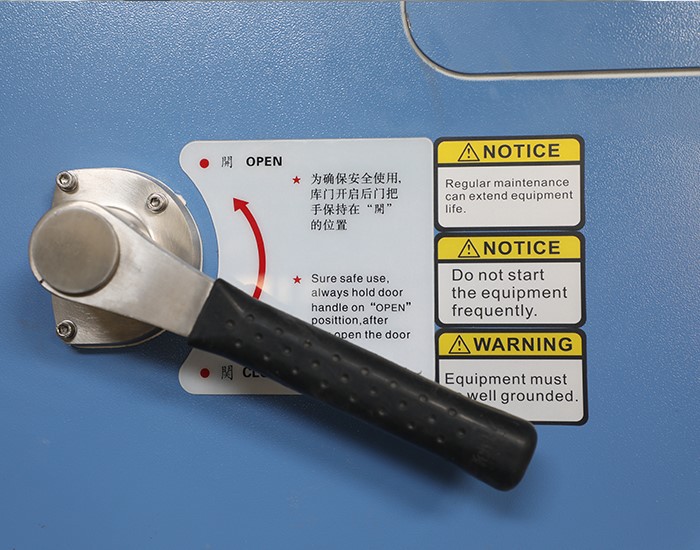
Door Lock |
Electromagnetic lock |
|
Exterior Material |
A3 Steel Plate with protective coating |
|
Interior Material |
SUS304 stainless steel |


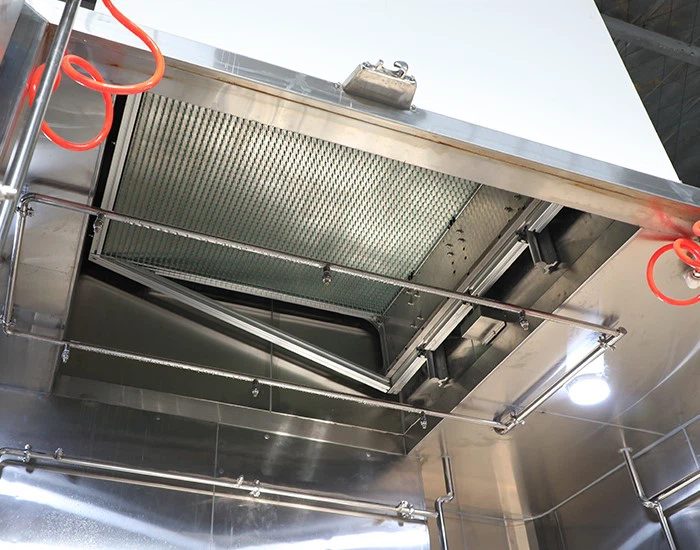
Accurate Rain Simulation: Adjustable droplet sizes, wind speed, and coverage.
Flexible Test Procedures: Supports all three MIL-STD-810H rain procedures.
Durable Construction: SUS304 stainless steel interior resists corrosion; A3 steel exterior provides structural protection.
Programmable Testing: Color LCD controller allows multi-stage tests with real-time monitoring and data logging.
Visual Leakage Detection: Optional fluorescent dye to track water ingress.
|
|
|
| Built-in light | Turntable |
|
|
|
| Built-in power supply | Centrifugal fan |
|
|
|
| Drip tray | Door lock |


4. Interpretation of Dust and Sand Test Requirements in MIL-STD-810H
Dust and sand testing ensures equipment maintains performance in arid, windy, or dusty environments. The three procedures include:
Procedure I – Blowing Dust: Simulates fine dust (<150 μm) with airflow 1.5–8.9 m/s and concentrations of 10.7 ± 7 g/m³. Common in deserts with powdery dust.
Procedure II – Blowing Sand: Evaluates impact of larger particles (150–850 μm) at air speeds 18–29 m/s with concentrations up to 2.2 ± 0.5 g/m³. Abrasive sand challenges seals, connectors, and optical surfaces.
Procedure III – Dust Settling: Tests low-airflow accumulation of fine dust (<105 μm), typical for indoor storage or office equipment. It also evaluates filter performance and heat dissipation.
Dust and Sand Test Key Data Table
| Procedure | Particle Size (μm) | Air Velocity (m/s) | Concentration (g/m³) | Notes |
|---|---|---|---|---|
| I – Blowing Dust | <150 | 1.5–8.9 | 10.7 ± 7 | Fine desert dust exposure |
| II – Blowing Sand | 150–850 | 18–29 | 0.18–2.2 | Abrasive sand impact, seal testing |
| III – Dust Settling | <105 | Minimal airflow | 6 g/m²/day | Long-term indoor accumulation |
5. Advantages of LIB MIL-STD-810H Dust and Sand Test Chamber
Precision Airflow Control: Six centrifugal fans and adjustable rings ensure uniform particle distribution.
Dual-Mode Simulation: Rapid switching between dust (Method 510.7) and sand (Method 510.8).
Environmental Monitoring: Built-in sensors track dust concentration, temperature, and humidity in real time.
Rugged Build: Stainless steel interior resists abrasion; anti-static exterior coating reduces particle adhesion.
Automated Profiles: Programmable exposure time, fan speeds, and rest intervals with data logging for full compliance documentation.
6. Common Questions About the MIL-STD-810H Sand and Dust Test Chamber
Q1: How does the chamber achieve 29 m/s wind speed?
An extended air duct with flow-straightening plates, high-power centrifugal fans, and reinforced cooling ensures uniform laminar airflow at required velocities. Noise and vibration dampers maintain stable operation.
Q2: What are the mesh sizes for dust and sand?
Two sieves: 75 μm for talcum dust, 150 μm for quartz sand, ensuring particles meet standard grain size requirements.
Q3: Is there insulation in the chamber?
The chamber lacks independent insulation but uses 1 cm-thick steel walls for natural thermal buffering. Temperature control maintains stability up to 45 °C.
Q4: What is the testing platform speed?
Adjustable 1–7 r.p.m, allowing uniform exposure to dust and sand for all sides of the specimen.
Q5: How is real-time data monitored?
Integrated PID controller with color LCD touchscreen records particle concentration, temperature, humidity, and fan speeds, enabling full traceability and report generation.
MIL-STD-810H Blowing Sand and Dust Test Chambers offer military-grade precision, durability, and repeatability. With 3-year warranty, 24/7 English technical support, and global spare parts service, these chambers provide long-term confidence in environmental simulation.
Contact LIB Industry today for a tailored solution to your military-standard testing needs.