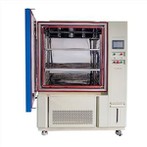
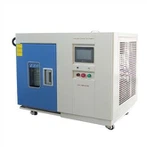
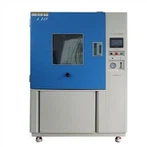
Imagine sending your PV modules on a simulated tropical expedition. As PV modules face decades of outdoor exposure, accelerated climatic testing is essential to reveal moisture, thermal-mismatch, and freezing-related failure modes before field deployment.
LIB's PV Damp Heating Test Chamber is engineered to run the full IEC 61215 design-qualification sequences (Thermal Cycling, Humidity-Freeze, Damp-Heat) with the exact setpoints, tolerances, instrumentation, and post-test checks specified in your source material. Each capability below highlights how LIB's chamber not only follows the procedures but provides precision, efficiency, and durability advantages.
 |
 |
||
|
Internal Dimension (mm) |
1300*700*1350 |
||
|
Overall Dimension (mm) |
1900*1100*1750 |
||
|
Parameter |
Temperature Range |
-60℃ ~ +100 ℃ |
|
|
Temperature Fluctuation |
± 0.5 ℃ |
||
|
Temperature Deviation |
± 2.0 ℃ |
||
|
Humidity Range |
20% ~ 98% RH |
||
|
Humidity Deviation |
± 2.5% RH |
||
|
Temperature Change Rate |
1 ~ 3.4℃ / Min |
||
|
Panel Size |
1M*2M |
||
|
Panel Capacity |
4 / 6 / 8 / 10 / 12 Pieces |
||
|
Structure |
Cooling |
Cooling system |
Mechanical compression refrigeration system |
|
Refrigerating unit |
French TECUMSEH compressor |
||
|
Heating Element |
Nichrome heater |
||
|
Controller |
Programmable color LCD touch screen controller |
||
|
Ethernet connection, PC Link, USB |
|||
|
Humidity |
Water supply system |
Automatic water supply |
|
|
Water supply system |
Water purification system |
||
|
Humidifier |
External isolation, stainless steel surface evaporation humidifier |
||
|
Dehumidification |
Evaporator |
||
|
Sensor |
Temperature Sensor |
PTR Platinum Resistance PT100Ω/MV A-class, accuracy 0.001℃ |
|
|
Humidity Sensor |
Dry and wet bulb sensor |
||
|
Build-in Water Tank (mm) |
270*300*450 |
||
|
View Window Size (mm) |
330*370 |
||
|
Material |
Exterior Material |
Steel Plate with protective coating |
|
|
Interior Material |
SUS304 stainless steel |
||
|
Thermal Insulation |
Polyurethane foam and insulation cotton |
||
|
Observation Window |
Interior lighting, double-layer therm stability silicone rubber sealing |
||
【How Can LIB's PV Damp Heating Test Chamber Simulate Long-Term Damp Heat Exposure at 85°C and 85% RH?】
LIB's Damp-Heat (DH) mode implements the IEC 61215 damp-heat procedure: modules are maintained at 85°C ±2°C and 85% relative humidity ±5% for 1,000 hours on low-conductance supports, inside a climate chamber with fans to minimize gradients. Temperature is measured at module centers (front or back) with ±1°C accuracy. Both temperature and current are logged continuously.
Key operational steps:
1. Place modules at room temperature into the chamber on non-conductive supports like support shelves.
2. Maintain 85°C ±2°C and 85% RH ±5% for 1,000 hours.
3. Chamber interior and condensate handling resist corrosion, preventing false failures in the aggressive DH environment.
4. After testing, allow 2–4 hours recovery before repeating baseline checks: visual inspection, maximum power, and insulation resistance.
Advantages of LIB's PV Damp Heating Test Chamber:
1. Precision & Repeatability: PT100 Class A sensors with ±0.001°C accuracy and chilled-mirror RH readings ensure temperature and humidity stay within IEC 61215 tolerances.
2. Stable and Uniform Environment: Dual centrifugal fans and laminar airflow baffles eliminate hot or humid spots, allowing multiple modules to be tested simultaneously.
3. Operational Efficiency: 120 programmable PID controller, automated ramp-soak sequences, and remote monitoring reduce manual oversight and support high-throughput labs.
4. Durability: SUS304 stainless interior and corrosion-resistant condensate handling guarantee long-term reliability for multi-week DH campaigns.
|
|
|
|
| High-Quality Workroom | Precise Sensors | Smart PID controller |


【How Does LIB's PV Damp Heating Test Chamber Conduct Humidity-Freeze Cycles Between High Humidity and Low Temperatures?】
LIB programs the Humidity-Freeze (HF) sequence for 10 cycles as per IEC 61215: alternating high-temperature/high-humidity holds with low-temperature holds, maintaining tolerances throughout.
Procedural implementation and advantages:
1. Temperature sensors placed at module center (±1°C), modules loaded at room temperature.
2. Execute 10 HF cycles: high and low temperatures within ±2°C, relative humidity above ambient within ±5% RH.
3. Continuously monitor module internal circuit continuity; record temperatures and currents. (Parallel open branches may create voltage discontinuities without reducing voltage to zero.)
4. After HF, allow 2–4 hours recovery, then repeat IEC-style post-sequence checks: visual inspection, maximum power, insulation tests.
LIB PV Damp Heating Test Chamber Chamber Advantages:
1. Fast Ramp Rates & Accurate Control: Heating up to 3°C/min, cooling at 1°C/min, reliably reproducing timed HF sequences without exceeding IEC tolerances. The French Taikang system combines compressor-based cooling with heating-wire technology for efficient cooling and rapid heating.
2. Data Integrity: Continuous logging of temperature, humidity, and electrical parameters for ISO/IEC-compliant reporting.
3. Operational Efficiency: Touchscreen interface with up to 120 programs allows chaining complex HF sequences without reprogramming.
4. Durability & Ease of Use: Corrosion-resistant stainless interior and full-height tempered viewing window allow safe observation during extreme conditions.
 |
|

【How Does LIB's PV Damp Heating Test Chamber Perform Fast Thermal Cycling Between −40°C and 85°C?】
Thermal Cycling (TC) mode follows IEC 61215 parameters: cycles between −40°C ±2°C and 85°C ±2°C, with ≤100°C/h ramp rate and ≥10 min dwell at each extreme; single cycle ≤6 hours unless module heat capacity requires longer.
Implementation and advantages:
1. Modules installed on low-conductance supports or metal frame; temperature sensor at center ±1°C.
2. For 200-cycle qualification, apply current equal to maximum-power current (±2%) when module temperature >25°C; record temperature and current throughout. The 50-cycle variant does not require current.
3. After TC, allow ≥1 hour recovery, then repeat baseline electrical and visual tests.
LIB PV Damp Heating Test Chamber Advantages:
Wide Temperature Span: –70°C to +150°C, programmable in 0.1°C increments.
Stable and Uniform Cycling: Laminar airflow and high-performance insulation prevent thermal gradients.
Smart Test Management: Chain complex sequences such as TC → DH → HF with programmable profiles, reducing setup time.
Maintenance-Friendly: Lockable castors, leveling feet, and easy-access observation window minimize downtime.
|
|
|


【LIB's After-Sales Service for PV Damp Heat Chamber】
LIB's after-sales services support long IEC 61215 DH/HF/TC test campaigns: we provide factory calibration and on-site verification of sensors (±1°C accuracy), keep critical spare parts (like heaters) in stock, and supply detailed protocol templates covering sensor placement, recovery times, current application rules, and other checks.
Service Advantages:
Global Support: 3-year warranty and lifetime technical assistance, with multilingual 24/7 service and 7–15 day replacement shipping worldwide.
Training & Documentation: Laboratory staff receive instruction on instrumentation, electrical routing, and IEC-compliant pass/fail reporting.
Comprehensive Traceability: Continuous logging ensures full audit trails for QA teams, supporting repeatable and reliable testing results.
LIB's PV Damp Heating Test Chamber combines precision, reliability, and operational efficiency to meet the most demanding IEC 61215 DH, HF, and TC test campaigns. With stable temperature and humidity control, rapid ramp rates, and continuous data logging, laboratories can confidently evaluate long-term PV module durability under extreme environmental conditions.
Conatact LIB to help your PV modules withstand decades of outdoor exposure, and bring unparalleled confidence to your design qualification and reliability assessments.