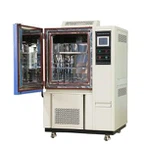
When your testing requires more than standard features such as optical holes for imaging, cable shafts for complex wiring, or explosion-proof safety for batteries, you need a chamber that meets your exact needs without sacrificing accuracy or stability.
LIB's Temperature and Humidity Test Chamber combines high-accuracy environmental control with flexible customization, enabling you to conduct repeatable, compliant, and safe testing across industries from electronics and automotive to aerospace and pharmaceuticals. With options for tailored airflow, door configurations, cable holes, and controller placement, it's not just a piece of equipment-it's a purpose-built solution that works seamlessly with your samples, workflows, and safety needs.
【What Advantages Does LIB's Temperature Humidity Test Chamber Bring to Your Product Testing?】
The LIB temperature and humidity chamber provides "accurate, fast, stable, and traceable" environmental testing capabilities through precise sensing, advanced control, optimized airflow, and reliable mechanical structure, making it suitable for R&D and reliability verification in industries such as electronics, automotive, aerospace, materials, and pharmaceuticals.
|
|
|
|
|
Name: Benchtop Environmental Test Chamber |
Name: Standing Temperature and Humidity Test Chamber |
Name: Walk-in Temperature and Humidity Test Chamber |
| Volume: 50L/80L | Volume: 100L/225L/500L/800L/1000/L | Volume: >8m³ |
| Temperature Range: -70°C~+150°C | ||
| Huimidity Range: 20%-98%RH | ||
| Heating rate: 3 ℃ / min; Cooling rate: 1 ℃ / min | ||
| Temperature deviation: ± 2.0 ℃; humidity deviation ≤ ±2.5% RH | ||
| Exterior material: A3 Steel Plate with protective coating; Interior material: SUS304 stainless steel | ||
| Standard configuration: 1 Cable hole (Φ 50) with plug; 2 shelves | ||


High-precision Temperature and Humidity Control and traceable data
Sensing System: Standard PT100 Class A temperature probes (system-level reading resolution down to 0.001°C) and industrial-grade humidity sensors (humidity deviation ≤ ±2.5% RH).
Controller: PID control algorithm with multi-segment programming capability, supporting setting resolutions of 0.1°C and 1% RH. Continuous data logging (temperature, humidity, event markers, alarms), supporting CSV/PDF export and Ethernet/USB remote download, meeting quality management and certification audit requirements.
Acceptance Criteria Example: Temperature fluctuation ≤ ±0.5°C, temperature deviation ≤ ±2.0°C, humidity deviation ≤ ±2.5% RH.
|
|
|
| Precise Temperature and Humidity Sensors | Smart PID controller |


high-quality refrigeration and stable transition
Performance: Maximum heating rate of 3°C/min, cooling rate of 1°C/min.
Mechanism description: Combination of high-efficiency French Tecumseh compressor and electric heater, coupled with a preconditioning program to reduce overshoot and stabilize the rise/fall process.
Application Scenarios: Reduces cycle test time (e.g., temperature-humidity cycles, thermal shock) and improves experimental throughput (production capacity).
 |
 |
Excellent Uniformity and Airflow Management
Design Features: The Temperature and Humidity Test Chamber uses fans that blow air in two or multiple directions, along with precision guides and adjustable ducts, to circulate air evenly throughout. Zone control ensures there are no hot or cold spots, keeping temperature and humidity uniform inside the chamber.
Verification methods: It is recommended to conduct 9-point or 27-point multi-point uniformity tests before and after delivery, recording the curves to ensure that all test points meet uniformity standards (e.g., within ±1.5°C).
|
|
|


Structural reliability and long-term durability
Materials and Construction: Inner liner made of SUS304 stainless steel (easy to clean, corrosion-resistant); outer shell made of A3 steel with powder coating; observation window made of tempered laminated glass.
Mechanical Durability: Door hinges, door locks, and turntables use high-strength components and undergo fatigue testing, suitable for high-frequency use environments.
Maintenance Convenience: Modular electrical cabinets, easily removable fan and humidifier components reduce maintenance time.
|
|
|
| Robust Workroom | Viewing window |


Energy Efficiency and Environmental Protection
Water Resource Management: Closed-loop condensation recovery and multi-stage filtration reduce makeup water frequency (water savings of up to 70% or more, depending on operating conditions).
Energy consumption optimization: Variable-frequency compressors, variable-speed fans, intelligent standby mode, and insulation layers (e.g., 3mm polyurethane insulation) reduce operational power consumption.
Environmental noise: Optimized air ducts and vibration damping reduce operational noise to <65 dB(A) (typical value).
Safety and compliance assurance
Built-in protection: Over-temperature, low water level, door open, electrical leakage, phase sequence protection, and emergency stop; supports remote alarms and event notifications.
Standard compliance: Equipment design and functionality meet common environmental testing standards such as IEC/ISO (e.g., IEC 60068, ISO 16750, etc.), and relevant factory test reports can be provided.
【Customized Solutions for Temperature Humidity Test Chambers by LIB】
Optical Hole Drilling Service
Optical holes are drilled into the walls of the test chamber to accommodate the installation of optoelectronic components and connect with other optical instruments, enabling precise optical testing.
The design of the optical holes allows light to pass through the test chamber seamlessly, enabling real-time monitoring and analysis of the sample.
The position, diameter, and sealing structure of the holes can be customized according to your testing requirements, ensuring the collection of optical signals while maintaining the stability of temperature and humidity inside the chamber.
This design is particularly suitable for experiments requiring real-time observation of sample deformation, color changes, surface conditions, and other details, such as material aging monitoring, spectral analysis, or surface defect detection.
 |
 |
| Optical hole | Optical hole of Benchtop Environmental Test Chamber |
Addition of core shafts for cable testing
For experiments requiring a large number of cables, core shafts can be installed on the chamber to secure and organize test cables, preventing tangling or interference.
 |
 |
| core shaft | core shaft of Standing Temperature and Humidity Test Chamber for cable testing |
Explosion-proof design (suitable for special samples such as batteries)
For samples like lithium batteries or chemicals that may catch fire or explode during testing, explosion-proof structures can be designed into the test chamber.
The explosion-proof chamber features explosion-proof windows and chains to minimize safety risks.
Optional flame sensors, smoke alarms, and automatic fire suppression systems can be added for comprehensive safety protection.
 |
|
 |
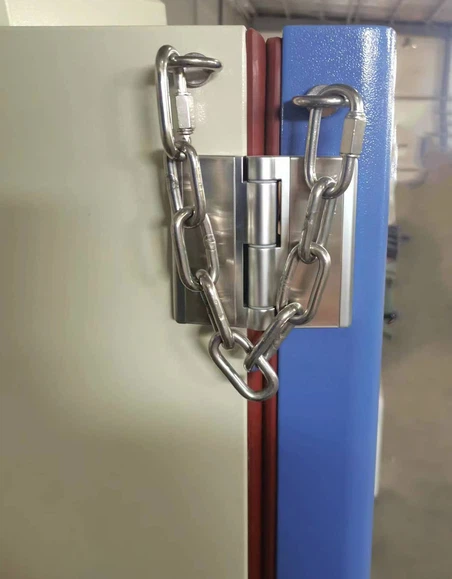 |
| Explosion-proof window | The explosion-proof chain on the door |
 |
|
| Water Spraying nozzles are used for extinguishing fires | Explosion-proof smoke detector |

Double-door design
For applications involving large-sized samples or frequent sample handling, the single-door design can be modified to a double-door structure to enhance handling efficiency.
The dimensions of the double doors can be customized to ensure convenient access for large samples while maintaining excellent thermal insulation and sealing performance.
Cable holes of various shapes and positions
Different testing standards (such as IEC, ISO, MIL-STD) may have different requirements for the shape, position, and size of cable holes. LIB can design according to standards or customer requirements.
Holes of various shapes, such as circular, square, or elliptical, can be created with diameters ranging from several dozen millimeters to hundreds of millimeters, and can be equipped with high-temperature resistant or corrosion-resistant seals.
Hole positions can be selected on the left or right side panels, rear panel, or even the top, facilitating connection to various external devices.
Flexible adjustment of controller position
The touchscreen controller of the test chamber can be customized and installed on the left, right, or top of the equipment according to the laboratory layout, making it convenient for operators to monitor data and control the testing process.
Not only these customization options. Through these customized options, LIB not only ensures that the temperature and humidity test chamber meets general experimental requirements but also tailors efficient, safe, and user-friendly solutions tailored to your actual testing processes, sample characteristics, and laboratory environment.
【Daily maintenance for Temperature and Humidity Test chambers】
1. Maintenance Frequency and Responsibilities
Daily (Operator): 5–10 minutes of pre-startup and post-shutdown checks.
Weekly Inspection (On-duty Engineer): 30–60 minutes of functional and cleaning checks.
Monthly Inspection (Maintenance Engineer): 1–2 hours of in-depth inspection.
Quarterly: Performance verification and sensor calibration.
Annual: Third-party calibration and comprehensive maintenance (including refrigeration and electrical systems).
2. Pre-Operation/Daily Inspection
Power Supply and Grounding: Verify that the main power supply, ground fault protection, and grounding are functioning normally.
Exterior: Door seals, observation windows, handles, and panels show no visible damage.
Water system: Humidifier water level is normal, incoming water is clean, and drainage is unobstructed.
Controller: Touchscreen self-test passes, no unresolved alarms.
Door seal: Visually and manually check the seal after closing the door.
Abnormal conditions: Record any abnormalities in the log and immediately notify the on-duty engineer; export the data from the past 30 minutes for reference.
Acceptance: Can enter standby/operating mode; no persistent alarms or obvious leaks.
3. Weekly Maintenance
Clean the intake/exhaust air filters (record the date).
Inspect the humidifier and water tank for deposits; clean or replace the filter cartridge as needed.
Listen for abnormal noise from the compressor/fan and record any abnormalities.
Inspect the door hinges and locks.
Record this week's alarms and their resolutions.
4. Monthly Maintenance
Inspect hoses, connectors, and valves; replace aged or cracked components.
Confirm that the condensate recovery pump and piping are unobstructed.
Inspect electrical panel terminals for loose connections or signs of overheating.
Compare PID controller readings with portable standard instruments; adjust as necessary.
Conduct a 9-point (or equivalent) uniformity check and record results.
5. Quarterly Maintenance
Conduct 9/25/27-point uniformity tests and generate a report.
Inspect the condenser/evaporator for scaling and clean or have a refrigeration engineer perform maintenance.
Test all safety protections (over-temperature, low water, door open, electrical leakage) to ensure they trigger and reset normally.
Verify data export and remote connection (Ethernet/USB) functionality.
6. Annual Calibration and Comprehensive Maintenance
It is recommended that a third-party or manufacturer-certified service provider perform the following: PT100 and humidity sensor calibration, refrigeration system pressure testing, and electrical insulation/grounding testing.
Replace door seals, main filters, and necessary consumable parts.
The annual report can include calibration certificates, uniformity curves, maintenance records, and recommendations for the following year.
LIB offers a 3-year warranty and lifetime service. Any issues that cannot be resolved during the warranty period will be replaced free of charge. 24/7 English-speaking after-sales team. Fast shipping within 7-15 days.
Contact LIB to develop a professional and efficient solution tailored to your specific standards and stringent requirements.