When testing modern electronic and wireless devices, such as smartphones, Bluetooth headsets, and smartwatches, even minor temperature fluctuations or electromagnetic interference can compromise results. Ensuring stable environmental conditions while isolating devices from external RF noise is critical. Engineers and R&D teams need a chamber that not only reproduces precise temperature cycles but also guarantees reliable radio frequency (RF) testing in a fully shielded environment.
LIB's RF Radio Frequency Shielded Temperature Chamber delivers exactly that. Combining a -20 °C to +85 °C temperature range with a built-in RF shielding box, this chamber ensures your electronic devices are tested under realistic conditions while free from external electromagnetic disturbances. Equipped with PT-100 Class A sensors, a PID programmable touch-screen controller, and advanced airflow design, it provides highly uniform, repeatable, and accurate test results.
What is an RF (Radio Frequency) Shielded Temperature Chamber?
An RF Shielded Temperature Chamber is a specialized test system designed to simulate environmental conditions-primarily temperature changes-while isolating devices from external radio frequency interference. This allows engineers to accurately measure electrical performance, wireless signal quality, and thermal stability simultaneously.
In simple terms, it is like a "quiet room" for electronics: the temperature can go from freezing to warm while all outside electromagnetic signals, including Wi-Fi, Bluetooth, and 5G, are blocked. This is crucial for R&D, EMC (Electromagnetic Compatibility) testing, and 5G/IoT device validation, ensuring test data reflects true device performance without outside interference.
These chambers are essential in research and development (R&D) environments, where engineers need to simulate real-world operating conditions for new products. For example, a smartphone may need to function reliably both in a cold winter environment and a hot summer setting, while maintaining stable 5G connectivity. Without RF shielding, the measurements of signal strength or wireless communication quality could be distorted by ambient electromagnetic noise, making it difficult to draw accurate conclusions.
Additionally, RF Shielded Temperature Chambers play a crucial role in EMC (Electromagnetic Compatibility) testing. EMC testing ensures that electronic devices can operate without interfering with, or being affected by, other electronics. By isolating devices from external RF signals while subjecting them to temperature stress, engineers can identify potential design flaws, verify compliance with international standards such as IEC 61000, and prevent costly failures in the field.
Modern versions of these chambers, like LIB's RF Shielded Temperature Chamber, also allow simultaneous multi-device testing, precise data logging, and automated control of temperature cycles. This enables repeatable testing protocols for a variety of electronics, including IoT devices, wearable gadgets, smart home appliances, and automotive components. By integrating advanced sensors and airflow systems, these chambers guarantee uniform temperature distribution and accurate measurements across all devices being tested.
How LIB's RF Shielded Temperature Chamber Works and Its Advantages
|
|
|
|
| Name | Temperature Test Chamber With RF Shielding | |
|
Internal Dimension (mm) |
360*460*410 D*W*H |
|
|
Overall Dimension (mm) |
860*660*1430 D*W*H |
|
|
Interior Volume (Liter) |
68L |
|
| Workroom | Shielding Box | |
|
Exterior Material |
A3 Steel Plate with protective coating |
|
|
Interior Material |
SUS304 stainless steel |
|
|
Temperature Range |
-20℃ ~ +85 ℃ |
|
|
Cooling Rate |
1 ℃ / min, average |
|
|
Heating Rate |
3 ℃ / min, average |
|
|
Temperature Fluctuation |
± 0.5 ℃ |
|
|
Temperature Deviation |
± 1.0 ℃ |
|
|
Heat load |
1000W |
|

High-Precision Temperature Control
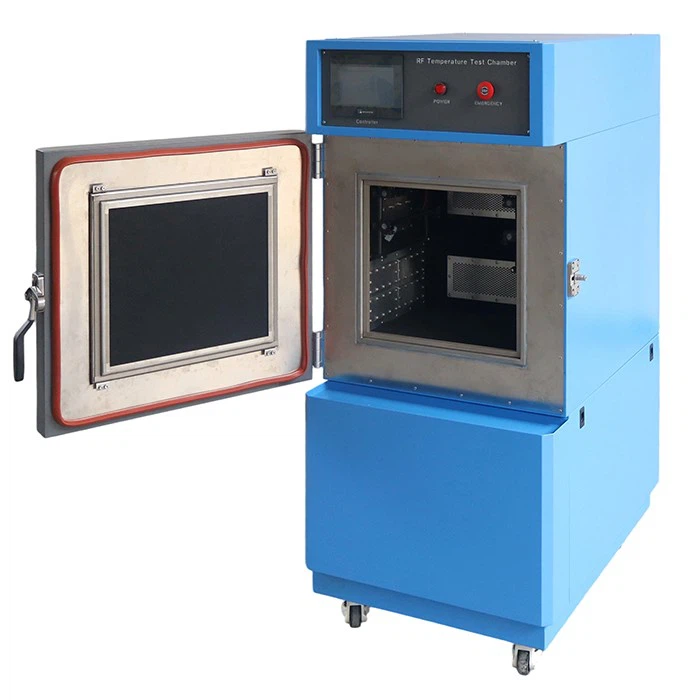
LIB's chamber provides a wide temperature range of -20 °C to +85 °C. Heating occurs at 3 °C/min on average, while cooling happens at 1 °C/min, maintaining ±0.5 °C fluctuation and ±1 °C deviation. PT-100 Class A platinum sensors measure temperature with ±0.001 °C resolution, guaranteeing uniform and reliable conditions for sensitive electronics.
RF Shielding for Signal Integrity
The internal RF shielding box isolates devices from external electromagnetic interference, ensuring accurate measurements for Bluetooth, Wi-Fi, and 5G devices. Internal SUS304 stainless steel resists corrosion from temperature or humidity changes, providing durability over long-term testing.
Efficient Air Circulation
A top air inlet combined with a bottom return and centrifugal fan creates stable laminar airflow. This ensures no hot or cold spots, allowing multiple devices to be tested simultaneously without rotation.
Intelligent PID Control and Safety
The 7-inch color touch screen supports up to 120 programmable profiles with 100 segments each. Remote operation via Ethernet and USB data logging simplify test monitoring. Safety systems include over-temperature, over-current, refrigerant high-pressure, and earth leakage protection, ensuring device and operator safety.
Standards Compliance
LIB chambers meet IEC 60068 environmental testing standards for electronics, IEC 61000 EMC testing standards, and ISO 16750 automotive environmental conditions requirements, guaranteeing internationally recognized reliability and acceptance for test results.
|
|
 |
| The workroom is fitted with a green RF shielding box(green) that efficiently blocks external electromagnetic interference. | Intelligent PID Controller |

Testing 5G Signals of a Mobile Phone with LIB RF Shielded Temperature Chamber
Step 1: Sample Preparation
Place the mobile phone inside the chamber on a live DC holder. Ensure all test cables pass through the chamber's cable hole (Φ50 mm) to maintain RF isolation while allowing device power and measurement connections.
Step 2: Set Test Parameters
Program the chamber for the desired temperature cycle, e.g., ramp from 25 °C to 60 °C at 3 °C/min, hold for 30 minutes, then cool to 0 °C at 1 °C/min. Enable PID control and airflow to guarantee uniformity across all device surfaces.
Step 3: Activate RF Shielding
Close the RF shielded workroom to block all external electromagnetic signals. This ensures the 5G signal measurement reflects only the device's performance without interference.
Step 4: Conduct 5G Performance Tests
Connect measurement equipment to monitor throughput, latency, and signal stability. The chamber maintains stable temperature while RF shielding ensures accurate, interference-free signal readings.
Step 5: Data Logging and Analysis
All temperature, ramp rate, and signal measurement data are logged via Ethernet/USB. Generate ISO/IEC compliant reports for review, validation, and certification purposes.
Step 6: Test Completion and Sample Removal
Once the cycle ends, slowly return the chamber to room temperature. Remove the device and analyze data to confirm compliance with performance standards.
LIB's RF Shielded Temperature Chamber combines environmental precision, RF isolation, and smart control for reliable and repeatable testing of wireless devices. It is ideal for R&D labs, 5G/IoT development, automotive electronics, and EMC evaluation.
Contact LIB Industry to learn more about how to implement advanced RF temperature testing and access step-by-step guides for multi-stage, compliant testing workflows.