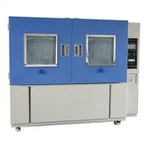
NSS Salt Spray Corrosion Test Cabinets play a crucial role in evaluating the corrosion resistance of materials and products exposed to harsh marine or coastal environments. These specialized testing devices simulate prolonged exposure to salt-laden atmospheres, allowing manufacturers to assess how their products will perform under aggressive conditions. By replicating real-world scenarios in a controlled setting, NSS Salt Spray Corrosion Test Cabinets enable companies to improve product durability, extend service life, and ensure compliance with industry standards. This testing process is invaluable for industries such as automotive, aerospace, electronics, and marine equipment, where corrosion prevention is paramount.

The Significance of Salt Fog Simulation Test
-
Assessing Corrosion Resistance
Salt fog simulation tests are instrumental in evaluating the corrosion resistance of various materials and coatings. By subjecting samples to a controlled saline environment, manufacturers can observe how their products withstand prolonged exposure to salt-laden atmospheres. This assessment helps identify potential vulnerabilities in materials, allowing for improvements in design and selection of more suitable protective coatings or alloys.
-
Ensuring Product Reliability
The reliability of products destined for use in coastal or marine environments hinges on their ability to withstand corrosive conditions. NSS Salt Spray Corrosion Test Cabinets enable manufacturers to rigorously test their products, ensuring they meet or exceed industry standards for corrosion resistance. This process helps companies deliver dependable products that perform well even in challenging environments, ultimately enhancing customer satisfaction and brand reputation.
-
Compliance with Industry Standards
Many industries have specific standards and regulations governing the corrosion resistance of products. NSS Salt Spray Corrosion Test Cabinets allow manufacturers to conduct tests in accordance with these standards, such as ASTM G85 or ISO 9227. By demonstrating compliance through standardized testing procedures, companies can gain certifications necessary for market entry and maintain a competitive edge in their respective industries.
Uses of NSS Salt Spray Corrosion Test Cabinet
-
Automotive Industry Applications

In the automotive sector, NSS Salt Spray Corrosion Test Cabinets are extensively used to test the corrosion resistance of various components. From body panels and exhaust systems to electrical connectors and suspension parts, these chambers help manufacturers ensure their vehicles can withstand harsh road conditions, especially in regions where road salt is commonly used during winter months. By simulating years of exposure in a compressed timeframe, automakers can develop more durable vehicles with extended service lives.
-
Aerospace Industry Testing
The aerospace industry relies heavily on NSS Salt Spray Corrosion Test Cabinets to test the corrosion resistance of aircraft components. Given the critical nature of aerospace applications, ensuring the integrity of materials used in aircraft construction is paramount. Salt fog testing helps identify potential weaknesses in structural elements, coatings, and fasteners, allowing engineers to implement necessary improvements to withstand the corrosive effects of high-altitude environments and coastal operations.
-
Marine Equipment Evaluation
For manufacturers of marine equipment, NSS Salt Spray Corrosion Test Cabinets are indispensable tools. These chambers allow for the thorough testing of boats, offshore platforms, and other marine structures exposed to constant salt spray and high humidity. By subjecting materials and components to accelerated corrosion conditions, manufacturers can develop more resilient products capable of withstanding the harsh marine environment, ultimately reducing maintenance costs and extending the operational life of marine equipment.
Assembly and Commissioning of NSS Salt Spray Corrosion Test Cabinet
-
Chamber Construction and Materials
The assembly of a NSS Salt Spray Corrosion Test Cabinet requires careful consideration of materials and construction techniques. The chamber itself is typically constructed using corrosion-resistant materials such as fiberglass-reinforced plastic or stainless steel to withstand the harsh saline environment. Proper sealing and insulation are crucial to maintain consistent test conditions and prevent salt fog leakage. The internal components, including spray nozzles, solution reservoirs, and air circulation systems, must be designed and installed to ensure uniform distribution of the salt fog throughout the chamber.
-
Control Systems and Instrumentation
Advanced control systems and precise instrumentation are integral to the effective operation of NSS Salt Spray Corrosion Test Cabinets. During assembly, sophisticated sensors for temperature, humidity, and salt concentration are carefully installed and calibrated. These sensors work in conjunction with programmable logic controllers (PLCs) to maintain precise test conditions as specified by various testing standards. The integration of data logging and monitoring systems allows for real-time tracking of test parameters and ensures the reliability and repeatability of test results.
-
Calibration and Validation Procedures
Following the assembly of a NSS Salt Spray Corrosion Test Cabinet, rigorous calibration and validation procedures are essential to ensure its proper functioning. This process involves verifying the accuracy of temperature and humidity controls, checking the uniformity of salt fog distribution, and confirming the correct operation of all safety features. Calibration is performed using certified reference instruments, and the chamber's performance is validated against standardized test protocols. Regular maintenance and recalibration schedules are established to maintain the chamber's accuracy and reliability over time, ensuring consistent and dependable test results for users across various industries.
lIB NSS Salt Spray Corrosion Test Cabinet
|
Temperature Range |
Ambient ~ +60 ℃ |
|
Temperature Fluctuation |
± 0.5 ℃ |
|
Temperature Deviation |
± 2.0 ℃ |
|
Humidity Range |
95% ~ 98% RH |
|
Salt Fog Deposition |
1~2ml / 80cm2 · h |
|
Spray Type |
Continuous / Periodic |
|
Salt Fog Collected |
Fog collector and fog measure cylinder |
|
Air Preheating |
Saturated air barrel |
|
Spraying System |
Atomizer tower and Spray nozzles |