A smartwatch goes for a swim in a backyard pool and comes out still tracking heart rate. A submersible pump sits at the bottom of a flooded basement for hours, working exactly as it should. A sealed EV battery pack survives a river crossing without a single warning light. Behind each of these everyday miracles is a piece of lab equipment most consumers never see - one that spends its days flooding, drowning, and burying products in dust long before those products ever reach a customer.
This article walks through what an IP68 Water and Dust Tester actually simulates, the IEC and ISO standards it must satisfy, how the equipment works internally, why a recent five-chamber order from an Uzbekistan customer put LIB Industry's build quality to the test, and how IP68 compares with IP69 when it's time to choose between the two.
IP68 Water and Dust Tester
What Is an IP68 Water and Dust Tester
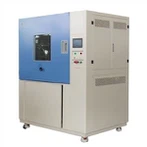
An IP68 Water and Dust Tester is a combined chamber built to prove two things at once: that a product's enclosure is completely dust-tight, and that it can survive continuous submersion in water beyond the depth and duration covered by lower ratings. The "6" in IP68 confirms total protection against dust ingress, with zero penetration allowed during a full dust-cycle test. The "8" confirms the product can be fully immersed in water under conditions more demanding than IP67, typically at depths greater than 1 meter and for durations agreed between manufacturer and customer. Because the two ratings are earned separately but tested on related equipment, most labs run both dust and immersion checks in a single combined chamber to save floor space and cross-reference the results against one seal design.
Standards and Working Principle
IP68 testing follows IEC 60529 and ISO 20653, the same base standards referenced across the IP rating family, with the exact immersion depth and duration for IP68 left open for negotiation between manufacturer and test lab - commonly 1 to 3 meters for 30 minutes up to 24 hours, depending on the product's intended use case. Inside the chamber, the dust side of the test uses talcum powder with a nominal particle diameter of 50 micrometres, circulated by a vertical airflow system and filtered through a 75-micrometre mesh sieve to stop clumping. A heating tube keeps the dust dry so it doesn't cake inside the ductwork. The water side relies on a sealed immersion tank with a hydraulic lift or pneumatic platform to lower the specimen to the programmed depth, while a PID controller and pressure sensor hold water depth and duration within tight tolerance for the full test cycle.
Test Methods
A typical IP68 sequence starts with the dust phase: the specimen sits inside the workroom while a circulating pump sprays dust at a concentration of roughly 2 to 4 kg/m³, with a vacuum pump often applied to draw a partial vacuum around the specimen for a stricter pass condition. After the dust cycle, the chamber is cleaned and the specimen moves to the immersion tank, where it's lowered below the water line and held there for the agreed depth and time. Sensors log pressure, depth, and elapsed time continuously, and the specimen is inspected immediately after removal for any trace of water or dust intrusion. Because both phases are logged automatically, engineers get a full digital record - depth curves, dust concentration, temperature - that supports IEC/ISO-compliant certification paperwork.
Thailand Customer Chooses LIB Industry for a 2000L IP6X Chamber
When an industrial customer in Thailand placed an order for a 2000-liter IP6X dust test chamber, it was for a full round of product performance testing across their production line, and the feedback after installation was clear: the equipment held up to daily testing without a single deviation in results. Several factors stood out. Compliance came first - the chamber ships built to CE, IEC, and CSA safety requirements, so the customer's certification data holds up under audit without extra retrofitting. Safety interlocks, including over-temperature, low-water, and door-open protection, gave their operators confidence running back-to-back cycles at full capacity.
Cost-effectiveness mattered too: fewer replacement parts and long service intervals kept total ownership cost down even at the larger 2000L scale. Free customization on the sample holder and test profiles meant the chamber matched their exact product lineup rather than a generic configuration, and a 3-year full warranty backed by lifetime technical support removed the risk of unexpected downtime.
LIB Industry also sent an engineer for on-site training, walking the customer's team through programming, maintenance, and troubleshooting - a hands-on step the customer specifically called out as making the whole rollout smoother. On top of that, stable humidity control inside the chamber meant results stayed consistent test after test, which is exactly what a high-volume 2000L testing schedule needs.
IP68 Water and Dust Tester vs IP69 Water and Dust Tester: How to Choose
| Parameter | IP68 Water and Dust Tester | IP69 Water and Dust Tester |
|---|---|---|
| Water condition | Continuous immersion, depth/duration by agreement (commonly 1-3 m, 30 min-24 h) | High-pressure, high-temperature water jets at 80°C ± 5°C |
| Water pressure | Static immersion pressure only | 8,000-10,000 kPa |
| Flow rate | Not applicable (submersion, not spray) | 14-16 L/min |
| Nozzle distance | N/A | 100-150 mm |
| Dust requirement | Full dust-tight (IP6X), 50 µm particle size | Full dust-tight (IP6X), 50 µm particle size |
| Reference standards | IEC 60529, ISO 20653 | IEC 60529 Annex R, ISO 20653, DIN 40050-9 |
| Typical use case | Wearables, submersible pumps, sealed connectors, outdoor sensors | Engine bays, food/dairy processing equipment, hot pressure-washdown environments |
If a product's real-world risk is prolonged contact with standing or flowing water - a pool, a flooded enclosure, a submerged sensor - IP68 is the right test. If the greater risk is repeated hot, high-pressure washdown, such as automotive underbody cleaning or food-plant sanitation, IP69 is the better match. Many manufacturers with mixed product lines choose a combined chamber capable of running both protocols, which covers a wider certification scope without doubling equipment footprint.
FAQs on the IP68 Water and Dust Tester
Q1: Does installation require special site preparation? No special foundation is needed. The chamber ships on lockable, height-adjustable castors and only needs a stable power supply, a water connection, and floor drainage nearby.
Q2: What certifications ship with the equipment? Every unit is built to CE, IEC 60529, and ISO 20653 requirements, and test data can be exported in CSV or PDF format for audit trails.
Q3: Can the immersion depth and dust concentration be customized? Yes. Immersion depth, duration, dust concentration, and fixture design can all be configured to match a specific product line at no extra cost.
Q4: What does after-sales support include? Standard coverage includes a 3-year full warranty, lifetime technical support, and on-site installation and training assistance for larger orders.
Q5: How long does shipping take, and are spare parts available? Lead times vary by configuration, but spare parts are stocked regionally, so replacements typically arrive within one to two weeks rather than requiring a full return-to-factory cycle.
Contact LIB Industry for a customized IP68 Water and Dust Tester design, a live demonstration, or to schedule delivery of your next environmental test chamber.