A battery pack that survives a desert afternoon can still crack open in a mountain blizzard. That kind of failure doesn't show up in a spec sheet - it shows up in the field, after the product has already shipped. For engineers building EV batteries, aerospace parts, and automotive electronics, the only way to catch that failure before a customer does is to force it to happen first, safely, inside a lab.
This article explains how LIB Industry's 3 Zone Thermal Shock Chamber recreates that failure on demand, what standards it meets, why a Thai battery manufacturer chose it for production testing, and how it stacks up against a traditional 2 Zone design.
LIB Industry: A Manufacturer Built on Engineering Depth
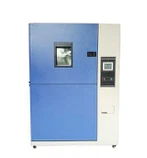
LIB Industry has spent years designing environmental test equipment for automotive, aerospace, and battery industries, and that experience shows in the hardware itself. Every 3 Zone chamber uses a SUS304 stainless-steel interior and A3 powder-coated steel exterior, dual centrifugal fans for airflow, and a PID closed-loop controller paired with PT100 sensors for ±1 ℃ accuracy. The chamber is built with a 100 L to 500 L interior volume range (models 3TS-100, 3TS-210, 3TS-300, 3TS-500), with loading capacity from 10 kg up to 35 kg, so labs can test anything from small components to full battery modules on the same platform family.
Standards the 3 Zone Chamber Is Built to Meet
A test result only matters if a customer, OEM, or certification body trusts it. LIB's 3 Zone chambers are designed and calibrated to comply with IEC 60068-2-14 (change of temperature testing), ISO 16750 (road vehicle electrical/electronic equipment), GB/T 2423.22 (China's national thermal shock standard), and UN 38.3 for lithium battery transport safety. That means the data generated in-house lines up with what auditors and regulators expect to see, without extra conversion or re-testing.
What Is a 3 Zone Thermal Shock Chamber and How Does It Work?
Unlike a 2-zone design that shuttles samples between only a hot chamber and a cold chamber, a 3 zone thermal shock chamber adds a third, ambient testing section in the middle. The sample moves from the ambient zone into the +220 ℃ pre-heat room or the -75 ℃ pre-cool room, and can dwell in the ambient zone between shocks if the test profile calls for it. Heating from ambient to +200 ℃ takes about 30 minutes, and cooling from ambient to -70 ℃ takes roughly the same, with temperature fluctuation held to ≤±0.5 ℃ and deviation within ≤±3 ℃. This three-zone layout gives engineers a more realistic simulation of real-world conditions, where products rarely jump straight from extreme heat to extreme cold without passing through a normal operating range first.
To show how this plays out in a real test, here is a typical thermal shock cycle referencing IEC 60068-2-14 (Test Na), which is one of the most commonly cited standards for change-of-temperature testing:
| Step | Action | Parameter |
|---|---|---|
| 1 | Sample placed in ambient zone | Room temperature |
| 2 | Transfer to hot zone | Up to +200 ℃, 30-min ramp |
| 3 | Dwell at high temperature | Set per product spec |
| 4 | Transfer to cold zone | Down to -70 ℃, 30-min ramp |
| 5 | Dwell at low temperature | Set per product spec |
| 6 | Repeat cycle | Per program (up to 9,999 cycles) |
| 7 | Data logging | Continuous, exportable via USB/Ethernet |
A Thailand Customer's Experience With the 3 Zone Chamber
A battery manufacturer in Thailand recently brought a 3 Zone Thermal Shock Chamber into their production line to run performance testing on lithium battery packs, and the results kept them coming back for a second unit. Several things stood out for their QA team.
Safety compliance was the first concern, and it was fully addressed. The chamber carries CE certification and is built to align with IEC and CSA safety requirements, so their exported products could pass downstream audits without extra documentation work. Explosion-proof features - pressure-relief construction, reinforced housing, and automatic shutdown on abnormal readings - meant their engineers could run battery cycling tests without treating every run as a safety risk.
Test precision matched their production tolerances. With ±0.5 ℃ fluctuation and ±1 ℃ sensor accuracy from the PT100 probes, their repeat tests produced consistent, comparable data across shifts - something they said their previous chamber could not deliver reliably.
Customization came at no extra cost. LIB Industry configured shelf load capacity, cable hole placement, and program storage (up to 120 test profiles, 9,999 cycles each) to match their specific battery module dimensions, free of charge.
Long-term support closed the deal. A 3-year warranty, ongoing spare-parts support, and on-site training for their technicians gave the team confidence that the chamber would stay productive well past installation day - not just during the first year.
3 Zone vs. 2 Zone Thermal Shock Chamber: How to Choose
Both designs shock a sample between hot and cold extremes, but the way they do it - and what they're best suited for - is different.
| Feature |
|
|
|---|---|---|
| Zones | Hot + Cold | Hot + Cold + Ambient |
| Transfer time | < 3 seconds | Basket/elevator transfer, ambient dwell optional |
| Temperature range | -70 ℃ to +200 ℃ (cold zone to -75 ℃, hot zone to +220 ℃) | -70 ℃ to +220 ℃, low-temp exposure -65 to -5 °C |
| Ambient dwell | Not available | Available between shocks |
| Loading capacity | Up to 80 kg | 10–35 kg depending on model |
| Best fit | Fast pass/fail shock testing, large modules | Standards requiring an ambient stabilization stage, smaller components |


If a test standard or customer specification calls for a stabilization period at room temperature between thermal extremes, or if the application is closer to component-level electronics rather than large battery packs, the 3 Zone chamber is the better fit. If the priority is maximum load capacity and the fastest possible hot-to-cold transfer with no ambient stage required, the 2 Zone chamber is typically the more efficient choice.
LIB industry's Popular Controlled Laboratory Climate Chambers

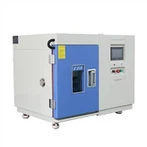
Space-Saving Laboratory Design, Precise Temperature and Humidity Control


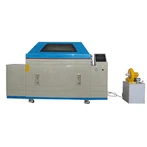
Combined Climatic and Vibration Testing, Reduced Testing Time and Improved Correlation


Up to 5/ 10/ 20°C/min Temperature Ramp Rates, Accelerated Product Reliability Validation.
FAQs on the 3 Zone Thermal Shock Chamber
Q1: Can the chamber be customized for our specific product size?
Yes. LIB Industry customizes shelf configuration, interior volume, cable hole placement, and load capacity based on the samples being tested, at no additional design cost.
Q2: How do we know which model is right for our lab?
Share your testing requirements - sample size, temperature range, and applicable standard - and LIB Industry's engineering team will recommend the correct chamber model and configuration.
Q3: Do you support installation and training on-site?
Yes. LIB Industry offers both online training and overseas on-site installation and commissioning. Every chamber is debugged for 72 hours before shipment, with a test report issued prior to delivery.
Q4: How long does shipping take, and what happens after the warranty period?
Standard models ship within 10–15 business days worldwide. Each chamber includes a 3-year warranty, and LIB Industry's global service team continues to provide spare-parts and remote technical support in English, Chinese, and other local languages after the warranty ends.
Contact LIB Industry today to learn how our 3 Zone Thermal Shock Chamber can accelerate your testing, improve safety, and ensure your products meet the world's most rigorous standards.