
When manufacturers evaluate the durability of metals, coatings, fasteners, or automotive components, corrosion becomes one of the most expensive forms of material failure. Every year, corrosion causes an estimated US $2.5 trillion in global economic losses. This makes accelerated corrosion testing essential for predicting real-world performance, shortening product development cycles, and meeting strict certification requirements.
ISO 9227 Salt Spray testing provides a controlled, repeatable, and internationally recognized way to simulate harsh corrosive conditions. A standard-compliant salt spray instrument recreates a high-salinity, continuously atomized fog environment to expose samples to accelerated corrosion. In the following sections, we interpret ISO 9227, explain how salt spray instruments work, present a step-by-step coating test procedure using the LIB ISO 9227 Salt Spray Instrument, and answer the five most common questions.
1. Interpretation of ISO 9227 Standard for Salt Spray Testing
The ISO 9227 standard defines how to perform accelerated corrosion tests using a salt spray chamber.
The first key requirement is the type of test method. ISO 9227 specifies three procedures: NSS (Neutral Salt Spray), AASS (Acetic Acid Salt Spray), and CASS (Copper-Accelerated Acetic Acid Salt Spray). NSS uses a 5 ± 1 % NaCl solution at pH 6.5–7.2, AASS adds acetic acid to reach pH 3.1–3.3, and CASS includes both acetic acid and copper chloride to create a highly aggressive environment.
The second requirement is environmental control. The chamber must maintain a consistent 35 °C for NSS and up to 50 °C for AASS/CASS. The fog must fall at 1.0–2.0 mL/h per 80 cm², ensuring uniform corrosion exposure across all sample surfaces.
The third requirement is sample preparation and positioning. Samples must be placed at 15°–25° from vertical, without touching, and all edges must be properly coated or covered according to ISO guidelines. The standard also requires pre-cleaning, rinsing, and post-conditioning to ensure comparable results.
The fourth requirement is test duration and evaluation. ISO 9227 does not define pass/fail criteria; instead, industries set their own benchmarks-such as 120 hours for zinc plating or 480 hours for powder coating. The standard focuses on achieving repeatable, neutral, and controlled corrosive environments for accurate comparison.
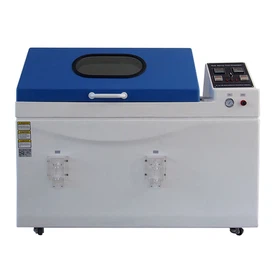
2. Overview of the ISO 9227 Salt Spray Instrument
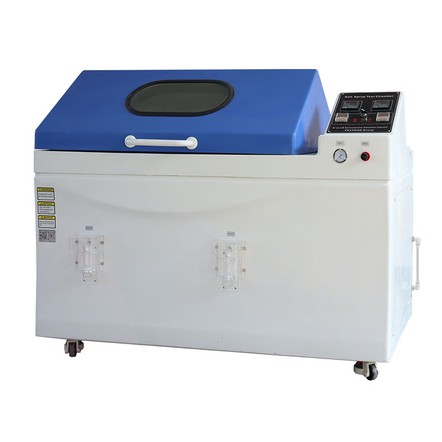
A salt spray instrument is designed to create a continuous saline fog environment that accelerates corrosion in a controlled manner.
The instrument is important because it provides repeatable, standardized test conditions. A chamber built according to ISO 9227 ensures compliant temperature control, stable fog distribution, and precise pH and salinity management-allowing manufacturers to meet automotive, aerospace, and industrial quality requirements.
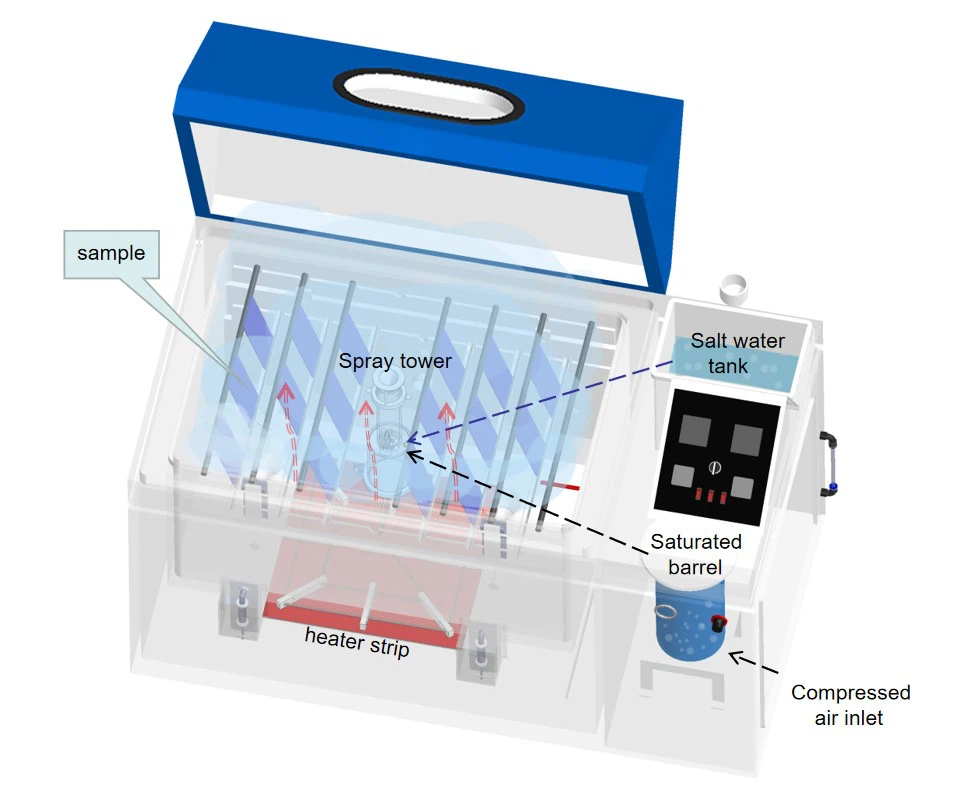
The instrument works by atomizing a salt solution into fine droplets. A built-in air saturator heats compressed air to ensure consistent humidity, then forces the air through a nozzle to atomize the 5 % NaCl solution. This produces a dense, uniform fog that continuously settles on the specimens at controlled rates.
The instrument is engineered for uniform exposure. Internal circulation, calibrated fog collectors, and corrosion-resistant materials (Integrated FRP molding) ensure even distribution of saline mist. This eliminates variations such as dry zones or inconsistent droplet fall rates.
The instrument ensures stable long-duration performance. Many tests run for 48, 96, 240, or even 1000 hours, requiring chambers to operate nonstop. ISO-graded sealing, temperature sensors, and automatic water supply systems prevent fluctuations that could affect results.
 |
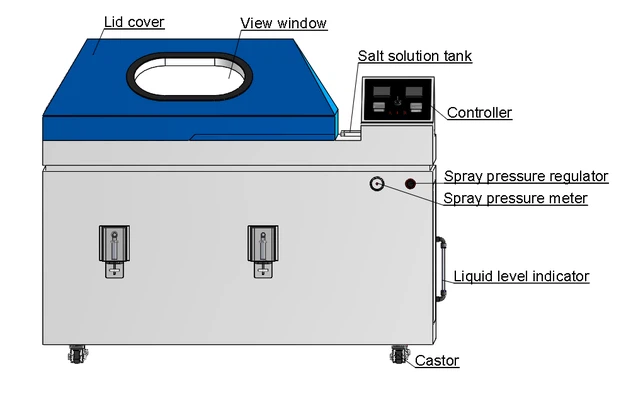 |
||
| Name | Salt Spray Corrosion Test Chamber | ||
|
Model |
S-150 |
||
|
Internal dimensions (mm) |
470*590*400 |
||
|
Overall dimensions (mm) |
620*1400*1050 |
||
|
Temp. Range |
Ambient ~ +60 degree |
||
|
Temp. Fluctuation |
± 0.5 ℃ |
||
|
Temp. Deviation |
± 2.0℃ |
||
|
Humidity Range |
95 % ~ 98 % RH |
||
|
Salt Fog Deposition |
1~2ml / 80cm2 · h |
||
|
Spray Type |
Continuous / Periodic |
||
|
Heating Element |
Nichrome heater |
||
|
Salt Fog Collected |
Fog collector and fog measure cylinder |
||
|
Controller |
PID controller |
||
|
Material |
Glass fiber reinforced plastics |
||
|
Standard Configuration |
8 round bars and 7 V-shaped grooves |
||
|
Power |
380V 50Hz |
||
|
Environmental Conditional |
5 ℃~+35 ℃ ≤85% RH |
||
3. Procedure for Conducting Coating Tests Using the LIB ISO 9227 Salt Spray Instrument
Salt spray testing plays a crucial role in coating performance evaluation. It reveals coating defects such as blistering, rusting, cracking, and under-film corrosion far more quickly than natural exposure. A proper test procedure ensures repeatability, compliance, and meaningful comparison between products.
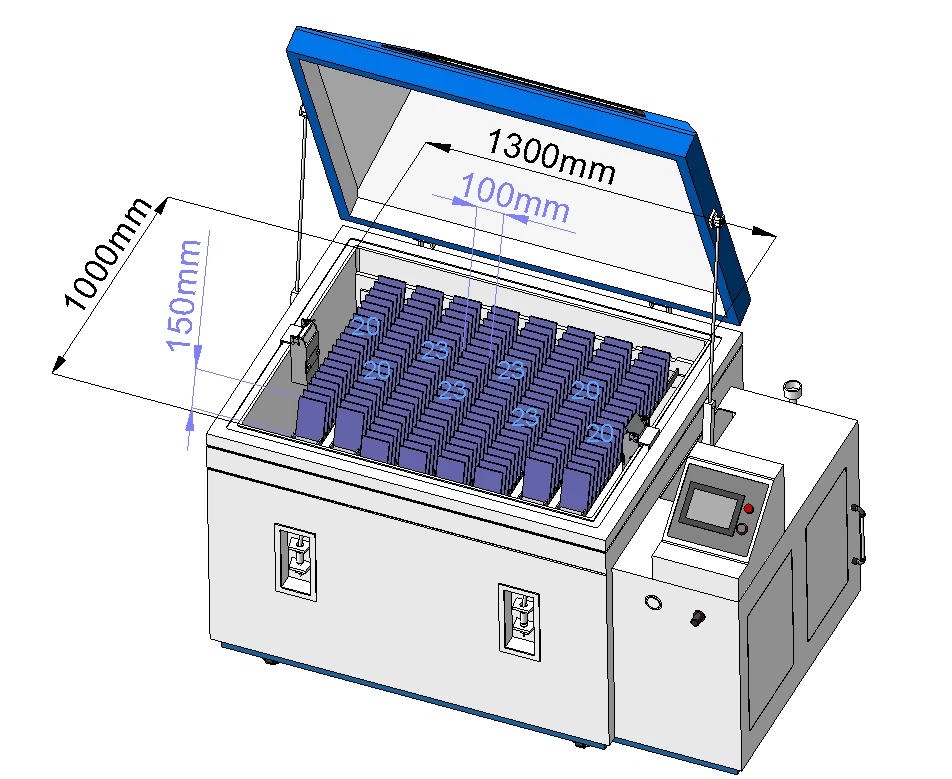 |
 |
| Coating Test | |
Below is a structured, ISO-aligned process using the LIB ISO 9227 Salt Spray Instrument, with each step highlighting an operational advantage.
Step 1: Sample Preparation
Prepare samples according to ISO 9227, including cleaning, degreasing, and masking edges.
LIB Advantage: Precision-controlled air saturator ensures stable humidity, preventing pre-corrosion before the test begins.
Step 2: Prepare Salt Solution
Mix a 5 ± 1 % NaCl solution and calibrate pH to 6.5–7.2.
LIB Advantage: Built-in pH and conductivity monitoring systems reduce manual checking time and ensure solution consistency.
Step 3: Load Samples into the Chamber
Place samples at a 15°–25° angle without touching.
LIB Advantage: Adjustable specimen racks support multiple sizes and maintain correct ISO angles for uniform exposure.
Step 4: Set Temperature and Fog Rate
Select 35 °C (NSS), 50 °C (AASS/CASS), and fog fall at 1.0–2.0 mL/h per 80 cm².
LIB Advantage: High-accuracy PT100 sensors provide ± 0.1 °C temperature stability for consistent results.
Step 5: Start Test Cycle
Run the chamber for the required duration, such as 120, 240, 480, or 1,000 hours.
LIB Advantage: 7-inch touchscreen controller stores up to 120 test profiles for long, continuous operation.
Step 6: Post-Test Rinse and Evaluation
Rinse samples with deionized water and evaluate corrosion per ISO 4628-1 to 4628-8 ratings.
LIB Advantage: Automatic fog shutdown and chamber drainage make post-test handling safer and faster.
|
|
|
| Corrosion-Resisitant Workroom | Modular grooves are used for holding samples |


|
salt spray tower |
cylinder |
spray collector |


4. What are the typical test temperatures for ISO 9227 salt spray testing?
ISO 9227 specifies a test temperature of 35 ± 2°C for NSS, AASS, and CASS tests unless otherwise required by specific product standards.
Q1. How long does a standard NSS test usually run?
The duration of an NSS (Neutral Salt Spray) test varies depending on material specifications, but typical test periods range from 24 to 1000 hours or longer for high-performance coatings.
Q 2. What type of salt solution is required for ISO 9227?
The test requires a 5% sodium chloride (NaCl) solution prepared with deionized or distilled water. The pH should be adjusted to 6.5–7.2 for NSS unless otherwise specified.
Q3. How is the fog collection rate measured?
The fog collection rate is measured by placing collection funnels and graduated cylinders inside the chamber. ISO 9227 requires a deposition rate of 1.0–2.0 mL/h per 80 cm².
Q4. What maintenance is needed to keep the salt spray instrument performing accurately?
Routine maintenance includes:
Regular cleaning of the chamber and reservoir to avoid salt buildup
Checking and replacing nozzles when necessary
Verifying fog distribution uniformity
Inspecting seals to ensure airtight operation
Ensuring sensors, heaters, and controllers remain calibrated
Q5. How to prevent salt spray leakage?
To prevent leakage, the chamber uses a one-piece molded fiberglass (FRP) structure, which is highly resistant to corrosion and deformation. A water-sealed groove around the chamber lid ensures airtight sealing-adding water into the groove during operation effectively prevents salt mist from escaping, maintaining a clean and safe testing environment.
Q6. Does the salt spray chamber have an automatic water inlet?
Yes. The chamber is equipped with an automatic water inlet system, which replenishes water based on actual operating needs. This ensures stable and continuous operation without manual intervention.
Any customization can be made. LIB offers a 3-year warranty and lifetime service. Any issues that cannot be resolved during the warranty period will be replaced free of charge. 24/7 English-speaking after-sales team. Fast shipping within 7-15 days.
Contact LIB Industry to develop a professional and efficient solution tailored to your specific standards and stringent requirements.


