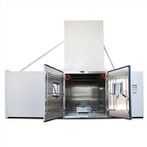
When electronic devices are exposed to flooding, heavy rain, or underwater environments, failure does not happen slowly-it happens instantly. A single drop of water entering a connector, camera module, or battery housing can cause signal loss, short circuits, or permanent damage. For automotive electronics, mobile phones, and industrial sensors, waterproof reliability is no longer optional-it is critical.
LIB IPX8 Testersare designed to answer one essential question before products reach the real world: Can your device survive real immersion conditions defined by international standards? By providing accurate pressure-based immersion testing, LIB ensures that waterproof claims are not assumptions, but verified results under IEC 60529 and ISO 20653 requirements.
Requirements for IPX8 Tester and IPX7 Tester Under IEC 60529 Standard
IPX8 testers are governed by international standards, primarily IEC 60529: Degrees of Protection Provided by Enclosures (IP Code), with automotive applications also referencing ISO 20653.
Under IEC 60529, the water protection levels IPX7 and IPX8 are defined as follows:
IPX7 Requirements (IEC 60529)
|
Test Method |
Static water immersion |
|
Water Depth |
1.0 m |
|
Duration |
30 minutes |
|
Water Type |
Fresh water |
|
Acceptance Criteria |
• No harmful ingress |
|
Typical Simulation Scenario |
Accidental immersion, flooding, or short-term submersion |
IPX8 Requirements (IEC 60529)
|
Test Method |
Continuous immersion under manufacturer-specified conditions |
|
Water Depth |
Greater than 1 m |
|
Duration |
Longer than 30 minutes |
|
Pressure |
Defined by the declared immersion depth |
|
Acceptance Criteria |
• Long-term waterproof integrity |
IEC 60529 does not fix a single depth for IPX8. Instead, it requires that IPX8 conditions be more severe than IPX7, and that the depth, time, and pressure be clearly declared.
LIB IPX8 Testers are engineered to simulate up to 50 m water depth, fully satisfying and exceeding IEC 60529 and ISO 20653 requirements for advanced waterproof validation.
Working Principle of the LIB IPX8 Tester
LIB's IPX8 Tester recreates deep-water environments using pressure simulation instead of relying on extreme water heights. This approach ensures testing is both safe and accurate.
 |
 |
During testing, the sample is immersed in approximately 1 meter of water, and the sealed chamber is pressurized using compressed air. The system can generate pressures from 0 to 0.5 MPa, simulating water depths of up to 50 meters. This method reproduces hydrostatic pressure precisely, following the principle that every 10 meters of water depth corresponds to 0.1 MPa, so 50 meters equals 0.5 MPa.
  |
 |
 |
Pressure simulation provides higher accuracy, improves operator safety, reduces the laboratory footprint, and ensures better repeatability across tests.
A double-layer silicone seal-combining soft and hard silicone-prevents leaks during repeated high-pressure cycles, while the 15 mm A3 steel chamber body maintains structural integrity and resists deformation under load.
| IPX7/IPX8 Immersion Tester | |
| Model | R78-600 |
| Internal Dimension (mm) | Diameter 600 mm * Height 1500 mm |
| Overall Dimension (mm) | Diameter 800 mm * Height 1800 mm |
| Pressure | 50m water depth pressure |
| Open mode | Pneumatic lid |
| Material | A3 steel plate, wall thickness 15 mm |
| Controller | Programmable color display touch screen controller |
| Water Supply System | Storage water tank, Automatic water supply
|

Mobile Phone Testing Procedures Using the LIB IPX8 Tester
Smartphones are among the most frequently IP-rated consumer devices, yet they face real-world risks such as flooding, pool immersion, and underwater photography. LIB's IPX8 Tester enables repeatable and standard-compliant mobile phone testing.
Step 1: Sample Preparation and Fixation
The mobile phone is mounted on the adjustable sample rack, which supports:
|
Up to 50 kg load Height adjustment Rotational positioning(optional) |
workroom |
pressure sensor |


LIB Advantage: The adjustable rack ensures the phone remains fully submerged and correctly oriented, preventing false results caused by trapped air or uneven immersion.
Step 2: IPX7 Immersion Test
- Water depth set to 1 m
- Test duration: 30 minutes
- No applied pressure
LIB Advantage: External water-level gauges allow operators to visually confirm compliance with IEC 60529 depth requirements in real time.
Step 3: IPX8 Pressure Immersion Test
- Water depth: approx. 1 m
- Air pressure applied: up to 0.5 MPa
- Duration: as specified (e.g., 60–120 minutes)
LIB Advantage: The PID intelligent controller maintains stable pressure with minimal fluctuation, ensuring consistent and repeatable deep-water simulation.
Step 4: Monitoring and Safety Control
During testing, the system continuously monitors:
- Water level
- Internal pressure
- Leakage status
LIB Advantage: Leak detection sensors and over-pressure relief valves automatically stop the test if abnormal conditions occur, protecting both the device and operators.
Step 5: Post-Test Inspection
After testing: Device is removed safely using pneumatic lid control. Functional inspection, sealing evaluation, and power-on tests are performed.
LIB Advantage: One-touch pneumatic lid operation reduces physical strain and eliminates the risk of accidental opening under pressure.

FAQs on IPX8 Tester
Q1: If the IPX7/IPX8 tester cannot be fixed to the floor, what should be done?
If drilling is not possible, the chamber can be stabilized using cement or high-strength fixing materials at the three base corners. When filled with water, the equipment becomes very heavy, and proper fixation prevents tipping and ensures laboratory safety.
Q2: The IPX7/IPX8 tester has no internal coating and may rust. How is this handled?
According to IEC 60529, corrosion resistance is not part of IPX7/IPX8 evaluation. However, LIB applies an internal anti-rust treatment layer to reduce water-induced corrosion and ensure long-term reliability during repeated testing.
Q3: How many ways are there to add water to the IPX7/IPX8 tester?
There are two methods:
- Manual filling by opening the lid
- Automatic filling via an external water source
Users can choose based on laboratory conditions and convenience.
Q4: How does the IPX8 tester simulate 50 m water depth?
Instead of real deep-water immersion, the tester applies approximately 0.5 MPa air pressure to a sealed water tank. This pressure is equivalent to the static water pressure at 50 m depth, accurately simulating underwater conditions without safety risks.
Q5: How is the sample rack adjusted in the IPX7/IPX8 tester?
The rack features height adjustment and rotational positioning, allowing precise placement of samples of different sizes and ensuring correct immersion depth as required by IEC 60529.
From IPX1 to IPX9K: Complete Compliance with International Standards
LIB provides a full range of IP testing equipment covering:
- IEC 60529 (IPX1–IPX9K, IP5X, IP6X)
- ISO 20653 (automotive applications)
- CE and UL safety compliance

Whether testing mobile phones, EV battery packs, ADAS sensors, or industrial electronics, LIB enables laboratories to build fully compliant IP testing systems/ lab with precision, safety, and efficiency.
Contact LIB Industry today for a tailored IPX7/IPX8 waterproof testing solution and ensure your products meet IEC 60529 and ISO 20653 standards with confidence.