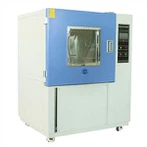
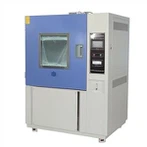
What is the dust test chamber
Sand and dust test chamber is suitable for testing the sealing performance of the shell of products, mainly simulating the damage caused by sandstorm weather to locks, auto and motorcycle parts (including lights, instruments, electrical dust jacket, steering system), seals, power meters and other products.
The dust test chamber is driven by a fan to blow a certain concentration of sand dust over the surface of the test samples at a certain velocity, so as to evaluate the ability of these test samples (equipment) to prevent the infiltration effect of dust particles, the ability to prevent the abrasive or blocking effect of sand and the ability to store and run.
Why do sand and dust test
The widely distributed sand and dust environment has a serious impact on the performance of products, such as abrasion, blocking, impact, penetration, corrosion and other damage effects. The main manifestations of sand damage include: it can affect the movement of moving parts and even jam, make the protective layer peel off, block the oil circuit and gas circuit, cause internal short circuit and open circuit of electrical equipment, destroy electrical insulation, cause bearing wear, weaken the reflection and light transmission effect of optical instruments, reduce heat conduction and so on.
The presence of dust, in combination with other environmental factors, may adversely affect the product, such as corrosion and mildew. Especially hot and humid environment
The combination of chemically corrosive dust will cause corrosion. In addition, blocked filters and reduced ventilation or cooling performance can lead to overheating and fire.
For non-conductive and corrosive dust such as salt used for thawing, a mixture of test dust and actual corrosive material can be used
A dust test was carried out, and then a heat and humidity test was carried out to study its influence.
However, in order to maintain reproducibility, consideration should be given to conducting dust tests with neutral dust and then conducting standard corrosion tests separately.
In order to study the effect of hygroscopic dust, the dust test can be mixed with short cotton fiber, and then the corrosion test.
IP rating and its meaning
The two digits behind IP indicate the protective strength of the equipment shell against solid foreign objects and water intrusion. The first digit indicates the level of electrical equipment against dust and foreign objects, and the second digit indicates the degree of confinement of the equipment against moisture and water intrusion, and the larger the digit, the higher the protection level.
Rankings 1-4 represent how resistant an object is to entry by foreign tools, ranging from fingers to fine tools. This is an important safety ranking that assesses protection against accidental contact with charged electricity. An IP3X is the minimum ranking you would want if you have children or pets around, and an IP4X protects against foreign contact for grain-sized and larger objects.
A rating of a IP5X or IP6X assesses a product’s protection against hazardous dust or other fine particles like sand. These are the two most common Single Particle Protection rankings, and they tell you how well a product keeps dust out of electronic components.
IP5X means a product is protected against dust. Dust entry is not entirely prevented, but significant protection of dust assures the product can operate in sandy conditions. A ranking of 5 is sufficient for most consumer-grade uses.
A rating of IP6X means the product is completely dust tight and there is no ingress of dust. Contractors and those traveling to extremely dirty or dusty locations prefer products with an IP6X rating.
|
Level |
Effective against |
|
IP0X |
No Protection |
|
IP1X |
Protected against solid foreign objects of 50 mm Ø and greater |
|
IP2X |
Protected against solid foreign objects of 12.5 mm Ø and greater |
|
IP3X |
Protected against solid foreign objects of 2.5 mm Ø and greater |
|
IP4X |
Protected against solid foreign objects of 1 mm Ø and greater |
|
IP5X |
Dust-protected |
|
IP6X |
Dust-tight |
How to maintain the dust test chamber
- Before the sand test:
1. Confirm the power supply and grounding wire;
2. Keep the appearance of the box clean;
3. Keep a dry environment in the laboratory;
4. Avoid the tilt of the dustproof test box;
5. Whether the power cord is properly connected according to the specifications, and confirm the grounding;
6, open the machine first check the circuit control system;
- During sand and dust test:
1, please do not open the door of the workroom during the test;
2, such as in the operation of the dust test chamber heard a strange noise, please stop checking, to find out the fault and solve the fault before restarting, side affect the service life of the equipment.
- After the sand and dust test:
1, after the end of the experiment, the dust test chamber entire power supply cut off;
2, after the end of each test, to remove the dust test chamber samples, clean the equipment liner;
3, to avoid the intrusion of dust test chamber
We are an integrated industry and trade enterprise, from design to production, to packaging, to transport, one-stop service. Every link we are to the highest standards of their own, committed to creating the most advantageous Dust test chamber and solutions for customers.
If you do not know what products you really need, or you do not know what test program to choose, please do not hesitate to contact us in time, we will provide you with the most professional pre-sales guidance for free.