
Sunlight can silently damage packaging. Flexible films lose tensile strength, PET bottles discolor, labels fade, and adhesive seals weaken after prolonged UV exposure. These failures reduce product shelf life and brand credibility. The key question is: Can a UV chamber accurately test packaging materials under controlled laboratory conditions?
Reliable laboratory validation depends not only on standards, but also on stable equipment performance and long-term operational consistency. In real industrial environments, repeatability and service support are just as critical as technical parameters. Recently, a customer in Serbia shared positive feedback, noting that their quality department has been using LIB's UV chamber smoothly without any issues. They confirmed that testing has proceeded reliably and expressed appreciation for the responsive and professional technical support provided. Such feedback reflects how consistent irradiance control, stable temperature regulation, and dependable after-sales service translate into real confidence in daily R&D and quality operations.
📩📩📩

LIB's UV Weathering Test Chamber is designed to simulate ultraviolet radiation (290–400 nm), temperature up to 90 °C, humidity ≥95 % RH, and rain or condensation cycles. It accelerates natural aging in accordance with ASTM, ISO, and SAE standards, delivering measurable, repeatable data for packaging validation and material durability testing.
UV Chamber Testing Scope and Applicable Standards
UV chambers can test packaging materials directly. Plastic films, laminated pouches, PET containers, labels, inks, and adhesive seals can be evaluated for UV resistance, tensile retention, color stability, and seal durability.
UV chambers are designed to meet international accelerated aging standards. Below are the key standards and their commonly used laboratory parameters.
| Category | Standard | Typical Test Data (Common Lab Settings) |
|---|---|---|
| General Weathering | ASTM G151 | Framework practice; refers to controlled irradiance (0.15–1.55 W/m²), temperature 40–80 °C |
| Fluorescent UV | ASTM G154 | UVA-340; 0.89 W/m² @340 nm; 60 °C UV; 50 °C condensation; 8h UV + 4h condensation |
| Plastics | ISO 4892-1 / ISO 4892-3 | UVA-340; irradiance 0.68–0.89 W/m²; BPT 55–65 °C; 500–1000 h exposure |
| Packaging Films | ASTM D882 | Tensile strength measured before/after 500–1000 h UV; elongation retention ≥70 % typical requirement |
| Flexible Packaging | ASTM F1164 | Environmental conditioning at 23 °C / 50 % RH; UV aging combined with mechanical performance comparison |
| Paint & Coating | ASTM D4329 | UV exposure per G154; 0.89 W/m²; surface temp 60 °C; gloss retention evaluation |
| Automotive | SAE J2020 | UVA-340; 0.55 W/m² @340 nm; BPT 63 °C; cyclic UV + condensation; 1000 h common |
| Adhesives | ASTM C1442 / C1519 | 500–2000 h UV exposure; adhesion strength comparison before/after aging |
| Textile & Label | ASTM D4355 | Xenon or UV exposure; color change ΔE ≤ 3–4 typical acceptance |
Typical Exposure Cycle Example (ASTM G154 Cycle 1)
| Parameter | Setting |
|---|---|
| UV Lamp | UVA-340 |
| Irradiance | 0.89 W/m² @340 nm |
| UV Temperature | 60 °C |
| Condensation Temp | 50 °C |
| Cycle | 8 h UV + 4 h condensation |
| Duration | 500–1000 h |
These numeric parameters allow packaging manufacturers to quantify degradation instead of relying on subjective outdoor observation.

How LIB Performs Testing According to ASTM G154
ASTM G154 specifies fluorescent UV exposure procedures. The test requires precise irradiance control, temperature stability, and cyclic condensation.
 |
 |
|
Model |
UV-SI-260 |
|
Internal Dimension (mm) |
450*1170*500 |
|
Overall Dimension (mm) |
680*1300*1500 |
|
Irradiation Source |
Fluorescent UV lamps (8) - 40 W |
|
Temperature Range |
Ambient ~ 90 ℃ ±2℃ |
|
Black Panel Temperature (BPT) |
35 ~ 80 ℃ |
|
Humidity Range |
≥95% RH |
|
Bandwidth |
290 ~ 400 nm |
|
Irradiance Control |
0.3~20 W/㎡ |
|
Distance of Specimen and lamp |
50 mm |
|
Heating Element |
Nichrome heater |
|
Controller |
Programmable color LCD touch screen controller |
|
Ethernet connection, PC Link,USB |
|
|
Water Supply System |
Automatic water supply, Water purification system |
|
Interior Material |
SUS304 stainless steel |
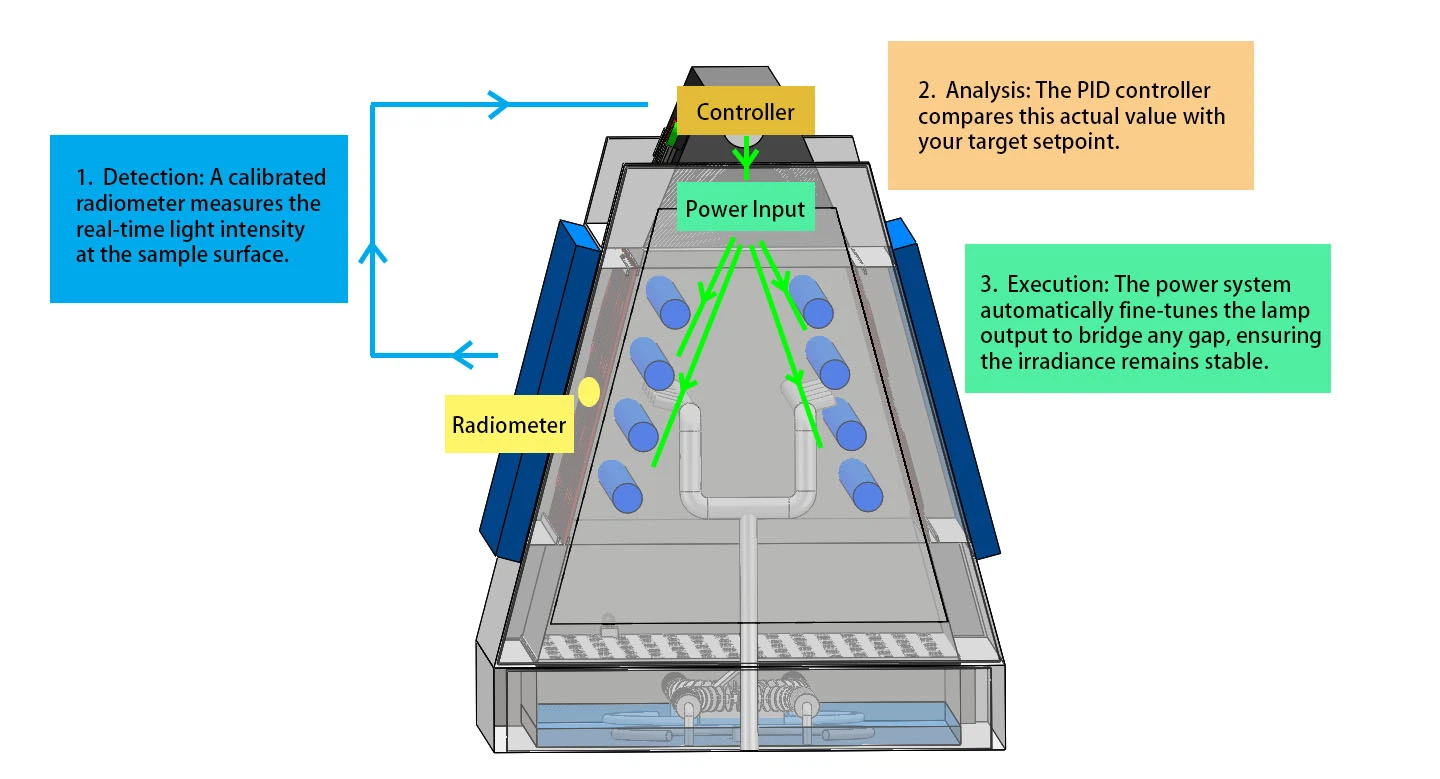
The first requirement is stable UV irradiance control.
ASTM G154 typically requires 0.89 W/m² at 340 nm.
LIB Advantage: Closed-loop irradiance control system maintains 0.15–5 W/m² range with real-time feedback, ensuring ±0.02 W/m² stability.
|
|
|
 |


The second requirement is controlled surface temperature (BPT).
Standard UV exposure temperature: 60 °C; condensation temperature: 50 °C.
LIB Advantage: Integrated Black Panel Temperature sensor accurately measures combined heat from UV and chamber air, ensuring ±2 °C precision.
The third requirement is cyclic UV and moisture exposure.
Common cycle: 8 h UV + 4 h condensation.
LIB Advantage: PID programmable touchscreen controller supports 120 programs × 100 steps, enabling complex standard-compliant cycles.
|
|
|
| Four current displays | Water spray system |


The fourth requirement is long-term exposure consistency.
Typical duration: 500–1000 hours.
LIB Advantage: QUV lamps (UVA-340, UVB-313, UVB-351) with 5000-hour lifespan maintain stable spectral distribution.
Through these steps, packaging films tested under ASTM D882 can compare tensile retention after 1000 h exposure, while adhesives tested under ASTM C1519 can measure bond strength reduction after UV cycling.
| Lamp Type | Wavelength Range | Best for Testing | Key Feature |
|---|---|---|---|
| UVA340 | 295–365 nm | Outdoor weathering | Closely simulates natural sunlight's UV portion |
| UVB313 | 280–315 nm | Accelerated aging | Faster degradation through stronger short-wave UV |
| UVB351 (optional) | 300–350 nm | Indoor materials | Simulates UV through window glass |
How to Choose Between UV Chamber and Xenon Chamber
UV chambers focus on polymer degradation.
They simulate short-wave UV (290–400 nm), which is responsible for most plastic embrittlement and tensile reduction. For ASTM G154, ISO 4892-3, ASTM D4329, and SAE J2020, UV chambers are efficient and cost-effective.
Xenon chambers simulate full-spectrum sunlight.
They include UV, visible, and infrared wavelengths and are often used for color-critical testing (ASTM G155, ISO 4892-2).
|
Sample holder |
Adjustable speed, 1r /min |
|
|
Chamber Type |
Rotating Holder |
|
|
Irradiation Source |
4500w water-cooled xenon arc lamp with inner quartz and outer borosilicate filter |
|
|
Irradiance Range |
35~150 W/㎡ |
|
|
Bandwidth Measurement |
280~800 nm |
|
|
Chamber Temperature Range |
Ambient~ 100 ℃ ±2 ℃ |
|
|
Black Panel Temperature |
BPT 35 ~ 85 ℃ ±2 ℃ |
|
|
Humidity Range |
50 % ~ 98 % RH |
|
|
Water Spray Cycle |
1~9999 H 59 M (Adjustable) |

For packaging materials, UV chambers are generally sufficient.
If testing tensile strength retention (ASTM D882), seal durability (ASTM C1442), or polymer cracking, fluorescent UV testing is appropriate. If evaluating label color fading per ASTM D4355 with strict ΔE requirements, xenon testing may be considered.
FAQs on the UV Chamber
Q1: Can UV testing replace outdoor testing?
It accelerates degradation but serves as a comparative laboratory method aligned with ASTM and ISO standards.
Q2: How long should packaging be tested?
Typical durations range from 500 h to 1000 h under ASTM G154; some automotive standards require up to 2000 h.
Q3: What measurable results can be obtained?
Tensile retention (%), elongation retention (%), gloss loss (%), color change (ΔE), adhesion strength (MPa).
Q4: What are LIB chamber technical parameters?
Temperature: Ambient to 90 °C ±2 °C
Humidity: ≥95 % RH ±2 %
Irradiance: 0.15–5 W/m²
Spray system: 10 nozzles, ~0.3 L/min
Q5: Can LIB provide customization?
Yes. Options include walk-in type, adjustable UV lamp quantity, removable spray system, and customized sample holders.
Any customization can be made. LIB offers a 3-year warranty and lifetime service. Any issues that cannot be resolved during the warranty period will be replaced free of charge. 24/7 English-speaking after-sales team. Fast shipping within 7-15 days.

Yes, a UV chamber can effectively test packaging materials under internationally recognized standards such as ASTM G151, ASTM G154, ISO 4892, SAE J2020, ASTM D882, and ASTM C1519. With precise numerical control and repeatable exposure cycles, LIB ensures accurate and accelerated weathering validation for packaging durability.
Contact LIB Industry to obtain your customized UV testing solution!


