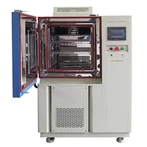
When PV modules are installed on rooftops, deserts, or coastal solar farms, they are exposed to ultraviolet radiation for more than 25 years. UV radiation can degrade encapsulants, backsheets, and adhesives, causing yellowing, cracking, delamination, and power loss. Accelerated UV testing allows manufacturers to identify these risks in weeks instead of decades.
LIB UV Chamber for PV Module is designed to perform controlled UV preconditioning according to international standards. With programmable irradiance, stable temperature control, and precise Black Panel Temperature (BPT) monitoring, it ensures that every module receives accurate and repeatable UV exposure before further environmental qualification tests.
UV Chamber for PV Module Preconditioning
UV preconditioning is required by IEC 61215 (MQT 10) before thermal cycling and humidity freeze tests. The standard specifies:
- UV dose (280–320 nm): 7.5 kWh/m²
- UV dose (320–400 nm): 15 kWh/m²
Controlled surface temperature (typically 35–80°C BPT)
The purpose of UV pretreatment is simple:
Before exposing modules to −40°C to +85°C thermal cycling or high-humidity conditions, manufacturers must first determine whether UV radiation weakens materials such as EVA, backsheets, or adhesives.
Without UV preconditioning:
Adhesion failure may go undetected
Encapsulant yellowing may not be revealed
Long-term outdoor durability cannot be accurately predicted
LIB UV chamber uses 20 UVA lamps and 10 UVB lamps, providing up to 250 W/m² UV irradiance, ensuring compliance with IEC spectral distribution requirements.

Advantages of LIB UV Chamber for PV Module
LIB UV preconditioning chamber is engineered with measurable precision and operational stability.
|
|
Name |
UV Preconditioning Chamber |
|
Model |
UVP-02 |
|
|
Internal Dimension (mm) |
1450*745*2500 D*W*H |
|
|
Overall Dimension (mm) |
1875*1210*2800 D*W*H |
|
|
Specimen Holder Size(mm) |
1400*2400 W*H |
|
|
Specimen Capacity |
2 Pieces |
|
|
Irradiation Source |
Fluorescent UVA lamps (20 pieces) and UVB lamps (10 pieces) |
|
|
Temperature Range |
Ambient ~ 90 ℃ ±2℃ |
|
|
Black Panel Temperature (BPT) |
35 ~ 80 ℃ |
|
|
Bandwidth |
UVC: (< 0.1%) UVB: (3% to 10% of total UV) UVA: (90% to 97% of total UV) |
|
|
Irradiance Control |
●The wavelength of 280 nm - 320 nm:7.5 k Wh/m2 ●The wavelength of 320 nm - 400 nm:15 k Wh/m2 ●Maximum Irradiance in the UV range: < 250 W/m2 |
|
|
Controller |
Programmable color LCD touch screen controller |
|
|
Exterior Material |
Steel Plate with protective coating |
|
|
Interior Material |
SUS304 stainless steel |
|
|
Thermal Insulation |
Polyurethane foam and insulation cotton |
|
|
Power Supply |
AC380V 50Hz 3Phase |

1. Accurate Irradiance Control
UVA proportion: 90–97%
UVB proportion: 3–10%
UVC: <0.1%
Programmable irradiance accumulation control
This ensures reliable simulation of solar UV spectrum without unrealistic overexposure.
2. Stable Temperature Control
Temperature range: Ambient to 90°C ±2°C
Black Panel Temperature (BPT): 35°C–80°C
PT100 Class A sensors for accurate monitoring
3. High Capacity & Adjustable Sample Holder
Specimen capacity: 2 PV panels
Adjustable holder for 1400 × 2400 mm panels
Flexible lamp distance adjustment
4. Smart Control System
7-inch programmable touchscreen
Up to 120 programs
Ethernet + USB + RS232 connectivity
Real-time data export in CSV format
The chamber interior uses SUS304 stainless steel, ensuring corrosion resistance and long service life.
LIB Integrated Testing Solution for PV Modules
UV preconditioning is only the first step in a complete PV qualification program.
Step 1: UV Preconditioning (IEC 61215 MQT 10)
Expose modules to required UV dose at controlled BPT.
Step 2: Temperature and Humidity Testing
After UV exposure, modules undergo:
Damp Heat Test (IEC 61215)
85°C / 85% RH for 1000 hours
Thermal Cycling Test (IEC 61215)
−40°C to +85°C for 200 cycles
Humidity Freeze Test
Alternating high humidity and sub-zero temperatures
LIB temperature and humidity chambers provide:
Humidity range: 20–98% RH
Temperature range: −60°C to +100°C
Deviation: ±2°C
Humidity accuracy: ±2.5% RH
 |
|
||
|
Internal Dimension (mm) |
1300*700*1350 |
||
|
Overall Dimension (mm) |
1900*1100*1750 |
||
|
Parameter |
Temperature Range |
-60℃ ~ +100 ℃ |
|
|
Temperature Fluctuation |
± 0.5 ℃ |
||
|
Temperature Deviation |
± 2.0 ℃ |
||
|
Humidity Range |
20% ~ 98% RH |
||
|
Humidity Deviation |
± 2.5% RH |
||
|
Temperature Change Rate |
1 ~ 3.4℃ / Min |
||
|
Panel Size |
1M*2M |
||
|
Panel Capacity |
4 / 6 / 8 / 10 / 12 Pieces |
||
|
Structure |
Cooling |
Cooling system |
|
|
Refrigerating unit |
|||
|
Heating Element |
Nichrome heater |
||
|
Controller |
Programmable color LCD touch screen controller |
||
|
Ethernet connection, PC Link, USB |
|||
|
Humidity |
Water supply system |
||
|
Water supply system |
|||
|
Humidifier |
|||
|
Dehumidification |
|||
|
Sensor |
Temperature Sensor |
||
|
Humidity Sensor |
|||
|
Build-in Water Tank (mm) |
270*300*450 |
||
|
View Window Size (mm) |
330*370 |
||
|
Material |
Exterior Material |
Steel Plate with protective coating |
|
|
Interior Material |
SUS304 stainless steel |
||
|
Thermal Insulation |
Polyurethane foam and insulation cotton |
||
|
Observation Window |
Interior lighting, double-layer therm stability silicone rubber sealing |
||

Step 3: Salt Spray Corrosion Test
For coastal installations, testing follows IEC 61701.
5% NaCl solution
Cyclic salt mist exposure
Corrosion resistance evaluation for frames and junction boxes
By combining UV → Damp Heat → Thermal Cycling → Salt Spray, LIB provides a complete environmental reliability solution for PV manufacturers.
FAQs on the UV Chamber for PV Module
Q1: Why is UV preconditioning required before thermal cycling?
Because UV exposure weakens polymers and adhesives. If thermal cycling is performed without UV pretreatment, hidden degradation mechanisms may not appear.
Q2: What wavelength range does the UV chamber cover?
The chamber covers 280–400 nm, including UVA and UVB bands required by IEC 61215.
Q3: How is temperature monitored?
Using Black Panel Temperature (BPT) sensors with ±2°C control accuracy to ensure realistic surface temperature simulation.
Q4: Can the chamber simulate long-term outdoor exposure?
Yes. By controlling cumulative UV dose in kWh/m², the chamber accelerates years of outdoor UV exposure into controlled laboratory conditions.
Q5: Is the chamber suitable for certification labs?
Yes. The system supports data logging, Ethernet connection, USB export, and programmable IEC-compliant test sequences.
Routine maintenance such as lamp replacement and sensor verification is simple and minimizes downtime. Time to Strengthen Your PV Reliability Testing? LIB UV Chamber for PV Module ensures accurate IEC 61215 UV preconditioning and supports full environmental qualification workflows.
Contact LIB Industry to enhance your PV module durability testing and ensure your products withstand decades of outdoor exposure.