
Assessing the long-term performance of paints, coatings, and polymer materials requires accelerated weathering tests that faithfully replicate real-world outdoor conditions. Factors like sunlight, temperature swings, humidity, and condensation collectively drive material deterioration, and even minor deviations in test settings can compromise results. For this reason, laboratories around the world turn to xenon arc weathering systems, which provide accurate, repeatable, and standard-compliant simulation of natural environmental exposure.
LIB's Xenon Arc Lamp Chamber is widely praised by customers globally for its dependable operation, consistent performance, and user-friendly maintenance. A long-term client in Vietnam recently confirmed that their chamber has been running reliably for years, aided by LIB's clear preventive maintenance instructions and responsive technical support. Remarks such as "the chamber runs smoothly" highlight the trust that laboratories place in LIB equipment for high-precision, continuous weathering tests under real laboratory conditions.
Designed to meet the rigorous demands of modern testing, LIB's Xenon Arc Lamp Chamber combines full-spectrum sunlight simulation with precise control over temperature, humidity, and water spray cycles. Its rotating sample holder ensures every panel or specimen receives uniform exposure, while advanced PID controllers continuously monitor and log irradiance, black panel temperature, and chamber air temperature. This level of precision allows researchers and quality control teams to obtain reproducible, comparable results, whether testing new paint formulations, automotive coatings, or polymer materials for outdoor durability.
Applications of Xenon Testers
Xenon testers are primarily used to simulate sunlight exposure and environmental weathering for materials that need to withstand outdoor conditions. The main application is testing paints and coatings for color stability, cracking, gloss retention, and adhesion loss. Beyond paints, Xenon testers are also applied in:
1. Plastics and polymers: evaluating photo-oxidation, UV resistance, and surface degradation.
2. Textiles: assessing fading, fiber strength loss, and dye stability.
3. Automotive components: testing exterior panels, dashboards, and trim under UV, heat, and moisture exposure.
4. Solar modules and PV panels: ensuring long-term durability under sunlight and moisture cycles.
5. Indoor materials: simulating light exposure through window glass to test fading and material stability.
In all these applications, the Xenon lamp's full-spectrum light (280–800 nm) reproduces natural sunlight, while adjustable temperature, humidity, and water spray cycles mimic real-world weather patterns.
Method of ASTM G155
ASTM G155 defines standardized accelerated weathering using Xenon arc lamps. This method replicates outdoor sunlight exposure with alternating cycles of light, water spray, and darkness. Key parameters include black panel temperature (BPT), chamber air temperature (CAT), irradiance, and cycle timing. Typical exposure cycles include:
| Cycle | Description | BPT | Irradiance | Water Spray | Application |
|---|---|---|---|---|---|
| 1 | Continuous light with periodic water spray | 63 °C | 340 nm | 18 min spray after 102 min light | General outdoor reference |
| 2 | Extended light + dark with high humidity | Maintained during light | Controlled | None during dark | ASTM D6695/D2565 alignment |
| 3 | Light with high humidity in dark periods | Maintained | Controlled | None | Exterior textiles |
| 4 | Continuous light without moisture | Maintained | Controlled | None | Indoor plastics |
| 5-6 | Window glass filter, indoor textiles | Maintained | 420 nm | Limited | Indoor textile fading |
| 7 | Automotive exterior exposure | Elevated | Daylight filter | Light/water/dark | SAE J2527 alignment |
| 8 | Automotive interior exposure | Controlled | Daylight filter | Light/water cycles | SAE J2412 alignment |
All cycles are repeated until the required number of exposures or total test duration is reached, ensuring reproducible, comparable results.
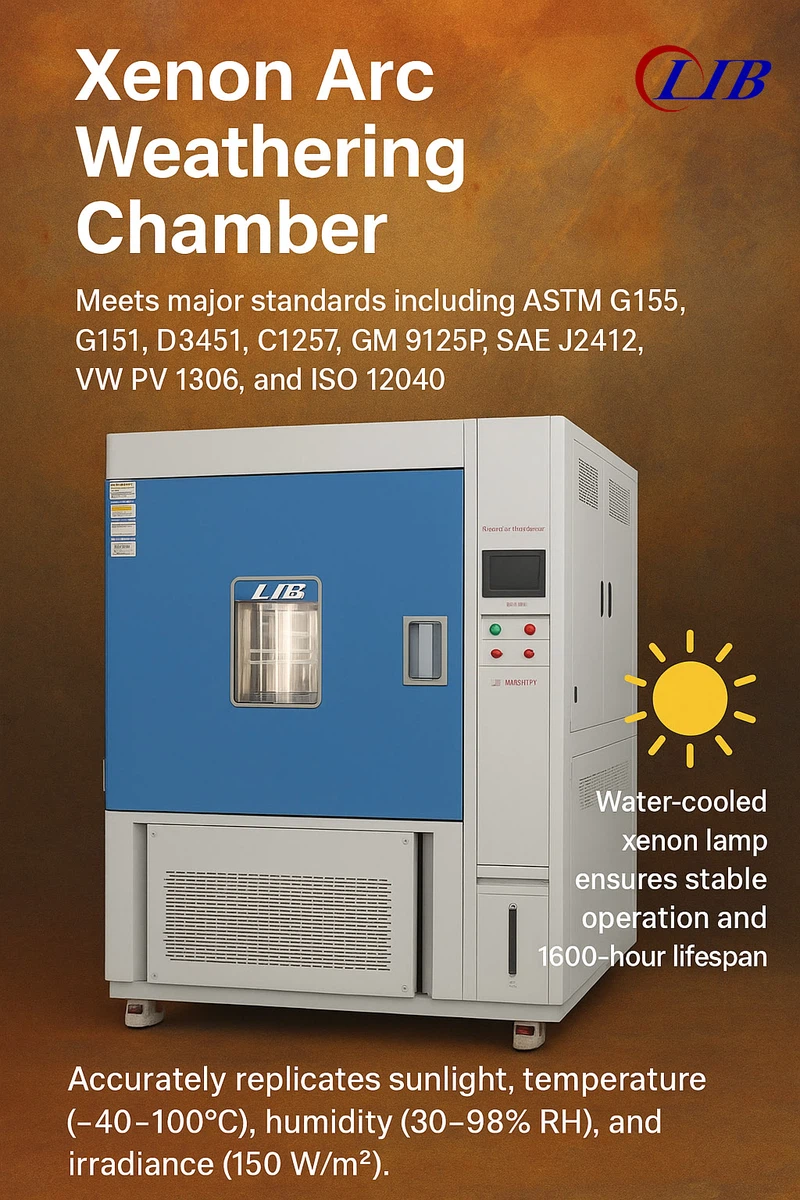
Accelerated Weathering Chambers for Coatings Test
Testing Paints with LIB Xenon Tester: A Step-by-Step Workflow
A practical workflow for testing paints according to ASTM G155 demonstrates how LIB Xenon Arc Lamp Chambers provide precise and reliable results:
|
Model |
XL-S-750 |
|
|
Internal Dimension (mm) |
950*950*850 mm |
|
|
Overall Dimension (mm) |
1300*1420*1800 mm |
|
|
Sample holder |
Adjustable speed, 1r /min |
|
|
Chamber Type |
Rotating Holder |
|
|
Irradiation Source |
1 piece of 4500w water-cooled xenon arc lamp with inner quartz and outer borosilicate filter |
|
|
Irradiance Range |
150 W/㎡ |
|
|
Bandwidth Measurement |
300~400 nm |
|
|
Chamber Temperature Range |
-40~ 100 ℃ ±2 ℃ |
|
|
Black Panel Temperature |
BPT 35 ~ 85 ℃ ±2 ℃ |
|
|
Humidity Range |
30 % ~ 98 % RH |
|
|
Water Spray Cycle |
1~9999 H 59 M (Adjustable) |
|
|
Controller |
Programmable color LCD touch screen controller |
|
|
Radiometer |
UV Radiometer, Tolerance: ±5 % |


Step 1: Prepare the Samples
Place painted or coated panels on the rotating rack, labeled according to orientation.
LIB advantage: Rotating rack ensures uniform exposure for up to 42 samples simultaneously.
Step 2: Preheat the Chamber
Set BPT to 63 °C according to sample color (e.g., 35 °C for dark panels, 50 °C for light).
Fill and check water spray system for operation.
LIB advantage: PID touchscreen allows precise temperature control ±2 °C and adjustable humidity 30–98 % RH.
Step 3: Run ASTM G155 Cycles
Example: Cycle 1-102 minutes of continuous light followed by 18 minutes of water spray.
Repeat for the required number of cycles.
LIB advantage: 120 pre-set programs with 100 segments each enable simulation of complex light/water/dark sequences. Uniform airflow and lamp rotation reduce variability between samples.
|
|
|


xenon lamp and filters
|
|
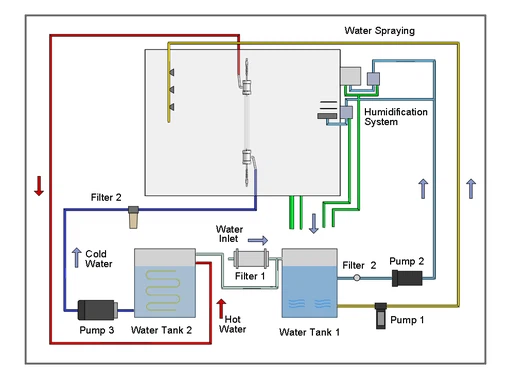 |
| Spraying system provides uniform water over specimens. Automatic water supply, filtration, and drainage ensure uninterrupted long-term testing. | |

Step 4: Monitor and Record Data
Continuously check irradiance, BPT, and CAT.
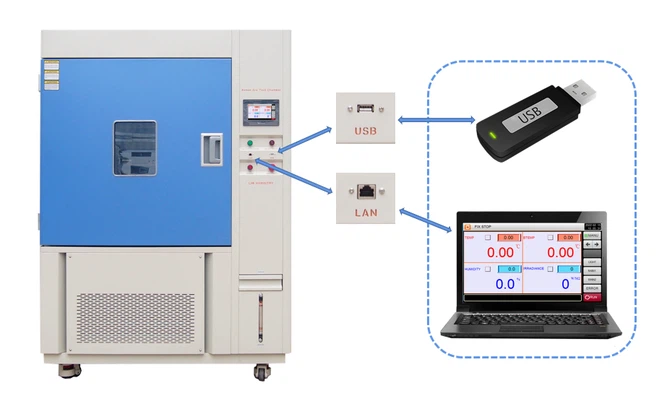
LIB advantage: Automatic Ethernet-based logging exports data in ISO/ASTM-compliant formats for traceability and historical comparison.
Step 5: Evaluate Coating Degradation
Inspect panels for color change, cracking, adhesion loss, gloss reduction, or ΔE changes.
LIB advantage: Stable light output with ±5 % radiometer tolerance ensures accuracy, while adjustable water spray cycles (1–9999 h 59 min) maintain reproducibility.
FAQs on LIB Xenon Tester
Q1: What is the lifespan of the Xenon lamp tube?
A: Standard lifespan is 1,600 hours. Beyond this, light intensity gradually decreases, affecting accuracy. Prompt replacement ensures reliable results.
Q2: Maximum sample thickness for the rotating rack?
A: Standard racks support up to 3 cm. Customized racks can accommodate up to 11 cm for specialized testing.
Q3: Will empty spaces affect humidity?
A: No. The chamber's uniform light distribution and air circulation maintain consistent humidity even when not fully loaded.
Q4: Diameter of the rotating Xenon rack?
A: 650 mm according to ASTM G155; sample-to-lamp distance 320–420 mm ensures uniform irradiation.
Q5: Can the lamp spray water from both front and rear?
A: Yes, optional rear spray enhances damp-heat cycling. Additional cost: $1,230.
Q6: What is the principle of Xenon lamps?
A: Xenon lamps are gas discharge lamps, generating light by passing voltage through high-pressure xenon gas, forming a plasma that emits full-spectrum light. Quartz tubes house the discharge, while external borosilicate filters regulate the light spectrum to 280–800 nm.
LIB Xenon Arc Lamp Chambers provide a complete solution for paint and coating testing. With precise sunlight simulation, adjustable temperature and humidity, water-efficient cycles, and automated data logging, these chambers deliver repeatable and comparable results in line with ASTM G155, ASTM D6695, ISO 11341, and SAE standards. Beyond paints, they are suitable for plastics, textiles, automotive components, and solar modules.
Contact LIB Industrytoday to design a customized test plan, implement ASTM G155 cycles, and accelerate coating development with precise, reliable, and internationally recognized weathering results.


