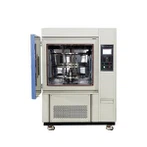
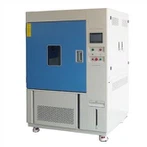
Modern laboratories demand accuracy, efficiency, and space optimization. As product reliability standards become increasingly stringent, engineers require environmental simulation systems that deliver laboratory-grade precision without occupying valuable floor space. LIB Benchtop Environment Test Chambers were developed precisely for this purpose - providing stable temperature and humidity control in a compact, energy-efficient footprint while fully complying with international testing standards such as IEC and UL.
Customer confidence is equally important as technical performance. As Srichon Nithichareon, Battery Shop Executive, shared after using the LIB climate chamber:"Now I am confident and understand how to use the climate chamber, especially the FIX mode, which is quite easy to use." This feedback reflects what matters most in real laboratory environments - not only precision and compliance, but also intuitive operation, stable control, and user-friendly programming that allows engineers to focus on testing rather than equipment complexity.

Benchtop Environment Test Chamber Development
Benchtop Environment Test Chambers were developed to solve one clear problem: laboratories needed professional environmental simulation without large walk-in chambers. Traditional chambers occupy 2–20 m² of floor space, while benchtop models fit within 0.8–1.0 m² and operate at ≤ 65 dBA.
Their purpose is simple:
They simulate extreme temperature and humidity conditions to evaluate reliability, durability, and safety performance of materials and devices.
Modern benchtop chambers must comply with major international standards, including:
1. IEC 60068-2-1 (Cold test)
2. IEC 60068-2-2 (Dry heat test)
3. IEC 60068-2-30 (Damp heat cyclic)
4. UL 2580 / UL 2271 / UL 1642 / UL 1973 / UL 2054 (Battery safety testing)
5. IEC 62660-2 / IEC 62133 / IEC 61960 (Lithium-ion cell performance)
6. SAE J2929 / SAE J2464 (Automotive battery abuse testing)
7. IEC 61215 (Photovoltaic module qualification)
8. SAE J2334 / VW 80000 (Automotive environmental durability)
To meet these standards, chambers must provide:
a Benchtop Environment Test Chamber must deliver precise and stable environmental control across a wide operating range. It should provide stable low temperatures down to –40 °C or lower to support cold resistance and reliability testing, as well as high temperatures up to +125 °C or even +150 °C for heat endurance evaluation. In addition, the chamber must maintain controlled humidity levels reaching 95 % RH or above to simulate damp heat and high-moisture environments. For accurate and repeatable results, temperature fluctuation should be maintained within ±0.5 °C, while overall temperature uniformity inside the chamber should remain within ±2 °C to ensure consistent exposure conditions across all test samples.
LIB's benchtop model exceeds these minimum requirements.
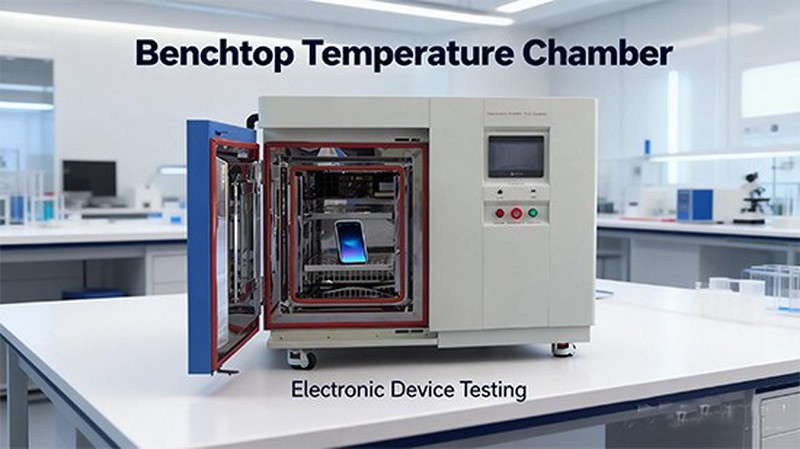
Temperature Humidity Chambers for Environment Test
Benchtop Environment Test Chamber Method of IEC 60068-2-30
One of the most commonly applied standards is IEC 60068-2-30 (Damp Heat, Cyclic Test).
This standard evaluates how products perform under repeated high-humidity and temperature cycles.
Key Requirements of IEC 60068-2-30:
| Parameter | Requirement |
|---|---|
| High Temperature | +40 °C or +55 °C |
| Humidity | 93 % ±3 % RH |
| Cycle Duration | 24 h per cycle |
| Number of Cycles | 2 to 6 cycles |
| Temperature Stability | ±2 °C |
| Humidity Stability | ±5 % RH |
How LIB Meets This Standard
|
|
|
|||||
| Model | TH-50 | TH-80 | ||||
| Internal dimension (mm) |
320x350x450 |
400x400x500 | ||||
| Overall dimension (mm) | 800x1050x950 | 900×1100×1000 | ||||
| Temperature range | -86 ℃ ~+150 ℃ | |||||
| Temperature fluctuations | ± 0.5 ℃ | |||||
| Humidity Range | 10%/20%~95 % | |||||
| Temperature deviation | ± 2.0 ℃ | |||||
| Temperature Sensor | PTR Platinum Resistance PT100Ω/MV A-class | |||||
| Temperature Resolution | ± 0.001 ℃ | |||||
| Exterior Material | Steel Plate with A protective coating | |||||
| Interior Material | SUS 304 stainless steel | |||||


|
|
|
|
|
|
| Robust Workroom | Cable Hole | Temperature and Humidity Sensor | PID controller |


Real Automotive Testing Case - IEC 60068-2-30
Automotive Component Testing Under IEC 60068-2-30
A real example comes from automotive component testing conducted according to IEC 60068-2-30 (Damp Heat, Cyclic Test). This standard evaluates a product's resistance to high humidity combined with temperature cycling. Unlike light exposure testing, IEC 60068-2-30 focuses specifically on moisture penetration, condensation effects, insulation degradation, corrosion, and material swelling under cyclic damp heat conditions.
Typical IEC 60068-2-30 Test Cycle
Under IEC 60068-2-30, the test chamber must maintain controlled cyclic temperature and humidity conditions. A typical cycle includes temperature rising to +40 °C or +55 °C with relative humidity maintained at 93 % ±3 % RH. Each cycle lasts 24 hours and may be repeated for 2 to 6 cycles depending on product requirements. Temperature stability must remain within ±2 °C, and humidity deviation must stay within ±5 % RH to meet compliance standards.
Pre-Conditioning Before Damp Heat Testing
Before starting the cyclic damp heat test, samples often require environmental stabilization. This may include low-temperature storage at –40 °C for 4 hours, heat exposure at +85 °C for 4 hours, and humidity conditioning at 95 % RH. These steps ensure materials reach a controlled baseline state before formal testing begins.
Step 1 – Cold Soak (–40 °C or Lower)
The LIB Benchtop Environment Test Chamber uses a French TECUMSEH compressor to achieve stable low temperatures down to –70 °C or even –86 °C. It provides a cooling rate of 1 °C per minute without thermal overshoot, ensuring controlled and uniform cold conditioning.
Step 2 – Heat Soak (+85 °C to +125 °C)
During the heat stabilization phase, a nickel-chromium heater supports ramp rates up to 3 °C per minute. Temperature fluctuation remains within ±0.5 °C, guaranteeing precise and repeatable heating performance.
Step 3 – High Humidity Conditioning (95 % RH)
For humidity conditioning, the chamber adopts a closed-loop humidification system with automatic water refill and condensate recycling. Humidity deviation is controlled within ±2.5 % RH, meeting the strict moisture stability requirements of IEC 60068-2-30.
Final Result
With accurate cyclic temperature and humidity control in a compact footprint, automotive manufacturers can complete IEC 60068-2-30 damp heat testing and pre-conditioning efficiently-without relying on large walk-in environmental chambers.
|
|
|
|
|
|---|---|---|---|
 |
 |
 |
|
| Name | Small Climatic Test Chamber | Standing Climatic Test Chamber | Walk-In Climatic Test |
| Capacity |
TH-50: 800x1050x950 mm TH-80: 900×1100×1000mm |
Capacity: 100L; 225L; 500L; 800L; 1000L |
>20m³ |
| Throughput | Ideal for small components, sensors, boards | Subassemblies or mid-volume batches |
Bulk testing of items or vehicles as a whole |
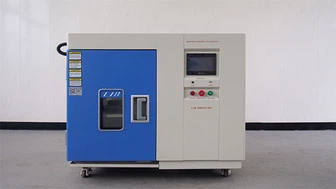


There are different sizes of LIB temperature and humidity test chambers available for you to choose from.
FAQs on the Benchtop Environment Test Chamber
Q1: What is the full temperature range of the Benchtop Environment Test Chamber?
The LIB benchtop model offers –86 °C to +150 °C.
Q2: Is this range suitable for battery safety testing?
Yes. It meets requirements of UL 2580, IEC 62660-2, SAE J2929, and IEC 62133.
Q3: Can it maintain stable humidity at high temperatures?
Yes. It supports 20 %–98 % RH with ±2.5 % RH accuracy.
Q4: Is the chamber accurate enough for certification testing?
Yes. With ±0.5 °C fluctuation and ±2 °C deviation, it satisfies IEC and ASTM requirements.
Q5: Can it replace a walk-in chamber?
For R&D, component-level testing, and certification pre-testing, absolutely-while saving space, energy, and cost.
Contact LIB Industry to receive professional technical consultation and customized solutions for your Benchtop Environment Test Chamber.