
A walk-in climatic chamber is a device that can simulate different environmental conditions such as temperature, humidity, salt spray and lighting. It is used to test the performance and stability of various products under different weather conditions, such as electronic devices, automotive parts, and pharmaceuticals. The main applications of walk-in climatic chambers are in the fields of product development, quality control, and research. It is utilized by manufacturers, researchers, and testing laboratories to ensure that products can withstand different environmental conditions and meet regulatory and safety standards.
Advantages of walk-in climatic chamber
-
Larger Test Samples: The chamber allows large and bulky items to be tested, which cannot be accommodated in smaller chambers.
-
Advanced Testing Capability: Walk-in chambers have advanced testing capabilities like vibration testing, altitude simulation, and solar radiation simulation.
-
Efficient Access: It is easier to access the test samples in a walk-in chamber, making it easier to monitor the test process and make necessary adjustments.
-
Improved Temperature and Humidity Control: Large chambers have a more precise and uniform temperature and humidity control, which ensures the accuracy and reliability of the test results.
-
Safe and Comfortable Environment: The enclosed space of the chamber prevents external interference and provides a comfortable and safe testing environment.
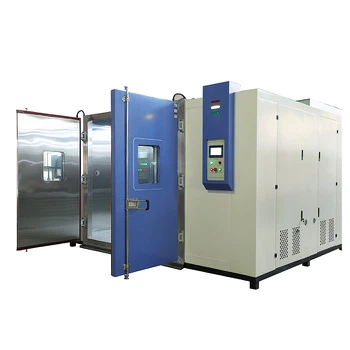
Different models of walk-in climatic chamber
The most common types of walk-in climatic chambers include temperature and humidity chambers, Noxious gas corrosion chambers, and Xenon chambers.
The main testing objects for a large walk-in environmental chamber are typically products or materials that need to be tested for their ability to withstand certain temperatures and humidity levels. Some common testing objects include electronic components, automotive parts, medical devices, and pharmaceuticals.
To test these objects, the chamber must be set to the desired temperature and humidity levels, which can range from extreme cold to extreme heat and from low humidity to high humidity. The objects are then placed inside the chamber and monitored for their performance and durability under these conditions. Data loggers may be used to record temperature and humidity readings, and certain sensors may be placed on the objects to monitor any changes in their properties or behavior. This information is then used to evaluate the performance and quality of the objects being tested.
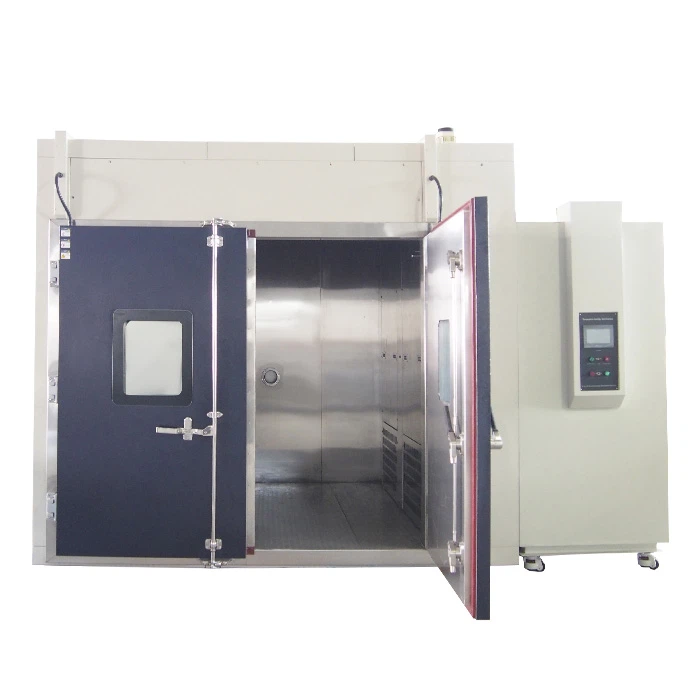
Walk-in climatic chamber adopts unique balanced temperature regulation mode, with stable and balanced heating capacity, high precision and stable temperature control can be carried out. Temperature display with touch screen, intuitive, easy to read, accurate and convenient. Heating, cooling and complete system independence can improve efficiency, reduce testing costs, increase life and reduce failure rate. The water tank is placed in the lower right part of the control box, and has automatic water shortage protection, more convenient for the operator to replenish water. The humidifier system pipes are separated from the control circuit board to avoid faults caused by water leakage in the humidifier pipes and improve safety.
Walk-in temperature and humidity test chamber is a kind of equipment used to simulate different environmental conditions for reliability testing of products. For large automotive parts, the test standards based on reliability testing usually include international standard ISO, American SAE standard and German VDA standard, etc.
Specifically, for the reliability testing of automotive parts, the corresponding test standards need to be selected according to the different uses and materials of the parts, such as
1. interior parts and exterior parts: UV radiation test can be conducted according to ISO 4892-2 standard to simulate sunlight exposure; salt spray test can also be conducted according to SAE J2527 standard to test the corrosion resistance of the parts under severe weather conditions.
2. Engine components and suspension system: Damp heat cycle test can be conducted according to SAE J2334 standard to simulate high temperature and high humidity usage conditions to test the durability and performance stability of the components.
3. Electronic components: Heat stress test can be conducted according to VDA 621-415 standard to simulate the use of components in high temperature environment and test their heat resistance.
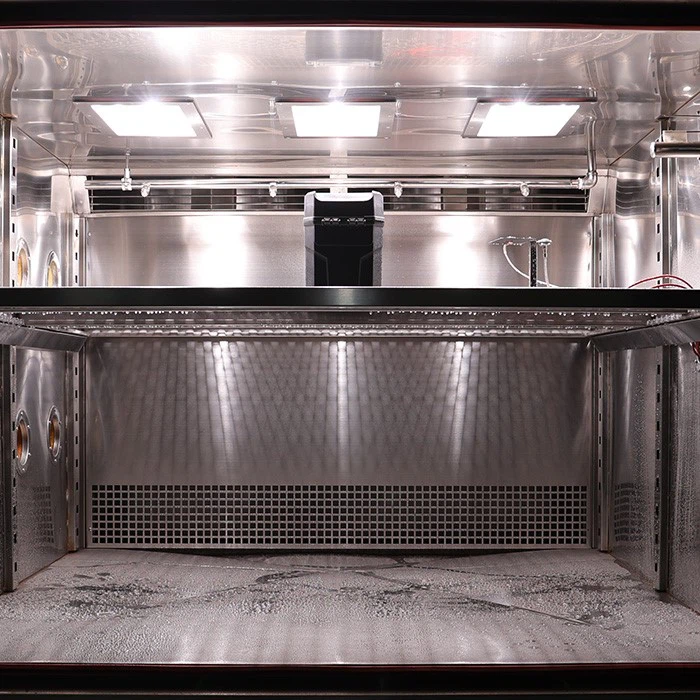
Walk-in xenon lamp test chambers are commonly used for xenon lamp aging tests of materials, including rubber materials for reliability testing. The test standards may be ISO 11440:1998 and ASTM G155-05, in which the conditions and requirements required for xenon lamp aging tests are specified. In the rubber reliability test, the main test material tensile strength, elongation, hardness, deformation, physical and chemical properties and other indicators, in order to assess whether its durability and performance meet the requirements. By testing these indexes, the reliability and durability of rubber materials can be evaluated, and corresponding data and reports can be provided to help manufacturers design and manufacture products.
The walk-in climatic chamber (xenon lamp test chamber) can be used to test the weatherability and color fastness of paint coatings. The test is based on the following main criteria:
1. ISO 11341:2010 Paints and varnishes - Artificial weathering and exposure to artificial radiation - Exposure to filtered xenon-arc radiation.
2. ASTM G155-05 Standard practice for operating xenon arc light apparatus for exposure of nonmetallic materials.
3. GB/T1865-1997 coatings -- weather resistance test -- Xenon lamp test.
These standards specify requirements for the preparation of test samples, test conditions, test cycles and evaluation methods to ensure the reliability and accuracy of test results. During testing, the walk-in xenon chamber is required to simulate different climatic conditions and UV radiation intensity, expose and observe samples for a long period of time, and then assess the degree and extent of changes. These changes include color change, shining, degradation, cracking, peeling, etc., to judge whether the weatherability and color fastness of the paint coating meet the requirements.


