When products are exposed to outdoor or industrial environments, they must resist both water and dust intrusion. Engineers, product designers, and quality managers rely on IP66 test equipment to simulate real-world environmental stresses-ensuring that enclosures and components remain sealed, safe, and fully functional under extreme conditions.
LIB Environmental's IP66 Test Equipment combines precision engineering with compliance to international testing standards, delivering consistent and repeatable results across industries including electronics, automotive, lighting, and telecommunications. Built with durable stainless steel and intelligent automation, LIB's systems make waterproof and dustproof testing accurate, efficient, and dependable.
What is IP66 Test Equipment
IP66 test equipment is specialized laboratory machinery used to verify the Ingress Protection (IP) level of a product's enclosure. The two digits-"6" for dust and "6" for water-define how well the device is sealed against external elements:
First digit 6: Dust-tight protection; no ingress of dust.
Second digit 6: Protection against powerful water jets (100 kPa pressure, 100 L/min flow) from any direction.
To meet IEC 60529 and ISO 20653 standards, IP66 chambers simulate both IP6X (dustproof) and IPX6 (waterproof) conditions, using fine talcum dust and high-pressure water sprays. Products tested under these conditions include outdoor electrical cabinets, sensors, control panels, vehicle lighting, and marine instruments.
This type of equipment is commonly used for testing outdoor electrical cabinets, automotive components, sensors, control panels, lighting systems, and marine instruments, ensuring that products remain safe and functional even in harsh environmental conditions.
What Tests IP66 Test Equipment Is Used For
IP66 equipment performs two major protection tests:
IP6X Dustproof Test: According to IEC 60529, ISO 20653, and IEC 60068-2-68, the dust chamber generates airflow carrying 2–4 kg/m³ of fine particles with a nominal diameter of 50 μm. The vacuum system (0–2 kPa adjustable) draws air through the specimen, verifying that no dust enters the enclosure.
IPX6 Waterproof Test: The water spray system ejects jets at 75 L/min ± 5 % with 1000 kPa pressure, at a distance of 2.5 m – 3 m, to simulate rainstorms and cleaning processes.
These tests replicate harsh field conditions faced by automotive components (ISO 20653), military electronics (MIL-STD-810), and consumer devices (ASTM D-standards). By passing both tests, a product earns the IP66 rating-meaning it is completely dustproof and can endure high-pressure water jets without performance loss.
|
IP66 Test Equipment for Dustproof and Waterproof Performance Testing |
||
|
|
Efficient IP6X Dust Ingress Test Chamber Comprehensive IP6X IP5X Ingress Test Chamber Durable IPX5 IPX6 Water Jetting Test Chamber |
|

Advantages of LIB IP66 Test Equipment
 |
 |
||
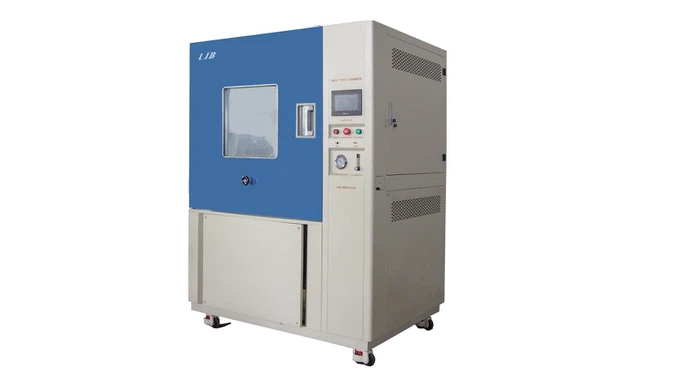
| NAME: IP6X Sand and Dust Testing Chamber | |||
|
Model |
DI-800 |
DI-1000 |
|
|
Internal Dimension (mm) |
800*1000*1000 |
1000*1000*1000 |
|
|
Overall Dimension (mm) |
1040*1450*1960 |
1200*1450*1960 |
|
|
Interior Volume (L) |
800 |
1000 |
|
|
Humidity Range |
< 30% RH |
||
|
Normal Wire Diameter |
50um |
||
|
Nominal Width of a Gap Between wires |
75um |
||
|
Specimen Power Outlet |
Dust-proof socket 16A |
||
|
Vacuum System |
Equipped with a pressure gauge, air filter, pressure regulator, connecting tube |
||
|
Controller |
Programmable color LCD touch screen controller,Ethernet connection, PC Link |
||
|
Door Lock |
Electromagnetic lock |
||
|
Maximum Noise |
65 dBA |
||
Accurate Testing Performance – Complies fully with IEC 60529, ISO 20653, IEC 60068-2-68, and ASTM/MIL standards to ensure precision and repeatability.
High-Quality Stainless Steel Construction – SUS 304 inner chamber and powder-coated A3 steel exterior resist rust and deformation in humid or high-temperature environments.
Automatic Control System – A PID-controlled touchscreen manages water pressure, spray angle, duration, and dust airflow automatically. Up to
120 programs with 100 steps each can be stored for multi-stage tests.
Customizable Design – Turntable diameters (200–600 mm), heights (200–400 mm adjustable), and load capacities (20–50 kg) can be configured to match your product's geometry.
Safety and Easy Maintenance – Features over-current, leakage, and over-temperature protection, an electromagnetic lock for operator safety, and a window with built-in wiper and lighting for clear observation.
These advantages make LIB's equipment ideal for both R&D laboratories and production-line quality inspections, offering consistent, traceable, and globally accepted test data.
  |
 |
|
| NAME: IPX6 Water Spray Test Chamber | ||
|
Internal Dimensions (mm) |
1000*1200*1000 D*W*H |
|
|
Overall Dimensions (mm) |
1150*3550*2100 D*W*H |
|
|
Interior Volume (L) |
1200 |
|
|
Testing Platform Diameters |
600 mm |
|
|
Testing Platform Speed |
5±1 r.p.m |
|
|
Turntable loads |
50kgs |
|
|
Testing Platform Height |
200-400 mm (adjustable) |
|
|
IPX6K
|
Internal Diameter of Nozzle |
6.3 mm |
|
Water Flow Rate |
75 L/min +/- 5% |
|
|
Water pressure |
1000 Kpa |
|
|
Distance from Water Spraying to Specimens |
between 2.5 m and 3 m. |
|
|
Water supply system |
Storage water tank; Booster pump; Automatic water supply; Water purification system; |
|
FAQs about IP66 Test Equipment
Q1: For IPX5/IPX6 testing, the spray pipes are located at the rear. Does this cause water to hit the door and observation window, making it difficult to see? Will it damage the door or window?
Thank you for your question. In IPX5/IPX6 testing, the spray pipes are indeed positioned at the rear of the chamber. During testing, a small amount of water may reach the door or viewing window. However, the window is made of tempered glass, which is highly durable and resistant to impact, ensuring no damage. Light water mist does not affect the overall test results, and operators can still clearly observe the testing process through the viewing window.
Q2: Since water pressure is high in IPX5/IPX6 testing, are fixtures provided to secure specimens?
Thank you for your question. According to IEC 60529, the water pressure in IPX5/IPX6 tests is relatively high (approximately 30 kPa for IPX5 and 100 kPa for IPX6). To prevent smaller test items from shifting during high-pressure spraying, the turntable is equipped with straps or other fixing tools that securely hold the specimen in place, ensuring test safety and reliability.
Q3: Can holes be made in the Rain Test Chamber? What if customers want to make one themselves?
Thank you for your question. It is generally not recommended to drill holes in the rain test chamber, as the interior includes turntables and oscillating spray pipes. Any unplanned openings could cause entanglement or safety hazards. Each chamber is already equipped with built-in power outlets for specimen connection. If you require an additional hole, please inform us of your specific purpose in advance. Our design team will evaluate your request and provide a customized and safe non-standard solution to maintain both functionality and safety.
Q4: After completing one test cycle, does the water go through a filtration system again?
To enhance user convenience, the chamber is equipped with a built-in water return and filtration system. After each test cycle, the water flows back through a 1.5 mm mesh filter, which removes residues from the specimen and keeps the circulating water clean. This not only ensures accurate test conditions but also extends equipment lifespan and maintains test reliability.
Q5: How is water flow controlled in the Rain Test Chamber?
The water flow in the chamber is precisely regulated using built-in pressure and flow meters. Operators can monitor and adjust flow rate in real time according to the test requirements, ensuring that all conditions strictly meet IEC 60529 standards. This system guarantees both accuracy and repeatability throughout every test.
Contact LIB Industry today to explore customizable IP66 testing systems that deliver certified precision, efficiency, and long-term durability-all compliant with global standards like IEC 60529 and ISO 20653.