
When rubber, elastomer, and polymer materials are exposed to ozone in real-world environments, micro-cracks appear, elasticity fades, and the material's mechanical strength deteriorates-often long before its expected lifespan. Ozone is a reactive gas that attacks double bonds in rubber molecules, causing structural breakdown even at low concentrations.
LIB's Ozone Climatic Test Chamber replicates these environmental conditions with scientific precision, offering accelerated, repeatable, and standards-compliant testing. Designed for engineers, manufacturers, and R&D teams, it delivers reliable data that ensures material durability, reduces design risk, and speeds up product validation across automotive, aerospace, and industrial applications.
Purpose and Applications of Ozone Climatic Test Chamber
Understanding Ozone Degradation
Ozone naturally forms in the atmosphere and reacts aggressively with unsaturated compounds in rubber and polymers. Over time, this leads to visible surface cracks, hardening, and failure. For industries relying on hoses, seals, gaskets, or cables, ozone degradation is one of the leading causes of early product damage.
Why Accelerated Ozone Testing Matters
Natural aging may take months or years to reveal these effects. Accelerated ozone testing simulates this process under controlled laboratory conditions, enabling manufacturers to evaluate product performance in just 48 hours instead of months. This helps identify weaknesses early and improves formulation and design before mass production.
Industrial and Research Applications
The ozone climatic test chamber is widely used in:
- Automotive and Energy Sectors: Assessing rubber hoses, seals, and grommets for ozone resistance under dynamic stress.
- Electrical and Electronic Industries: Verifying insulation materials' reliability under ozone and humidity exposure.
- Research Institutions: Studying polymer oxidation kinetics and environmental durability.
- Quality Control Laboratories: Conducting certification tests compliant with ISO 1431, ASTM D1149, IEC 60068-2-42, IEC 60903, and Volkswagen PV3305 standards.
Key Testing Conditions
A standard rubber hose ozone resistance test runs at 2 ppm ozone (± 15%), 40 °C (± 3 °C), and 55 % RH (± 5%) for 48 hours, precisely reproducing service-like stress conditions.
| Ozone Climatic Test Chamber for Ozone Resistance Testing | ||
|
|
High-Precision ISO 1033 Ozone Test Chamber Wire Ozone Resistant Test Equipment Precise SO2 Noxious Gas Test Chamber Multi-Gas SO2 H2S Noxious Gas Corrosion Test Chamber Mixed Flow Noxious Gas Test Machine |
|
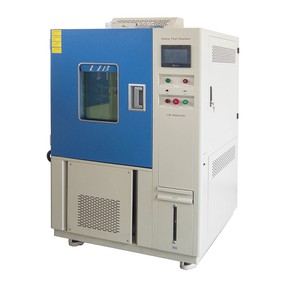
Technical Highlights of LIB Ozone Climatic Test Chamber
LIB as a leading Ozone Climatic Test Chamber manufacturer provides precise, reliable, and standards-compliant solutions for accelerated ozone aging and material durability testing.
|
|
|
|
|
Model |
OC-250 |
OC-500 |
|
Internal Dimension (mm) |
600*600*700 |
700*800*900 |
|
Overall Dimension (mm) |
960*1150*1860 |
1180*1350*2010 |
|
Interior Volume (L) |
250 |
500 |


Standards Compliance
LIB's chambers meet global testing requirements, including ISO 1431, ASTM D1149, IEC 60068-2-42, IEC 60903, and Volkswagen PV3305, ensuring results are accepted by auditors and regulatory bodies worldwide.
Precise Environmental Control
|
Ozone Concentration |
Adjustable from 1–1000 PPHM, maintained within ± 5% |
|
Temperature Range |
0 °C ~ 100 °C, with ± 0.5 °C fluctuation and ± 2.0 °C deviation |
|
Humidity Range |
30 % ~ 98 % RH, controlled within ± 2.5 % RH |
|
Airflow Rate |
0–60 L/min, ensuring uniform ozone distribution |
Continuous digital monitoring guarantees every test is consistent, accurate, and traceable.
Dynamic & Static Stress Simulation
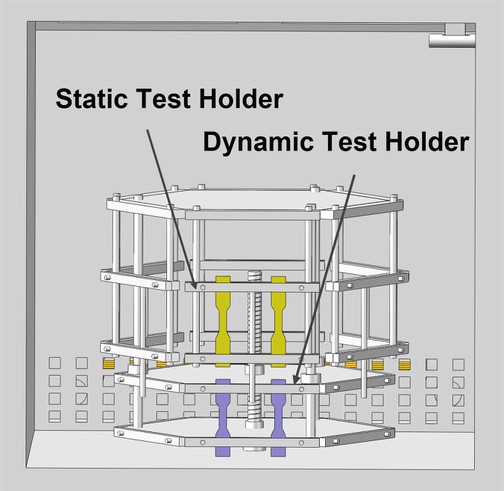
Samples can be tested under both static and dynamic tension modes. The rotating holder (0–10 r/min) and stretching clamps (5%~35%) reproduce bending, twisting, and stretching similar to real-world mechanical stress, enhancing test realism and result accuracy.
|
|
 |
Workroom
Durability & Corrosion Resistance
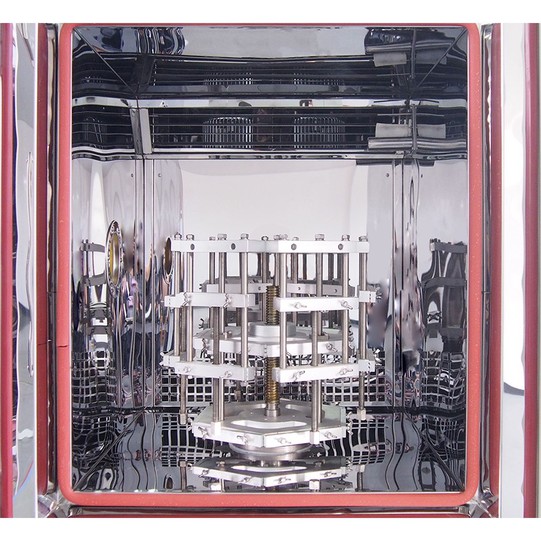
Constructed from SUS304 stainless steel, the inner chamber resists long-term ozone corrosion, maintains structure under extreme conditions, and is easy to clean. The powder-coated outer shell provides industrial-grade protection and a modern finish.
Smart Control & Monitoring
A programmable color touchscreen controller with Ethernet and PC Link connectivity supports up to 120 test programs (100 segments each). Users can automate complex profiles, log all environmental data, and generate audit-ready reports instantly.

Controller
Eco-Conscious Safety System
Residual ozone is neutralized by an activated-carbon exhaust system, meeting ISO 14001 environmental standards. Energy-efficient fans and intelligent airflow control reduce noise and energy consumption for a cleaner, safer workspace.
Ozone Climatic Test Chamber FAQs
1. What is the stretching speed?
The stretching speed range of the ozone specimen holder is 1 cm/min to 10 cm/min (adjustable). For standard ozone test specimens, a slower stretching speed is usually required to ensure the stability and accuracy of the test results.
2. Why is 304 stainless steel used for the inner workroom instead of fiberglass?
Ozone does not corrode 304 stainless steel, allowing the chamber to maintain long-term durability. Stainless steel also offers advantages over fiberglass - it is more aesthetically pleasing, easier to clean and maintain, and less prone to aging or deformation, resulting in a longer lifespan. Therefore, stainless steel is generally preferred in ozone test chamber design.
3. Can the ozone concentration be displayed in PPHM or PPB?
According to ISO1431-1 standards, 25 PPHM is the commonly recommended reference value. The standard display unit is PPHM or PPM, but it can be switched to PPB upon customer request. The conversion is: 1 PPM = 100 PPHM = 1000 PPB.
4. How is it ensured that ozone is fully removed before being discharged?
Ozone is a strong oxidizing gas and must be properly treated before release. The chamber uses an activated carbon adsorption method for purification. Based on experience, 2.5 kg of activated carbon is used per 1000 L of exhaust gas, and it is recommended to replace the activated carbon annually to ensure effective adsorption.
5. What is the service life of the ozone generator?
The typical service life of the ozone generator is about 3 years. It uses a silent ultraviolet discharge ozone generator, which produces ozone via UV discharge. This type of generator generally has a standard lifespan of around three years in the industry.
LIB's Ozone Climatic Test Chamber delivers reliable, standards-compliant performance for accelerated ozone aging. Contact LIB Industry today to enhance your material testing accuracy, gain dependable results, and access a global service network available 24/7.


