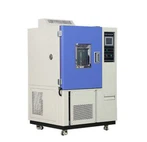
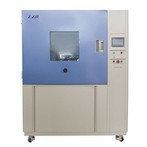
Picture two identical steel brackets, coated the same day by the same process. One goes into service on a coastal bridge, the other stays in a warehouse. Within two years, the coastal part is visibly corroding while the warehouse part looks untouched. A salt spray booth exists to compress that two-year difference into a matter of days, so you find out which coating actually holds up before it's bolted onto a real structure.
This article explains what LIB Industry's Salt Spray Booth is, which standards it satisfies, how it operates internally, and what test method it follows, so you know exactly what happens inside the chamber during a corrosion test.
What Is a Salt Spray Booth?
A Salt Spray Booth is a sealed test chamber that atomizes a salt solution into a fine fog and holds a specimen inside that fog for a set period, accelerating the corrosion process that would normally take months or years outdoors. The interior is typically built from FRP (fiber-reinforced plastic) to resist the corrosive fog itself, while V-groove or round-rod holders keep samples angled between 15° and 30° so condensation drips off cleanly instead of pooling on the surface. This setup makes the booth suitable for testing coated metals, automotive parts, marine hardware, and electronic enclosures where long-term saline exposure is a real risk.
Standards It Satisfies and How It Works
The equipment is built to meet ASTM B117, ISO 9227 (covering NSS, AASS, and CASS test methods), and IEC 60068-2-11, the core international references for salt fog corrosion testing. Under ASTM B117, the booth must hold a 5% sodium chloride solution at a pH of 6.5–7.2, run at a chamber temperature of 35 ± 2°C, and maintain spray pressure around 83 kPa to keep the deposition rate within 1–2 mL per 80 cm² per hour. Internally, a saturated air barrel preheats and humidifies incoming air before it reaches the spray tower, which stabilizes salt concentration and prevents temperature shock when the fog contacts the chamber walls. PT-100 sensors feed data to a PID controller in real time, keeping temperature fluctuation within ±0.5°C, well inside the ±2°C tolerance the standard allows.
Test Method Used in the Salt Spray Booth
A valid test starts with preparing fresh 5% NaCl solution using distilled or deionized water, then adjusting pH with acetic acid or sodium hydroxide if it drifts outside range. Specimens are mounted on their holders with no contact between samples and no drip-through from one piece onto another below it. Once the chamber reaches 35°C, the continuous spray cycle begins and typically runs for a set interval such as 24, 96, 240, or over 1,000 hours depending on the coating and industry requirement. After exposure, samples are rinsed with distilled water and evaluated for corrosion according to the applicable acceptance criteria. Touchscreen controllers that store up to 120 programs with 100 steps each allow labs to automate the full sequence, including pre-soak and drying phases, without staying by the chamber the entire run.
Korean Customers Are Highly Satisfied Testing Metal in the Salt Spray Booth
A group of Korean manufacturers recently used LIB Industry's Salt Spray Booth to evaluate coating performance on metal components, and their quality team reported strong results across the board. Several points stood out to them:
Standards compliance: the booth supports ASTM B117, ISO 9227, and IEC 60068-2-11, and satisfies CE, IEC, and CSA safety requirements, simplifying certification for products headed to multiple export markets.
High safety design: dry-burn protection, low-water alerts, and over-temperature interlocks kept multi-day test cycles running without any interruptions.
Strong test precision: temperature fluctuation stayed within ±0.5°C and deposition rate stayed consistent across the chamber, so every sample received identical exposure.
Cost-effective operation: automatic water replenishment cut refill frequency significantly, lowering day-to-day operating costs.
Full customization: chamber volume can be built up to 2000 L free of charge to match larger batches or bigger components.
Long-term confidence: a 3-year warranty with permanent maintenance support gave the team peace of mind for ongoing production testing.
These advantages made the choice easy for a facility that needed dependable, standards-backed corrosion testing without recalibration headaches between batches.
Salt Spray Booth vs Cyclic Salt Spray Booth: Comparison and How to Choose
| Feature |
|
|
|---|---|---|
| Primary standards | ASTM B117, ISO 9227 (NSS/AASS/CASS) | ISO 11997, ASTM D5894, SAE J2334 |
| Test environment | Constant salt fog at 35°C | Alternating salt fog, humidity, and drying phases |
| Temperature control | Fixed at 35 ± 2°C | Programmable from ambient to 60°C or higher |
| Test duration | 24–1,000+ hours continuous | 1–12 weeks of cyclic sequences |
| Best suited for | Routine quality control, simple coatings | R&D, automotive/marine, complex assemblies |
| Relative cost | Lower initial investment | Higher, due to added humidity and drying systems |


If your goal is basic compliance testing on a simple coated metal, a standard Salt Spray Booth running ASTM B117 is usually sufficient and more budget-friendly. If your product faces fluctuating outdoor conditions, like automotive exteriors or marine decks, a Cyclic Salt Spray Booth gives more realistic failure data by alternating fog, humidity, and drying phases to correlate with years of natural weathering.
LIB Popular Salt Spray Booth and Climate Test Chambers

Controlled Temperature, Humidity & Salt Spray for Realistic Simulation, Highly Popular.

Temperature & Salt Spray Control Only, Precision Salt Spray Measurement, Standard Compliant.
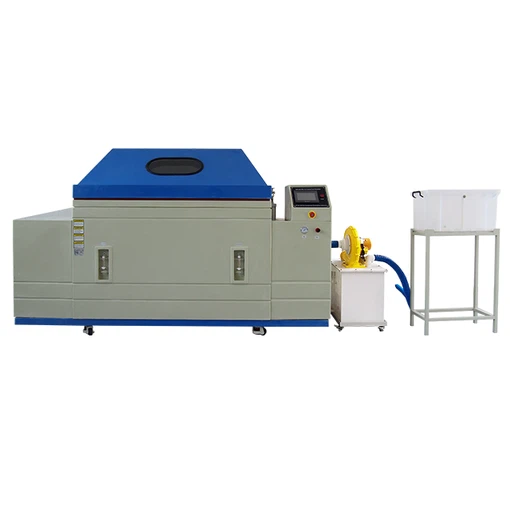
Controlled SO₂, Temperature, Humidity & Salt Spray for Industrial Environment Simulation.

Realistic Sunlight Simulation, Water-Cooled Lamp for Stability & Durability, Top Choice for Coating Companies.

UV Light Simulation Test, Stable Light Source, High Uniformity of Light Exposure.

Large Test Pieces, High-Volume Testing; Flexible Customization of Size & Function.
FAQs on the Salt Spray Booth
Q1: What after-sales service comes with the Salt Spray Booth?
LIB Industry provides a 3-year warranty, lifetime technical support, and a 24/7 English-speaking team. If remote troubleshooting can't resolve an issue, spare parts are guaranteed to arrive within 7–15 days.
Q2: How is the booth shipped, and what about customs clearance?
Units are packed in export-grade wooden crates with anti-moisture and anti-shock protection, shipped by air or sea freight, with our logistics team assisting on export documentation and customs clearance support.
Q3: Can the chamber size or sample holders be customized?
Yes. Beyond standard configurations, LIB Industry can customize chamber volume, sample holders, and software settings to match specific testing requirements.
Q4: How much daily maintenance does the booth require?
Very little. Checking salt solution level, cleaning the collector, and verifying pH takes under 10 minutes daily, and the corrosion-resistant FRP interior means no frequent deep cleaning is needed.
Contact LIB Industry today to discuss how our Salt Spray Booth can strengthen your product's corrosion resistance and protect your brand's reputation in the field.