Sunlight causes more material damage than most laboratories expect. The ultraviolet portion between 290–400 nm is the main driver of polymer chain scission, coating chalking, gloss loss, and color fading. Outdoor exposure can take 12–24 months, and results vary by season, humidity, and geographic location. For manufacturers that need reliable data quickly, waiting for natural weathering is neither efficient nor controllable.
A recent message from Vladimir Todorović in Serbia highlights why stability matters. He shared that the UV chamber is used daily by their Quality department and that testing has proceeded without any issues. He also emphasized appreciation for the consistent technical support provided. This kind of real-world feedback reflects what laboratories truly require: dependable irradiance output, stable temperature regulation, and long-term operational reliability-not just compliance on paper.
📩📩📩

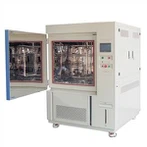
LIB ASTM G154 UV Test Machine compresses natural sunlight aging into 500–1000 controlled laboratory hours. By regulating UV irradiance, surface temperature, and condensation cycles, it produces measurable and repeatable data in accordance with ASTM G154, ASTM G151, ISO 4892-3, and SAE J2020.
ASTM G154 UV Test Machine Simulates Sunlight Exposure
The ASTM G154 UV Test Machine simulates the most destructive part of sunlight: short-wave ultraviolet radiation.
Natural sunlight contains UV, visible, and infrared energy. However, most polymer degradation is caused by UV below 400 nm. According to ASTM G154, fluorescent lamps such as UVA-340 reproduce the solar cutoff at 295 nm and accurately simulate the 295–365 nm range.
The machine combines three controlled factors.
First, UV irradiance is precisely regulated. Typical setting is 0.89 W/m² at 340 nm, with a controllable range of 0.3–20 W/m² and ±0.02 W/m² stability.
Second, surface temperature is controlled through Black Panel Temperature (BPT). Standard exposure temperature is 60 °C, with condensation at 50 °C, maintained within ±2 °C.
Third, moisture is simulated through ≥95% RH condensation cycles, reproducing dew formation and humidity stress.
It is widely used under standards such as ASTM D4329 for coatings, ASTM D882 for plastic films, and ASTM C1519 for sealants.

Method of ASTM G154 UV Exposure
ASTM G154 defines a controlled fluorescent UV exposure method with precise numerical parameters for irradiance, temperature, moisture, and cycle duration to ensure repeatable accelerated aging results.
According to ASTM G154, the test uses fluorescent UV lamps to simulate short-wave ultraviolet radiation in the 290–400 nm range. The most commonly used lamp is UVA-340, which closely matches the solar UV spectrum from 295–365 nm. This wavelength range is critical because it represents the portion of sunlight responsible for most polymer degradation, surface cracking, and coating chalking.
A typical Cycle 1 configuration under ASTM G154 includes an irradiance level of 0.89 W/m² at 340 nm. The UV exposure temperature is set at 60 °C, measured by Black Panel Temperature (BPT), while the condensation phase temperature is maintained at 50 °C. The exposure cycle consists of 8 hours of UV irradiation followed by 4 hours of condensation. This 12-hour cycle is repeated continuously for a total duration of 500 to 1000 hours, depending on the product specification. Some industrial or automotive applications may extend the exposure beyond 1000 hours.
The standard requires stable irradiance control throughout the test. Irradiance drift can significantly affect degradation speed, leading to inconsistent results between batches or laboratories. Therefore, closed-loop irradiance monitoring is recommended to maintain fluctuation within tight tolerances, typically within ±0.02 W/m² in high-precision systems.
Black Panel Temperature control is another critical requirement. ASTM G154 specifies a BPT control range between 35 °C and 80 °C. The BPT sensor measures the combined heating effect of UV radiation and chamber air temperature, representing the actual surface temperature of the specimen. Maintaining ±2 °C accuracy ensures realistic simulation of outdoor surface heating conditions.
Moisture simulation is achieved through a condensation cycle. During this phase, chamber humidity reaches ≥95% RH, forming water condensation directly on the specimen surface. This reproduces dew formation and accelerates hydrolytic and oxidative degradation. The condensation stage is essential for evaluating blistering, delamination, and adhesive weakening.
Programmable cyclic exposure is essential for compliance. The test system must allow continuous automatic operation of multi-step programs, including UV intensity adjustment, temperature switching, and condensation intervals. Reliable systems support extended operation for 500–2000 hours without interruption.
The objective of ASTM G154 testing is to produce quantifiable and comparable data. Common evaluation indicators include tensile retention (%) under ASTM D882, gloss retention (%) under ASTM D4329, adhesion strength reduction (MPa) under ASTM C1519, and color difference (ΔE) for appearance evaluation.
By defining numerical parameters for irradiance, temperature, humidity, and exposure duration, ASTM G154 ensures that accelerated UV aging is controlled, measurable, and repeatable across laboratories worldwide.
| Parameter | Standard Requirement | Common Lab Setting |
|---|---|---|
| Lamp Type | UVA-340 | 8 × 40W fluorescent lamps |
| Irradiance | 0.89 W/m² @340 nm | ±0.02 W/m² stability |
| UV Temperature | 60 °C | ±2 °C |
| Condensation Temp | 50 °C | ≥95% RH |
| Cycle | 8 h UV + 4 h condensation | Repeated |
| Duration | 500–1000 h | Adjustable |
Real Coating Test Case Under ASTM Standards
In coating durability evaluation, UV accelerated screening is first conducted under controlled laboratory standards to predict long-term outdoor performance.
 |
 |
|
Model |
UV-SI-260 |
|
Internal Dimension (mm) |
450*1170*500 |
|
Overall Dimension (mm) |
680*1300*1500 |
|
Irradiation Source |
Fluorescent UV lamps (8) - 40 W |
|
Temperature Range |
Ambient ~ 90 ℃ ±2℃ |
|
Black Panel Temperature (BPT) |
35 ~ 80 ℃ |
|
Humidity Range |
≥95% RH |
|
Bandwidth |
290 ~ 400 nm |
|
Irradiance Control |
0.3~20 W/㎡ |
|
Distance of Specimen and lamp |
50 mm |
|
Heating Element |
Nichrome heater |
|
Controller |
Programmable color LCD touch screen controller |
|
Ethernet connection, PC Link,USB |
|
|
Water Supply System |
Automatic water supply, Water purification system |
|
Interior Material |
SUS304 stainless steel |
Most industrial coatings are pre-qualified using ASTM G154 before moving to full-spectrum weathering. This method focuses on short-wave UV (290–400 nm), which is the primary driver of coating chalking, gloss loss, and micro-cracking.
For example, a polyurethane coating panel is tested under the following configuration:
1. Irradiance: 0.89 W/m² @340 nm
2. UV temperature (BPT): 60 °C
3. Condensation temperature: 50 °C
4. Cycle: 8 hours UV + 4 hours condensation
5. Total duration: 1000 hours
6. After exposure, gloss retention (%), color difference (ΔE), and surface cracking are evaluated according to ASTM D4329.
|
|
|
 |


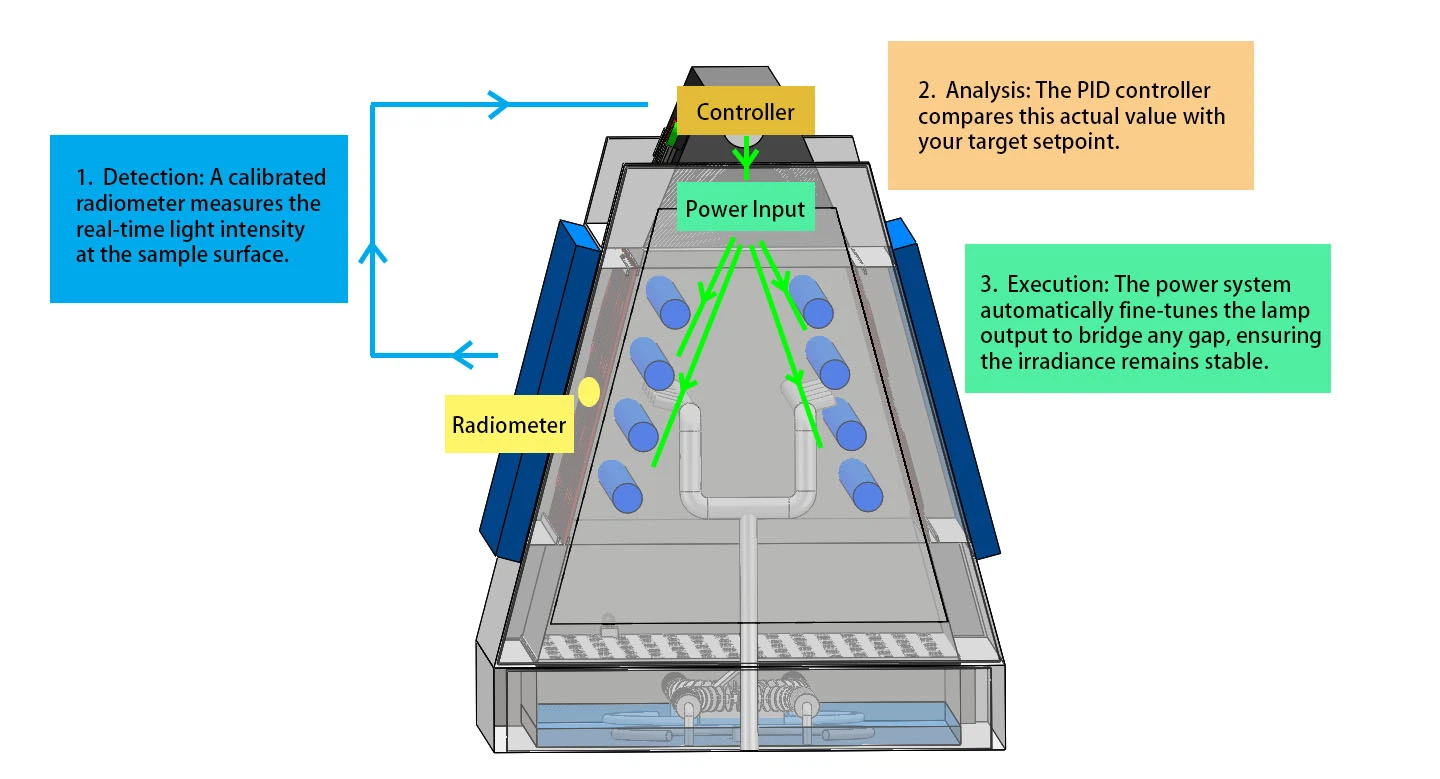
Step 1 – Irradiance Control
The first critical factor is stable UV intensity. ASTM G154 requires consistent irradiance at 340 nm to ensure comparable degradation rates.
LIB Advantage:
LIB adopts a closed-loop irradiance feedback system with a control range of 0.3–20 W/m². Real-time sensor monitoring maintains stability within ±0.02 W/m². This minimizes spectral drift and ensures batch-to-batch repeatability over long 1000-hour exposures.
Step 2 – Surface Temperature Stability
The second factor is accurate Black Panel Temperature control. Coating degradation is highly temperature-dependent, and even small deviations may accelerate oxidation.
LIB Advantage:
An integrated BPT sensor continuously measures combined lamp radiation and air heating. Temperature is controlled from 35–80 °C with ±2 °C precision. Uniform airflow design prevents hot spots, ensuring consistent panel heating across all specimens.
Step 3 – Moisture and Condensation Cycling
The third factor is moisture simulation. The 4-hour condensation phase at 50 °C produces ≥95% RH, allowing water vapor to condense directly on the coating surface. This accelerates blistering, adhesion loss, and hydrolysis.
LIB Advantage:
LIB chambers feature an automatic water supply and purification system. Water level is maintained without manual refilling, enabling uninterrupted long-term cycling. Ten precision spray nozzles can also simulate rain exposure when required.
|
|
|
| Four current displays | Water spray system |


Step 4 – Long-Term Continuous Operation
The fourth factor is durability during extended testing. A 1000-hour test equals approximately 6–12 months of outdoor UV stress in many climates.
LIB Advantage:
Eight 40W fluorescent UV lamps (UVA-340, UVB-313 optional) provide up to 5000 hours of stable service life. The programmable touchscreen controller supports 120 programs × 100 steps, ensuring uninterrupted cyclic operation. Ethernet and USB connectivity allow continuous data logging and export for audit traceability.
When Full-Spectrum Testing Is Required
If strict color stability validation is required, especially for automotive topcoats or decorative coatings, testing may proceed under ASTM G155. ASTM G155 includes UV, visible, and infrared radiation (280–800 nm), with typical parameters such as 0.35–0.55 W/m² @340 nm, Black Panel Temperature 63 °C, and 102 min light + 18 min water spray cycles.
|
Sample holder |
Adjustable speed, 1r /min |
|
|
Chamber Type |
Rotating Holder |
|
|
Irradiation Source |
4500w water-cooled xenon arc lamp with inner quartz and outer borosilicate filter |
|
|
Irradiance Range |
35~150 W/㎡ |
|
|
Bandwidth Measurement |
280~800 nm |
|
|
Chamber Temperature Range |
Ambient~ 100 ℃ ±2 ℃ |
|
|
Black Panel Temperature |
BPT 35 ~ 85 ℃ ±2 ℃ |
|
|
Humidity Range |
50 % ~ 98 % RH |
|
|
Water Spray Cycle |
1~9999 H 59 M (Adjustable) |

LIB Advantage in Transition Testing:
LIB offers both fluorescent UV and xenon arc systems, allowing laboratories to perform preliminary degradation screening under ASTM G154 and then conduct full-spectrum validation under ASTM G155 within the same technical framework.
Through precise irradiance control, stable BPT regulation, automated moisture cycling, and long-term operational reliability, LIB ensures coating durability testing is numerical, repeatable, and fully standards-compliant.
FAQs on the ASTM G154 UV Test Machine
Q1: Can ASTM G154 replace outdoor testing?
No, it does not fully replace natural exposure. ASTM G154 is designed as an accelerated laboratory comparison method. It reproduces UV radiation (290–400 nm), 60 °C surface temperature, and condensation cycles under controlled conditions. The purpose is to generate repeatable and comparable data within 500–1000 hours instead of waiting 12–24 months outdoors.
Q2: How long should materials be tested?
Most plastics, coatings, and packaging films are tested for 500–1000 hours under standard 8h UV + 4h condensation cycles. Automotive materials under SAE J2020 may require up to 2000 hours depending on performance requirements.
Q3: What measurable data can be obtained?
Testing produces clear numerical results. These include tensile retention (%) under ASTM D882, gloss retention (%) under ASTM D4329, adhesion strength change (MPa) under ASTM C1519, and color difference (ΔE). These values allow engineers to quantify degradation instead of relying on visual observation.
Q4: What are LIB's technical ranges?
Temperature range is Ambient to 90 °C with ±2 °C accuracy.
Humidity reaches ≥95 % RH with ±2 % stability.
Irradiance is adjustable from 0.3–20 W/m² with closed-loop control.
Cycle programming supports 120 programs with 100 steps each, enabling complex long-term exposure testing.
The ASTM G154 UV Test Machine converts natural sunlight variables into precise numerical parameters. Through stable irradiance, controlled Black Panel Temperature, and programmable moisture cycles, LIB ensures reliable and repeatable accelerated aging validation.
Contact LIB Industry today to discuss your ASTM G154 UV testing requirements. Our technical team will help you select the appropriate configuration, optimize your test parameters, and ensure your laboratory achieves stable, repeatable, and standards-compliant accelerated aging results. Reach out now to receive professional guidance and a customized solution for your material durability validation.