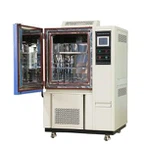
Corrosion testing must deliver not only standardized data, but also stable,  real-world performance. In laboratories where continuous salt fog exposure runs for hundreds of hours, equipment reliability and proper preventive maintenance are essential to ensure accurate, repeatable results.
Recently, Mr. Christian Hernández from Mexico, using the LIB S-150 (23A) Salt Spray Test Chamber, shared his feedback: "Yes, it has been working wonderfully. I only had a minor issue with the saline solution leaking from the container, but it was resolved." After receiving the updated maintenance manual and guidance, the chamber continued operating smoothly. This real user experience highlights both the stability of the S-150 and the responsive technical support behind every LIB system.
When metal parts start rusting after only a few months in the field, the real cost is not just material loss-it is brand reputation, warranty claims, and delayed certification. That is why salt fog testing has become a mandatory step in industries such as automotive, electronics, marine hardware, and home appliances.
LIB Salt Fog Machine is designed to simulate aggressive saline environments in a controlled, measurable, and standards-compliant way. From ISO 9227 to ASTM B117, it delivers repeatable corrosion data with precise control of temperature, spray pressure, and deposition rate-helping laboratories move from uncertainty to certified reliability.
Overview of the Salt Fog Machine
A Salt Fog Machine is a controlled corrosion testing system. It artificially accelerates corrosion by generating a fine mist of salt solution inside a sealed chamber. The purpose is to evaluate the corrosion resistance of metals, coatings, plating layers, and protective finishes under standardized conditions.
Salt fog testing exists because natural corrosion is unpredictable and slow. Outdoor exposure may take years to show results. A salt fog chamber compresses this process into 24 hours, 240 hours, or even 1000 hours by maintaining continuous exposure to 5% sodium chloride mist at controlled temperature and humidity.
The machine is built to meet strict international standards.
LIB Salt Fog Machines comply with:
1. ISO 9227 (NSS, AASS, CASS methods)
2. ASTM B117 (Neutral Salt Spray)
3. JIS Z 2371
| Test Method | Salt Solution | pH Range | Temperature | Spray Pressure | Deposition Rate | Notes |
|---|---|---|---|---|---|---|
| NSS (Neutral Salt Spray) | 5 % NaCl | 6.5–7.2 | 35 ± 2 °C | 83 kPa | 1–2 mL/80 cm²·h | Baseline general corrosion resistance |
| AASS (Acetic Acid Salt Spray) | 5 % NaCl + glacial acetic acid | 3.1–3.3 | 35 ± 2 °C | 83 kPa | 1–2 mL/80 cm²·h | Decorative/electroplated coatings |
| CASS (Copper-Accelerated Acetic Acid Salt Spray) | 5 % NaCl + glacial acetic acid + 0.26 g/L CuCl₂ | 3.1–3.3 | 35 ± 2 °C | 83 kPa | 1–2 mL/80 cm²·h | High-performance coating acceleration |

Salt Fog Machine for Corrosion Test
How to Operate a Salt Fog Machine
Step 1: Prepare the salt solution correctly.
Use industrial-grade sodium chloride without additives. Dissolve to 5 ± 1% concentration by mass. Adjust pH to 6.5–7.2 using distilled water. Correct concentration ensures compliance with ASTM B117 and ISO 9227.
Step 2: Fill the salt water tank and enable automatic water inlet.
LIB chambers are equipped with an automatic water inlet system. The built-in brine mixing system pushes solution from the bottom using compressed air, ensuring consistent concentration throughout the test.
Step 3: Set temperature and spray parameters.
Using the PID programmable touchscreen controller, set chamber temperature to 35 °C (or other standard requirement). The controller supports 120 programs with 100 steps each, allowing multi-stage testing such as NSS followed by CASS.
Step 4: Verify spray tower and nozzle performance.
Quartz nozzles and the salt spray tower generate fine, evenly distributed mist. Adjust spray pressure to 83 kPa. Confirm deposition rate using the salt spray collector (1–2 mL per 80 cm² per hour).
Step 5: Start the test and monitor in real time.
The viewing window allows observation without opening the lid, preventing salt fog leakage and temperature fluctuation. Ethernet and USB ports allow real-time data export and remote supervision.
Step 6: Ensure sealing and safety during operation.
To prevent salt spray leakage, LIB uses one-piece molded fiberglass (FRP) construction and a water-sealed groove around the chamber lid. Adding water into the sealing groove during operation effectively blocks salt fog escape and keeps the laboratory clean and safe.
Step 7: Complete the test and analyze results.
After the programmed duration (e.g., 240 h or 1000 h), remove samples carefully. Evaluate corrosion degree, blistering, or coating failure according to relevant standards such as ISO 4628 or ASTM D1654 if required.
LIB Salt Fog Machine Advantages
  |
|||
|
Model |
S-150 |
||
|
Internal dimensions (mm) |
470*590*400 |
||
|
Overall dimensions (mm) |
620*1400*1050 |
||
|
Temp. Range |
Ambient ~ +60 degree |
||
|
Temp. Fluctuation |
± 0.5 ℃ |
||
|
Temp. Deviation |
± 2.0℃ |
||
|
Humidity Range |
95 % ~ 98 % RH |
||
|
Salt Fog Deposition |
1~2ml / 80cm2 · h |
||
|
Spray Type |
Continuous / Periodic |
||
|
Heating Element |
Nichrome heater |
||
|
Salt Fog Collected |
Fog collector and fog measure cylinder |
||
|
Controller |
PID controller |
||
|
Material |
Glass fiber reinforced plastics |
||
|
Standard Configuration |
8 round bars and 7 V-shaped grooves |
||
|
salt spray tower |
cylinder |
spray collector |


Precise and Stable Environmental Control.
PT-100 Class A temperature sensors (accuracy 0.001 °C) combined with PID control maintain ±0.5 °C stability. The saturated air barrel preheats air to ensure uniform fog formation.
Zero Salt Leakage Design.
The fiberglass reinforced plastic (FRP) chamber body resists corrosion up to 110 °C. The water-sealed structure prevents salt fog from escaping, protecting both operators and surrounding equipment.
Durable Quartz Spray System.
Quartz nozzles resist corrosion and deformation under high temperature. They are easy to clean and maintain long-term spray uniformity.
Accurate Deposition Monitoring.
The salt spray collector connects to a graduated cylinder for clear measurement. It guarantees ISO/ASTM compliant deposition rates of 1–2 mL/80 cm²·h.
Industrial Mobility and Stability.
Four heavy-duty castors (420 kg capacity each) allow easy movement under load. Height-adjustable design ensures stability on uneven laboratory floors.
Flexible Sample Placement.
Round bars and V-groove sample holders accommodate panels, screws, irregular parts, and customized fixtures for different industries.
FAQs on the Salt Fog Machine
Q1: How do you prevent salt spray leakage?
LIB chambers use integral FRP construction and a water-sealed groove design. Adding water into the seal during operation effectively blocks fog escape and maintains laboratory cleanliness.
Q2: Does the chamber have an automatic water inlet?
Yes. All models are equipped with automatic water refilling to ensure stable, continuous testing without manual intervention.
Q3: Will the outer shell overheat?
The heating system is located at the bottom of the chamber. Surface temperature will not exceed 45 °C under normal operation. The FRP shell can withstand up to 110 °C. Proper ventilation further reduces surface temperature.
Q4: Can a composite salt spray chamber be made smaller?
CCT chambers require cooling systems, humidification systems, and uniform airflow modules. Reducing size too much would compromise performance and component layout.
Q5: What controller types are available?
S-150, S-250, and S-750 models use button controllers (touchscreen optional). S-010, S-016, and S-020 models are equipped with touchscreen controllers as standard.
Salt fog testing is not just about spraying salt-it is about controlling chemistry, pressure, temperature, and deposition rate with measurable precision. With compliance to ISO 9227, ASTM B117, and other global standards, LIB Salt Fog Machine delivers reliable corrosion data you can trust.
Contact LIB Industry to learn more about professional salt fog corrosion testing solutions.