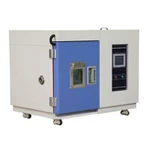
When materials face temperatures above 250 ℃, 600 ℃, or even 1200 ℃, their structure, stability, and durability can change dramatically. Metals soften, polymers degrade, electronics oxidize, and coatings lose adhesion. The question is not only how hot is too hot, but how accurately and safely can these limits be tested?
LIB Benchtop High Temperature Chambers deliver controlled heating from ambient to 1200 ℃ with precise regulation, uniform airflow, and customizable configurations. Whether you are validating aerospace composites, sintering ceramics, or conducting thermal-aging reliability tests, LIB provides consistent results aligned with global standards such as ASTM E145, IEC 60068-2-2, ISO 2151, UL 746B, and MIL-STD-202.
Overview of the Benchtop High Temperature Chamber
A benchtop high-temperature chamber provides a controlled thermal environment where materials can be heated from ambient levels up to extreme temperatures for evaluation, aging, and performance testing.
The LIB Benchtop High Temperature Chamber is engineered around a PT-100 Class-A sensor (±0.001 ℃ accuracy), airtight silicone-sealed construction, and uniform horizontal–vertical airflow. With heating rates up to 6 ℃/min and stable temperature deviation within ±2.0 ℃, it supports both rapid heating tasks and long-duration stabilization tests for scientific and industrial applications.
The chamber structure uses SUS304 stainless steel, polyurethane insulation foam, and a powder-coated A3 steel exterior. Optional vacuum configuration further prevents oxidation and allows controlled-atmosphere heating for sensitive materials.
|
Name |
Benchtop High Temperature Chambers | |
|
Model |
O-100 |
O-500 |
|
Internal Dimension (mm) |
400*500*500 |
700*800*900 |
|
Overall Dimension (mm) |
750*880*850 |
1100*1100*1300 |
|
Interior Volume |
100L |
500L |
|
Temperature Range |
A: Ambient ~+250 ℃,B: Ambient ~+400 ℃,C: Ambient ~+900 ℃ |
|
|
Temperature Fluctuation |
± 0.5 ℃ |
|
|
Temperature Deviation |
± 2.0 ℃ |
|
|
Heating Rate |
6 ℃ / min |
|
|
Controller |
PID color LCD touch screen controller,Ethernet connection, PC Link(Option) |
|
|
Exterior Material |
Steel Plate with protective coating |
|
|
Interior Material |
SUS304 stainless steel |
|
|
Thermal Insulation |
Polyurethane foam(Refractory brick) |
|
》》For more technical information and details about our Benchtop High Temperature Chambers, please feel free to email us at info@libtestchamber.com.
Application Areas of the Benchtop High Temperature Chamber
LIB chambers support a wide range of industrial and research applications:
High-Temperature Aging (plastics, composites, elastomers)
Thermal Shock & Heat Resistance Testing for electronics (IEC 60068 series)
Sintering & Pre-Sintering of ceramics and advanced materials
Coating Curing & Film Adhesion Stability (ASTM D2485, ASTM D3363)
Annealing & Stress Relief for metals and alloys
Oxidation & Corrosion Behavior Evaluation at elevated temperatures
Semiconductor Component Bake-Out & Degassing
Aerospace Material Qualification (according to MIL-STD-810H thermal standards)
Battery Component Safety Heating Tests
Furnace-like rapid heating for R&D thermal processes
Sterilization & High-Temperature Drying for medical parts
Temperature Limit Verification for polymers according to UL 746B

Testing Methods Using the LIB Benchtop High Temperature Chamber
|
|
|


High-Temperature Aging & Thermal Degradation
High-temperature aging determines how materials behave after prolonged exposure to elevated temperatures.
LIB chambers provide ±0.5 ℃ fluctuation, ensuring that long-term aging data remains reliable for certification tests such as ASTM E145 and IEC 60068-2-2.
Heat-Resistance & Melting-Point Threshold Testing
Materials reach mechanical limits as they approach transition temperatures.
The chamber's 6 ℃/min rapid ramp supports melting-point exploration, thermal-runaway studies, and polymer glass-transition verification.
Vacuum or Controlled-Atmosphere Testing
Testing sensitive metals or semiconductors often requires oxygen-free heating.
LIB can integrate partial-vacuum capability, inert-gas ports, and sealed feedthroughs, enabling oxidation-free heating and degassing processes.
Thermal Cycling & Multi-Stage Programming
Complex heating profiles-such as step-soak-step cycles-are essential in many standards (UL 746B, ISO 188, MIL-STD thermal cycles).
LIB's PID controller stores 120 programs × 100 segments, allowing hour-long or multi-day repeatable cycles.
Uniformity-Critical Tests for Coatings & Electronics
Some tests require exceptionally balanced temperatures, such as circuit-board bake-outs or coating stability studies.
The chamber's fan-powered circulation with side-mounted configuration ensures highly uniform distribution even when shelves are loaded up to 50 kg.
Rapid Drying & Moisture Removal
High-temperature drying accelerates moisture removal for ceramics, PCBs, adhesives, and composites.
Stable airflow and fast recovery after door openings speed up drying while preventing temperature deviations.
|
|
|
|
| Robust Workroom | PID Controller | Temperature Sensor |


》》To receive customized solutions and pricing for the Benchtop High Temperature Chamber, please contact us at info@libtestchamber.com.
Benchtop High Temperature Chamber FAQs
Q1. How does a temperature sensor located in the interlayer of a vacuum oven ensure detection accuracy?
In a vacuum oven, temperature accuracy is determined primarily by the precision of the sensor itself rather than its exact physical position in the interlayer. Since the chamber operates under low-pressure or vacuum conditions, air convection is nearly eliminated, resulting in minimal temperature gradients inside the workspace. Therefore, the temperature measured by the interlayer-mounted sensor closely represents the actual chamber temperature, ensuring reliable and stable detection.
Q2. How is the oven calibrated?
Oven calibration is performed using the 9-point temperature verification method.
After assembly, nine calibrated temperature probes are placed evenly throughout the chamber-covering upper, middle, and lower sections. Measured values are compared against the reference standard. If deviations occur, internal system parameters are adjusted so that all nine points meet uniformity and accuracy requirements, ensuring precise temperature control and compliant performance.
q3. What is the maximum temperature an oven can reach?
The heating capability varies depending on design: Standard ovens: 250 ℃ High-temperature ovens: up to 1200 ℃ LIB can customize non-standard sizes and higher temperature ranges to meet special laboratory or industrial applications.
q 4. What insulation materials are used for different oven temperature ranges?
Insulation materials depend on the operating temperature: Below 300 ℃: Polyurethane + high-density thermal insulation cotton.
Above 300 ℃: Firebricks and high-temperature refractory insulation. This ensures safe operation, stable temperature retention, and structural durability across different thermal ranges.
q5. What are the main application fields of tunnel ovens?
Tunnel ovens are widely used in continuous processing environments, especially where high throughput and uniform heating are required.
Typical applications include: Label drying, Wood drying, Coating curing, Food processing, Packaging materials drying, Electronics preheating or moisture removal. Tunnel ovens enable continuous conveyor-based production, offering highly stable and efficient drying for mass manufacturing.
Any customization can be made. LIB offers a 3-year warranty and lifetime service. Any issues that cannot be resolved during the warranty period will be replaced free of charge. 24/7 English-speaking after-sales team. Fast shipping within 7-15 days.
Contact LIB Industry to develop a professional and efficient solution tailored to your specific standards and stringent requirements.