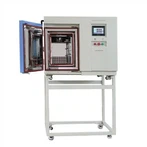
Photovoltaic (PV) panels are the backbone of renewable energy systems, converting sunlight into electricity for homes, commercial facilities, and utility-scale installations. Ensuring their performance and durability requires more than just visual inspection-rigorous testing under realistic environmental stresses is essential. Skipping pre-installation validation can lead to underperforming systems, costly rework, and warranty claims, especially as PV installations face extreme climates worldwide-from tropical humidity to arctic cold.
LIB PV Solar Panel Test Chambers provide a complete solution for validating PV modules before they leave the factory floor. By simulating thermal cycling, humidity-freeze conditions, damp heat, UV exposure, and corrosive environments, these chambers detect early-life failures such as backsheet delamination, solder-joint fatigue, and encapsulant degradation. Fully compliant with international standards-including IEC 61215, IEC 61646, IEC 61345, IEC 61108, IEC 62688, UL 1703, and ASTM B117-LIB chambers ensure reliable results that satisfy both regulatory audits and customer expectations.
Choosing Test Chambers for PV Solar Panels: LIB UV Preconditioning, Temperature and Humidity, and Salt-Fog
When setting up a PV test chamber, selecting the right type of environmental chamber is critical:
UV Preconditioning Chamber
- Profile: Fluorescent UV lamps simulate natural sunlight at 60 °C ± 5 °C, with cycling humidity and water spray to mimic rainfall.
- PV Focus: Detects UV-induced yellowing, surface cracking, and seal failures before panels enter service.
- Standards: IEC 61215, IEC 61730.
Temperature & Humidity Chamber
- Damp-Heat Testing: Maintains 85 °C and 85 % RH for 1,000–2,000 hours.
- Humidity-Freeze Cycling: Alternates between 85 °C/85 % RH and –40 °C for 10–20 cycles.
- Thermal Cycling: Rapid swings from –40 °C to 85 °C for 50–200 cycles validate solder-joint and frame adhesion strength.
- Precision: ±2 °C temperature stability, ±2.5 % RH, PT-100 Class A sensors, PID control.
- Standards: IEC 61215, IEC 61646, UL 1703.
 |
 |
||
|
Internal Dimension (mm) |
1300*700*1350 |
||
|
Overall Dimension (mm) |
1900*1100*1750 |
||
|
Parameter |
Temperature Range |
-60℃ ~ +100 ℃ |
|
|
Temperature Fluctuation |
± 0.5 ℃ |
||
|
Temperature Deviation |
± 2.0 ℃ |
||
|
Humidity Range |
20% ~ 98% RH |
||
|
Humidity Deviation |
± 2.5% RH |
||
|
Temperature Change Rate |
1 ~ 3.4℃ / Min |
||
|
Panel Size |
1M*2M |
||
|
Panel Capacity |
4 / 6 / 8 / 10 / 12 Pieces |
||
|
Material |
Exterior Material |
Steel Plate with protective coating |
|
|
Interior Material |
SUS304 stainless steel |
||
|
Thermal Insulation |
Polyurethane foam and insulation cotton |
||
|
Observation Window |
Interior lighting, double-layer therm stability silicone rubber sealing |
||
Salt-Fog Corrosion Chamber
- Profile: Simulates coastal and industrial environments using ASTM B117 and ISO 9227 fog testing to evaluate metal corrosion.
- PV Focus: Ensures frame and ribbon metallization maintain electrical conductivity under corrosive conditions.
Steps to Set Up a PV Solar Panel Test Chamber
Setting up a PV test chamber requires systematic planning to ensure repeatable and accurate results:
Step 1: Select Chamber Type & Size
Choose the chamber according to PV panel dimensions, ranging from 0.5 m² residential modules to large utility-scale arrays, ensuring full compatibility.
Step 2: Install Custom Fixtures
Use adjustable racks and holders to secure panels firmly without adding mechanical stress or damaging module surfaces.
Step 3: Connect Utilities
Provide stable power, reliable water supply for humidity, and proper venting systems to maintain consistent environmental conditions.
Step 4: Calibrate Sensors & Controllers
Verify PT100 Class A temperature sensors and humidity probes, maintaining accuracy within ±0.001 °C and ±2 % RH.
Step 5: Program Test Sequences
Set up test cycles using PID-controlled software, adjusting ramp rates (heating: up to 3 °C/min, cooling: 1 °C/min) and hold times for thermal, humidity, and UV testing.
Step 6: Perform Dry Run
Run the chamber empty to confirm stability and uniformity, ensuring airflow distribution within ±2 °C across all zones.
Step 7: Load PV Modules & Begin Testing
Insert the PV panels, apply combined stress profiles, and track real-time performance with USB/Ethernet logging systems.
Step 8: Generate Reports
Compile ISO, IEC, and UL-compliant test reports automatically for quality assurance and regulatory audits.
Comprehensive Services Provided by LIB for PV Solar Panel Test Chambers
LIB ensures your PV test chambers operate efficiently and reliably:
Advanced PID Control & Preconditioning: Smoothly preheats and balances humidity before testing, preventing sudden environmental changes.
Optimized Airflow Uniformity: Four-zone airflow and precision baffles eliminate hot or wet spots for multi-sample testing.
Smart Test Management: Up to 120 programmable profiles enable complex sequences like humidity ramp followed by thermal shock.
Durability & Maintenance: SUS304 stainless steel interior resists corrosion; powder-coated A3 exterior offers chemical and impact protection; lockable, adjustable castors allow quick repositioning; safety interlocks guard against over-temperature, low water, and power failure.
|
|
|
|
| High-Quality Workroom | Precise Sensors | Smart PID controller |


Global Support Network: Three-year warranty, lifetime technical service, 24/7 English-speaking hotline, and spare-part delivery in 7–15 days.
Integrating LIB's PV Solar Panel Test Chambers into your R&D and QA processes minimizes field failures, ensures compliance with IEC 61215, IEC 61646, IEC 61730, UL 1703, ASTM B117, ISO 9227, and IEC 60068 standards, and guarantees reliable performance in tropical, desert, alpine, or arctic environments.
Contact LIB Industry today to configure your bespoke PV Solar Panel Test Chamber program.