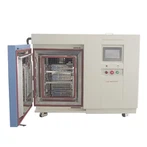
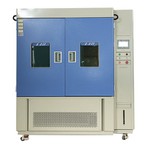
Testing products in harsh, dust-laden environments is no longer optional-it's essential. From electronics and automotive components to industrial equipment, exposure to sand and dust can cause failures, reduce lifespan, and compromise safety. Understanding how to operate a reliable sand and dust test chamber ensures accurate, repeatable results that comply with international standards and protect both your products and your reputation.
LIB's Sand and Dust Chamber delivers precise, standardized test conditions for dust and sand exposure. Designed according to IEC 60529 (IP5X/IP6X), ISO 20653 (road vehicle dust tests), IEC 60068-2-68 (environmental dust and sand testing), ASTM, and MIL-STD-810H requirements, the chamber provides uniform airflow, controlled particle concentration, and repeatable cycles. From small handheld devices to full vehicles, LIB chambers support comprehensive testing that meets regulatory and industry expectations.
Procedure for Using the Sand and Dust Chamber
Using LIB's Sand and Dust Chamber is straightforward yet requires careful attention to procedure to ensure repeatable results:
Step 1: Sample Preparation
Small components, such as headphones, can be suspended from the chamber's overhead beam. Heavier items can be placed on the standard holder, which has a load capacity of 50 kg.
Ensure all parts are clean and dry before testing. This prevents dust clumping and ensures accurate, reliable results.
Step 2: Chamber Setup
Select the chamber size that fits your samples, from 200 L benchtop units to walk-in models for vehicles.
Connect the programmable PID touch-screen controller to set test parameters, including dust concentration, exposure time, and temperature.
Step 3: Test Parameter Configuration
Maintain dust concentration at 2–4 kg/m³ for standard IP6X/IP5X tests.
Use vertical closed-loop airflow to ensure uniform dust distribution across all samples.
Set temperature as required. Normally, the chamber operates at ambient to +50 °C, while some models can reach up to 80 °C under static conditions with 800 W heating tubes.
Step 4: Observation and Monitoring
Use the chamber's view window with wiper and built-in lighting to monitor tests in real time.
Check the vacuum pressure and flowmeter readings regularly to confirm consistent airflow and dust concentration.
Step 5: Post-Test Procedure
If heated, allow the chamber to cool down before removing samples.
Carefully inspect all test items for dust ingress or potential damage.
Recycle or dispose of dust according to chamber guidelines to maintain consistency and reduce waste.
How LIB Sand and Dust Chamber Works and Why It Excels
LIB's chambers combine advanced airflow, heating, and dust control systems to simulate extreme conditions reliably:
 |
|
||
| Name | IP5X/ 6X Sand and Dust Chamber | ||
|
Model |
DI-800 |
DI-1000 |
|
|
Internal Dimension (mm) |
800*1000*1000 |
1000*1000*1000 |
|
|
Overall Dimension (mm) |
1040*1450*1960 |
1200*1450*1960 |
|
|
800 |
1000 |
||
|
Interior Volume (L) |
800 |
||
|
Temperature Range |
Ambient ~ +50℃ |
||
|
Humidity Range |
< 30% RH |
||
|
Normal Wire Diameter |
50um |
||
|
Nominal Width of a Gap Between wires |
75um |
||
|
Specimen Power Outlet |
Dust-proof socket 16A |
||
|
Heating Element |
Nichrome heater |
||
|
Vacuum System |
Equipped with a pressure gauge, air filter, pressure regulator, connecting tube |
||
|
Controller |
Programmable color LCD touch screen controller,Ethernet connection, PC Link |
||
|
Door Lock |
Electromagnetic lock |
||
|
Maximum Noise |
65 dBA |
||

Precise Airflow & Dust Circulation: Six centrifugal fans and vertical ducting create a closed-loop flow, ensuring even dust deposition. Mesh sieves remove oversize particles (>50 µm), while heating tubes prevent clumping.
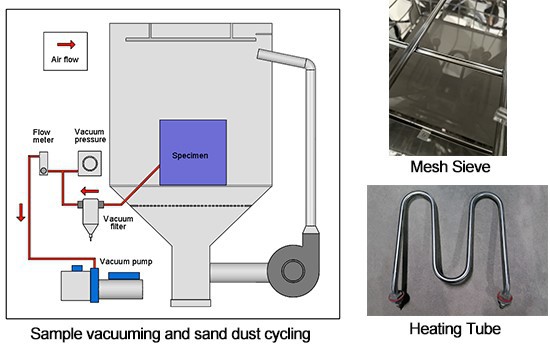
Accurate Dust Concentration Control: PID controller maintains 2–4 kg/m³ (IP5X/IP6X) or higher for military-grade chambers. Blow/stop cycles can run from 1 min to 99 h 59 min, ensuring repeatability.
|
|
|
| Robust Workroom | Precise Controller |


Temperature Stability: Heating tubes combined with insulation layers allow static temperatures up to 80 °C, with typical operational stability at 35–45 °C. Continuous monitoring prevents overheating and maintains equipment longevity.
Durable Construction: SUS304 stainless steel workroom resists abrasion and moisture; external A3 steel panels with 2 mm protective coatings withstand industrial wear. Electromagnetic door locks protect operators and ensure test integrity.
Customizable & Compliant: Chambers are available from 200 L to walk-in sizes and configured to meet IEC 60529, ISO 20653, IEC 60068-2-68, ASTM, and MIL-STD-810H standards.
FAQs about LIB Sand and Dust Chambers
Q1: Can the sand and dust chamber reach 80 °C? If yes, what special design is needed? If not, why?
According to IEC 60529 requirements for dust protection testing, there are no specific temperature conditions defined. Tests are generally conducted at "normal laboratory conditions," and the exact temperature depends on the test environment. Based on this, LIB's sand and dust chamber does not reach 80 °C during active dust-blowing operation, but under static conditions, it can approach this temperature. Typically, the chamber can stably reach 55 °C, and the combination of insulation layers and heating tubes effectively reduces heat loss, ensuring test reliability and safety.
Q2: Can the sand and dust chamber reach 80 °C under static conditions? If yes, how long does it take?
Under static conditions, the sand and dust chamber can reach 80 °C, which usually takes about 40 minutes. Depending on the model, the equipment is equipped with one or two 800 W heating tubes. Combined with the structural design of the insulation layer, heat loss is effectively minimized, ensuring heating efficiency and temperature stability.
Q3: Will temperatures above 80 °C affect the lifespan of the airflow duct or other components?
According to IEC 60529 standards, dust must remain circulating or suspended within the chamber airflow. Based on this design principle, temperatures above 80 °C do not adversely affect the airflow ducts. Additionally, the chamber's structure, with insulation layers and heating tubes, reduces heat loss. Components are carefully selected for temperature resistance and durability, ensuring stable and reliable operation even under elevated temperatures while still meeting standard requirements.
Q4: How is the temperature maintained at 35 °C or 45 °C? Does it rely on continuous heating?
Yes, the sand and dust chamber mainly relies on continuous operation of the heating tubes to maintain the set temperature. Once the temperature reaches the target value, the control system automatically adjusts the heating tubes' operation to keep the internal temperature stable at 35 °C or 45 °C, ensuring test accuracy and reliability.
Q5: For small test items such as headphones, what is the recommended placement method for dust testing?
According to IEC 60529 dust protection standards, test items can be naturally placed inside the chamber or suspended, depending on their size and shape, to ensure even dust exposure. For small items, LIB's sand and dust chamber is equipped with a specially designed overhead beam, allowing lightweight components like headphones to be suspended securely, better meeting test requirements and improving operational convenience.
LIB's Sand and Dust Chambers offer a complete, standards-compliant solution for dust and sand testing across electronics, automotive, industrial, and military applications. With precise control, durable construction, and customizable options, LIB ensures reliable, repeatable results in even the harshest environments.
Contact LIB Industry today for a tailored solution that ensures compliance, reliability, and mission-ready performance in the harshest environments.