
Cosmetic products are exposed to heat, cold, moisture, and repeated environmental changes long before they reach consumers. From transportation and warehouse storage to daily bathroom use, unstable temperature and humidity can cause separation, discoloration, microbial growth, or reduced shelf life.
To ensure safety, quality, and regulatory compliance, cosmetic manufacturers increasingly rely on controlled environmental testing. A professional temperature and humidity chamber allows brands to simulate real-world conditions in a short time, identify risks early, and release products with confidence.
LIB Temperature and Humidity Chambers are designed to deliver stable, repeatable, and standards-compliant environmental conditions. With precise temperature control from –40 ℃ to +150 ℃ and humidity regulation from 20 % to 98 % RH, LIB chambers provide a reliable testing platform for cosmetic stability, aging, and shelf-life evaluation.
Performance Aspects of Cosmetics Requiring Temperature and Humidity Testing
Physical stability is the first concern in cosmetic testing. Creams, lotions, and emulsions may separate, crystallize, or change viscosity when exposed to prolonged high temperatures or alternating hot-cold cycles.
Chemical stability directly affects product safety and efficacy. Active ingredients, fragrances, and preservatives can degrade faster under high humidity and elevated temperatures, reducing performance and increasing safety risks.
Appearance consistency influences consumer trust. Color change, turbidity, sediment formation, or oil migration often occur during humidity aging or thermal cycling tests.
Microbial resistance must be validated under humid conditions. High humidity environments (up to 98 % RH) accelerate microbial growth, making damp-heat testing essential for evaluating preservative systems.
Packaging compatibility requires environmental verification. Plastic containers, pumps, seals, and silicone gaskets may deform, crack, or leak under repeated temperature and humidity stress.
Temperature and Humidity Chambers for Cosmetics Testing

Methods for Testing Cosmetics Using the LIB Temperature and Humidity Chamber
Cosmetic testing in a temperature and humidity chamber follows a controlled, step-by-step process to ensure repeatability and regulatory acceptance.
Standards and Testing References
LIB Temperature and Humidity Chambers support testing aligned with:
IEC 60068-2-30 (Damp heat, cyclic)
IEC 60068-2-14 (Thermal cycling)
ISO cosmetic stability testing guidelines
Shelf-life and storage stability protocols
Automotive and material standards such as SAE J2334 and VW 80000 (for packaging materials)
|
|
|
||||


Step 1: Sample Preparation and Placement
Cosmetic samples are filled into final packaging and placed on SUS304 stainless-steel perforated shelves. The standard configuration includes two shelves, each supporting up to 50 kg, with adjustable height to accommodate different product sizes.
Step 2: Programming Test Conditions
Using the PID touchscreen controller, operators set temperature, humidity, duration, and ramp rates. The controller supports 120 programs with 100 steps each, allowing complex profiles such as temperature cycling followed by high-humidity soaking.
Typical cosmetic test conditions include:
- High-temperature aging: 40–60 ℃
- Damp heat test: 40 ℃ / 75 % RH or 85 ℃ / 85 % RH
- Thermal cycling: –20 ℃ to +60 ℃
Shelf-life acceleration tests
Step 3: Controlled Environmental Exposure
The chamber maintains temperature deviation within ±2.0 ℃ and humidity accuracy within ±2.5 % RH. Dual centrifugal fans ensure vertical forced convection airflow, eliminating hot and wet spots across the workroom.
Step 4: Live Monitoring and Data Logging
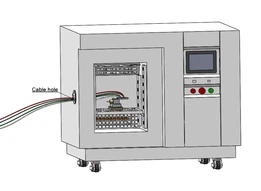
With a 50 mm sealed cable hole, powered cosmetic devices or sensors can operate during testing. Ethernet connectivity enables remote monitoring, real-time data logging, and one-click report export.
Step 5: Evaluation and Documentation
After testing, products are evaluated for physical appearance, odor, texture, microbial stability, and packaging integrity. Test data supports internal QA decisions and regulatory submissions.
》》》For more technical information and details about our Temperature and Humidity Chamber, please feel free to email us at info@libtestchamber.com.
Advantages of the LIB Temperature and Humidity Chamber in Cosmetics Testing
The LIB Temperature and Humidity Chamber combines precise environmental control, uniform airflow, high efficiency, durable construction, intelligent resource management, and comprehensive safety systems to deliver reliable, long-term performance for cosmetic stability and aging tests.
|
|
Name | Temperature and Humidity Chamber | ||||
|
Model |
TH-100 |
|||||
|
Internal dimension (mm) |
400*500*500 |
|||||
|
Overall dimension (mm) |
860*1050*1620 |
|||||
|
Capacity |
100L |
|||||
|
Temperature range |
-20℃ ~+150 ℃ |
|||||
|
Low type |
A: -40℃ B:-70℃ C -86℃ |
|||||
|
Humidity Range |
20%-98%RH |
|||||
|
Temperature deviation |
± 2.0 ℃ |
|||||
|
Heating rate |
3 ℃ / min |
|||||
|
Cooling rate |
1 ℃ / min |
|||||
|
Controller |
Programmable color LCD touch screen controller, Multi-language interface, Ethernet , USB |
|||||
|
Refrigerant |
R404A, R23 |
|||||
|
Exterior material |
Steel Plate with protective coating |
|||||
|
Interior material |
SUS304 stainless steel |
|||||
|
Standard configuration |
1 Cable hole (Φ 50) with plug; 2 shelves |
|||||
|
Timing Function |
0.1~999.9 (S,M,H) settable |
|||||

|
|
|
|
| Robust Workroom | Cable Hole | Temperature and Humidity Sensor |


Wide and Accurate Environmental Control
LIB chambers provide temperature ranges from –20 ℃ to +150 ℃, with optional low-temperature types reaching –40 ℃, –70 ℃, or –86 ℃, covering all cosmetic testing needs.
Uniform Airflow for Repeatable Results
Optimized air duct design and centrifugal fans create uniform airflow. Temperature fluctuation is controlled within ±0.5 ℃, ensuring consistent exposure for all samples.
High Operational Efficiency
Heating rates reach 3 ℃/min, and cooling rates reach 1 ℃/min, significantly shortening test cycles compared with natural storage studies.
Reliable Construction for Long-Term Use
Interior: SUS304 stainless steel, corrosion-resistant and easy to clean
Exterior: 4 mm powder-coated A3 steel, industrial-grade durability
Noise level: below 65 dB(A), suitable for laboratories and clean rooms
Smart Water and Humidity Management
An automatic water inlet system detects water levels and recycles condensate, improving efficiency while supporting environmentally responsible operation.
Safety and Compliance Built-In
Leakage current protection, grounding, phase monitoring, and over-temperature shutdown protect operators, samples, and equipment during long aging tests.
|
|
|
|
|
|---|---|---|---|
 |
 |
 |
|
| Name | Small Temperature and Humidity Chamber | Standing Temperature and Humidity Chamber | Walk-In Temperature and Humidity Chamber |
| Capacity |
TH-50: 800x1050x950 mm TH-80: 900×1100×1000mm |
Capacity: 100L; 225L; 500L; 800L; 1000L |
>20m³ |
| Throughput | Ideal for small components, sensors, boards | Subassemblies or mid-volume batches |
Bulk testing of items or vehicles as a whole |


》》》To receive customized solutions and pricing for the Temperature and Humidity Chamber, please contact us at info@libtestchamber.com.
Temperature and Humidity Chamber FAQs
Q1: How often should the silicone sealing ring be replaced?
It is recommended to replace the silicone sealing ring every 3 years to maintain airtightness and testing accuracy. LIB chambers are designed for up to 20 years of stable operation with proper maintenance.
Q2: How long does the refrigerant in the compressor last?
The refrigerant operates in a fully sealed system and is non-consumable. Under normal conditions, it can function reliably for up to 20 years.
Q3: Will the refrigerant leak during use?
Leakage is extremely rare due to strict pressure testing. While minor risk exists during long-distance transport, LIB uses reinforced packaging and shock-absorption structures to minimize this risk.
Q4: What language options are available for the controller interface?
Standard languages include English and Chinese. Optional languages such as French, German, Russian, and Polish are available at an additional cost of USD 500 per language.
Q5: Can cable holes and shelves be customized?
Yes. The Φ50 mm cable hole, its number, position, and shelf quantity can all be customized based on cosmetic testing requirements.
Every LIB chamber can be tailored to your exact application needs. We back our equipment with a 3-year warranty and lifelong service commitment. In the rare case that an issue cannot be resolved during the warranty period, LIB will replace the unit free of charge. With a round-the-clock English support team and fast global shipping in 7–15 days, your testing never has to wait.
Contact LIB Industry to learn how our Temperature and Humidity Chambers can help you accelerate cosmetic stability testing, improve product reliability, and meet global quality standards with confidence.


