Regarding temperature and relative humidity, how are the standards written?
The description of IS0 16151 is as follows: "Use a suitable system to keep the test chamber and its specimens under the specified temperature and humidity conditions. The temperature is measured at a position greater than 100 mm from the wall of the test chamber." The description in ISO9227 is very similar to this. Although the ISO requirements indicate that the insulation of the test chamber wall is poorly designed or may contain problems, as discussed below, it does not mention the complexity of temperature and relative humidity measurement. ASTM B117 and ASTM G85 have the same statement about temperature control and measurement: "Each setting value and its error represent the operating control point of a position in the test box under the balance bar, but not the uniformity of the test parameters in the test box. Sex ... "
In fact, the changing microclimate around the specimen will bring temperature and relative humidity measurement issues to all cyclic corrosion tests. For example, in the dry test, the relative humidity at the junction of the wet sample and the air is inevitably close to 100%. However, at a few millimeters from the surface of the sample, the relative humidity is low. In addition, the relative humidity is lower near the wall of the test chamber and away from wet surfaces. For test chamber manufacturers, installing sensors is a complex issue.
The environmental test chamber should be equipped with a uniform and effective air distribution device to ensure that the temperature and humidity changes in the test chamber are small. It is necessary to avoid uniformity requirements that cannot be achieved in practice. Humidity and temperature sensors should reflect the climatic conditions of each test area.
The trade-off between probe accuracy and corrosion protection often destroys the measurement. None of them can withstand corrosive conditions. The prevention of sensor corrosion is an important factor in the design of the test chamber, because the corrosion solution will reduce the accuracy of the measurement and cause permanent failure of these expensive sensors. Some manufacturers have designed a smarter mechanism to remove the sensor during the use of corrosive solutions to improve the durability of the relative humidity sensor. Such systems face design complexity and how to determine the position of the sensor in combination with the changing microclimate in the cabinet.
There are two factors that complicate the test when corroding the test chamber. First, the dry bulb thermometer must be kept dry and the wet bulb socks must be kept moist, clean, and salt-free. Second, the first point must be achieved while maintaining sufficient airflow through the wet bulb to promote evaporation. Therefore, the manufacture of the test chamber either cleans the salt in the wet bulb and keeps the dry bulb dry, or avoids the wet bulb and the dry bulb in a corrosive environment.
If the laboratory is accurately controlled to the environmental conditions listed in the standard, the sample can be exposed to these conditions by opening the lid of the test chamber or circulating the indoor air onto the sample in the chamber, thereby achieving a balance between inside and outside the test chamber This eliminates the need to adjust and control the relative humidity in the test chamber. However, the control of laboratory conditions to the accuracy required by these experiments is very rare, especially in corrosion tests. Therefore, a practical approach is to control the relative humidity in the test chamber to replace the lab with changing environment, which is necessary in the global market.
Cyclic corrosion testing has a history of a century. Relatively speaking, relative humidity control is a relatively new function. As in many areas, there is a certain balance between the standard and the function of the test equipment on sale. Test box manufacturers and standards writers must go hand in hand. For decades, the two parties have developed a method of no relative humidity control in the equipment, but more and more car OEMs believe that this test method is unreliable. As more and more devices with relative humidity control enter the market, standard writers must also modernize test methods to take advantage of better test technology while maintaining hardware-neutral standards so that the market can compete openly.
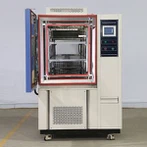
LIB compound salt spray corrosion test chamber can control relative humidity. Widely used in many fields, welcome to consult and purchase.