Coatings are exposed to sunlight, rain, humidity, and temperature changes every day.  Over time, these factors cause fading, chalking, cracking, blistering, and loss of adhesion. In natural outdoor exposure, it may take 1–3 years to see clear degradation results. For manufacturers, this timeline is too long and too unpredictable.
LIB's Xenon Arc Lamp Chamber is widely trusted by customers worldwide for its consistent performance, dependable operation, and user-friendly maintenance design. A long-term client in Vietnam recently reported that their chamber continues to run smoothly and reliably, thanks to routine preventive maintenance and the detailed service support documents provided by LIB. Comments such as "the system operates very stably" and positive feedback on clear maintenance guidance demonstrate the strong confidence users have in LIB equipment for long-term, high-accuracy weathering tests in real laboratory conditions.
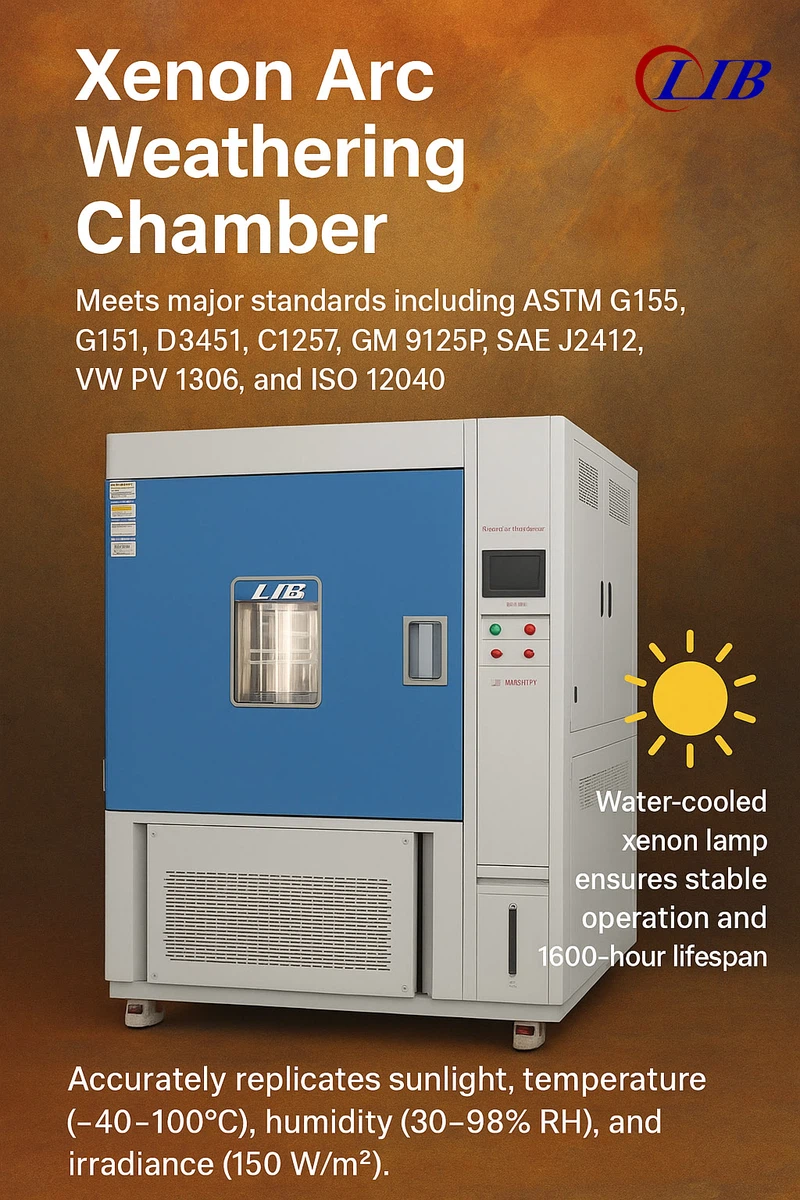
LIB Xenon Weather Resistance Chamber provides an accelerated and controllable solution. By simulating full-spectrum sunlight, moisture, and temperature cycles in a laboratory environment, it delivers repeatable and standards-compliant results within days or weeks, instead of years.
Understanding Coating Weather Resistance Test Methods
|
Coating weather resistance testing evaluates how paints, varnishes, and polymer coatings perform under combined environmental stress. The test typically simulates: 1. Solar radiation (UV, visible, IR) 2. Moisture (water spray or condensation) 3. Temperature cycling 4.Humidity control |
International standards define the exposure method, irradiance level, black panel temperature (BPT), humidity, and cycle timing. Common evaluation indicators include: 1. ΔE color change 2. Gloss retention (%) 3. Chalking grade 4. Crack formation 5. Adhesion loss |
Choosing Xenon or UV Light Source According to Standards
Xenon arc testing is required when full-spectrum sunlight simulation is needed.
Standards such as ASTM G155, ASTM D6695, and ISO 11341 specify xenon arc lamps because they reproduce natural sunlight from 280–800 nm, including UV, visible, and infrared radiation.
For example:
1. ASTM G155 Cycle 1: 102 min light + 18 min water spray, BPT 63°C, irradiance controlled at 340 nm.
2. ASTM D6695: 340 nm at 0.51 W/m²·nm, alternating light and water spray.
3. ISO 11341: Defines spectral distribution, irradiance flux, and temperature control for coatings.
Xenon testing is ideal for automotive coatings, exterior architectural paints, and high-performance industrial coatings.
UV fluorescent testing is suitable when short-wave UV degradation is the focus.
Standards such as ASTM G154 and ISO 4892-3 use UVA-340 or UVB-313 lamps to simulate ultraviolet radiation below 400 nm.
Typical parameters include:
1. UVA-340 lamp peak at 340 nm
2. Condensation phase at 50–60°C
3. UV exposure at 60–70°C
UV chambers mainly evaluate photo-oxidation and surface degradation, while xenon chambers evaluate combined light, heat, and moisture effects.
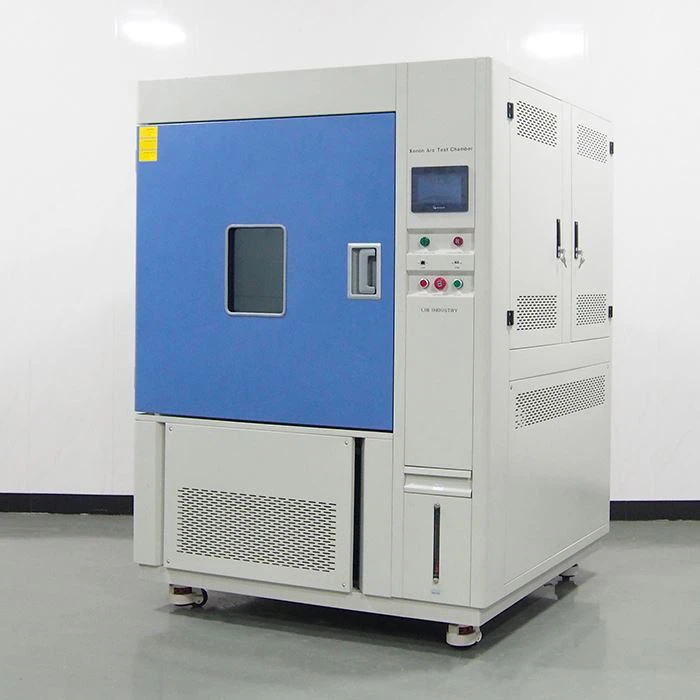
Accelerated Weathering Chambers for coating weather resistance test
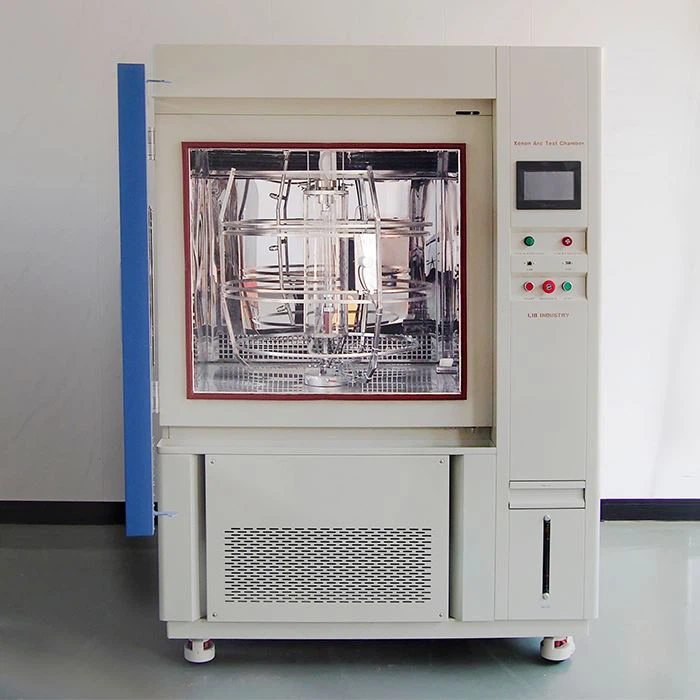
LIB Xenon Weather Resistance Chamber Method for Coating Testing
 |
 |
 |
|
|
Model |
XL-S-750 |
|
Internal Dimension (mm) |
950*950*850 mm |
|
Overall Dimension (mm) |
1300*1420*1800 mm |
|
Sample holder |
Adjustable speed, 1r /min |
|
Chamber Type |
Rotating Holder |
|
Irradiation Source |
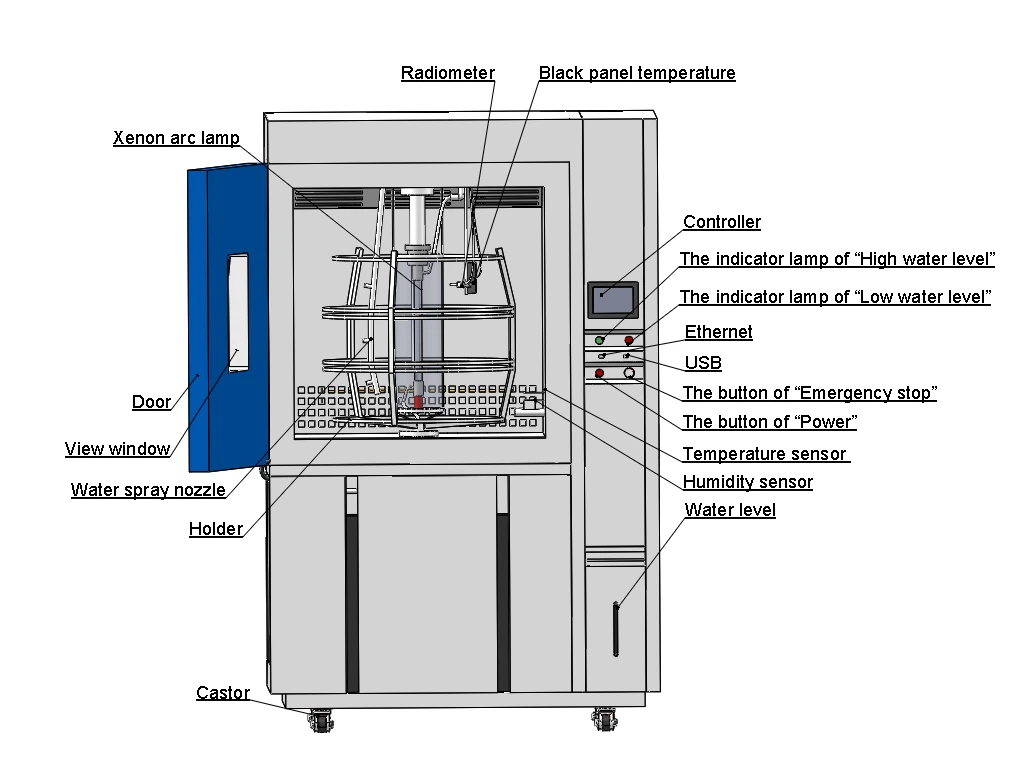
1 piece of 4500w water-cooled xenon arc lamp with inner quartz and outer borosilicate filter |
|
Irradiance Range |
150 W/㎡ |
|
Bandwidth Measurement |
300~400 nm |
|
Chamber Temperature Range |
-40~ 100 ℃ ±2 ℃ |
|
Black Panel Temperature |
BPT 35 ~ 85 ℃ ±2 ℃ |
|
Humidity Range |
30 % ~ 98 % RH |
|
Water Spray Cycle |
1~9999 H 59 M (Adjustable) |
|
Controller |
Programmable color LCD touch screen controller |
|
Radiometer |
UV Radiometer, Tolerance: ±5 % |
Step 1: Sample Preparation ensures realistic exposure conditions.
Mount coated panels on a rotating rack (diameter 650 mm) with a distance of 320–420 mm from the lamp. Maximum sample thickness is 3 cm (standard rack). Label each sample clearly.
Step 2: Stabilizing temperature guarantees repeatable results.
Set black panel temperature (BPT) between 35–85°C (±2°C). ASTM G155 commonly uses 63°C. Chamber humidity can be adjusted from 30% to 98% RH (±5%).
Step 3: Running ASTM G155 exposure cycles simulates outdoor weather.
A common cycle:
102 minutes continuous light
18 minutes light with water spray
Irradiance controlled at 340 nm
Other cycles include dark phases with high humidity to simulate condensation. Programs can run continuously for 500–2000 hours depending on test requirements.
Step 4: Monitoring and logging data ensures compliance.
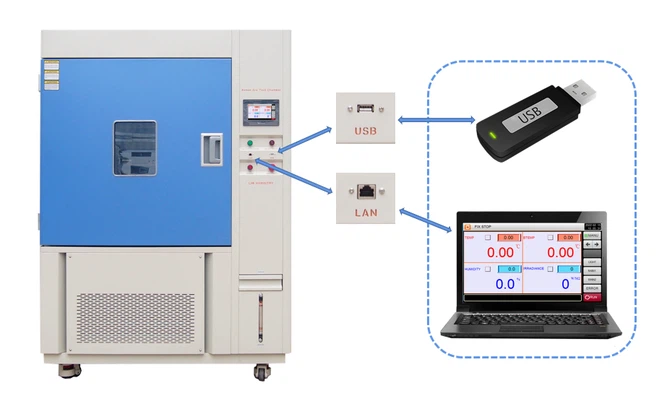
Irradiance tolerance is controlled within ±5%. The PID controller records irradiance, BPT, chamber air temperature (CAT), and spray timing. Data can be exported via Ethernet for ISO or ASTM reports.
Step 5: Evaluating degradation provides measurable results.
After exposure, measure gloss retention, color difference (ΔE), adhesion strength, and cracking width. Results are compared against standard performance criteria.
Advantages of LIB Xenon Weather Resistance Chamber
1. True sunlight simulation improves test reliability.
A 4500W water-cooled xenon arc lamp with daylight, window glass, or extended UV filters reproduces natural solar radiation from 280–800 nm.
|
|
|
| Workroom |
Hanging specimen |


|
|
|


xenon lamp and filters
2. Precise environmental control eliminates variability.
Temperature range: -40°C to 100°C (±2°C)
BPT range: 35–85°C (±2°C)
Humidity: 30–98% RH
This ensures accurate reproduction of Florida, desert, or tropical climates.
3. Uniform exposure increases test consistency.
The rotating sample holder runs at 1 r/min, ensuring all 42 specimens receive equal irradiation and spray distribution.
4. Flexible programming supports multiple standards.
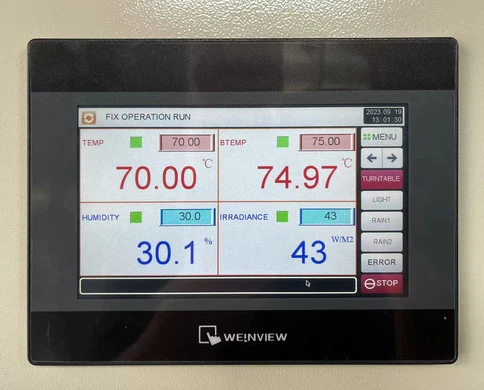
The controller stores 120 programs, each with 100 segments, allowing full compliance with ASTM G155, ISO 11341, ASTM D6695, and SAE J2527.
 |
 |
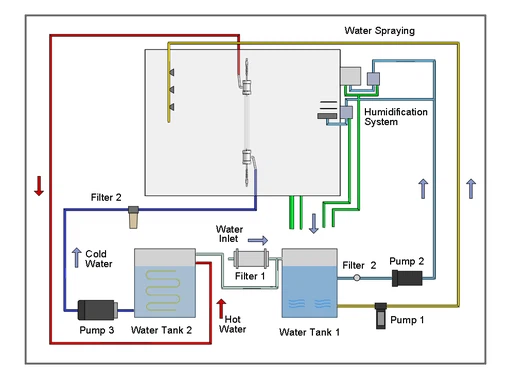
5. Water-saving system reduces operational costs.
Closed-loop filtration recycles up to 80% of spray water, maintaining consistent quality while lowering water consumption.
|
|
 |

FAQs on the Xenon Weather Resistance Chamber
Q1: What is the lifespan of the xenon lamp?
The rated lifespan is 1600 hours. After that, irradiance gradually decreases, so replacement is recommended to maintain accuracy.
Q2: Will empty space affect humidity uniformity?
No. The air circulation system maintains uniform humidity even if the chamber is partially loaded.
Q3: What standards does it comply with?
ASTM G155, ASTM D6695, ISO 11341, ISO 4892-2, SAE J2527, and related coating weathering standards.
Q4: Can both front and rear spray be installed?
Yes. Optional rear spray enhances condensation simulation.
Coating weather resistance test methods are defined by s`trict international standards such as ASTM G155, ASTM D6695, ISO 11341, and ASTM G154. Selecting the correct light source-xenon or UV-depends on whether full-spectrum sunlight simulation or short-wave UV degradation is required.
LIB Xenon Weather Resistance Chamber delivers accurate irradiance control, precise temperature and humidity management, and fully programmable cycles. It transforms long-term outdoor exposure into controlled laboratory testing, helping manufacturers accelerate product development, ensure compliance, and improve coating durability.
Contact LIB Industry today to design a customized test plan and accelerate your coating weather resistance testing with internationally recognized standards.