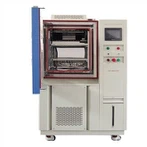
What is the thermal environment chamber?
A temperature environment test chamber is a specialized piece of equipment that is designed to maintain and regulate specific temperature and humidity conditions within an enclosed environment. These chambers are used extensively in a variety of fields, including manufacturing, research and development, quality control, and scientific research.
In what fields is it mainly used?
One of the primary uses of temperature environment test chambers is to test and evaluate how various materials, components, and products will perform under different temperature and humidity conditions. These tests are critical for ensuring the reliability, safety, and overall quality of a wide range of products, from electronics and aerospace components to medical devices and pharmaceuticals.
In manufacturing, temperature environment test chambers are often used in the production of food, pharmaceuticals, and other products that require strict temperature and humidity control. They are also frequently used in research and development facilities to test the performance of new materials and products, and to evaluate how different environmental factors can affect their properties and characteristics.
Several important indicators for purchasing thermal environment chamber
1. Temperature range – This refers to the highest and lowest temperatures that can be achieved in the chamber. It is important to choose a chamber with a range that covers the temperature range needed for the specific test.
2. Temperature stability – This refers to the consistency of the temperature within the chamber. A good temperature stability ensures that the temperature remains constant throughout the test.
3. Temperature uniformity – This refers to the evenness of temperature distribution across the test chamber. A chamber with good temperature uniformity ensures that all parts of the test specimen are exposed to the same temperature.
4. Ramp-up and ramp-down rates – This refers to the rate at which the temperature can be changed. A fast ramp-up and ramp-down rate is significant for some tests, while a slower rate may be sufficient for others.
5. Accuracy and precision – This refers to how close the measured temperature is to the actual temperature and how consistent the measurements are over time.
When your test has requirements for humidity, the corresponding indicator of humidity should also be noted.
LIB thermal environment chamber
|
|
Temperature Range A : -20℃ ~ +150 ℃ B : -40℃ ~ +150 ℃ C: -70℃ ~ +150 ℃ Temperature Fluctuation ± 0.5 ℃ Temperature Deviation ± 2.0 ℃ Humidity Range 20% ~ 98% RH Humidity Deviation ± 2.5% RH Cooling Rate 1 ℃ / min Heating Rate 3 ℃ / min |