When evaluating the long-term durability of materials, laboratories need testing equipment that can reproduce real environmental conditions while delivering stable and repeatable results. Ultraviolet radiation is one of the main causes of aging in plastics, coatings, and textiles, making accelerated UV testing an essential part of modern material research and quality control.
Recently, a customer from Serbia shared positive feedback after using LIB's UV Weathering Test Chamber in their laboratory. Vladimir Todorović wrote: "Hello Alice, how are you? These chambers are used by colleagues from Quality. So far, they didn't have any problem with the UV chamber and we tested without any problems. Yes, thank you, I know that support from your side is excellent and I am grateful." His team uses the LIB UV chamber for routine quality testing, confirming both reliable performance and professional technical support.
📩📩📩

This article explains the working principle of the UV chamber and how LIB UV Chambers help laboratories perform accurate and accelerated material aging tests.
UV chamber Principle
The UV chamber principle is to simulate ultraviolet radiation and environmental cycles to accelerate material aging in a controlled laboratory environment.
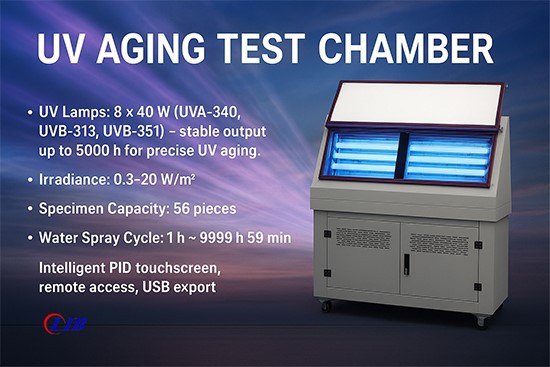
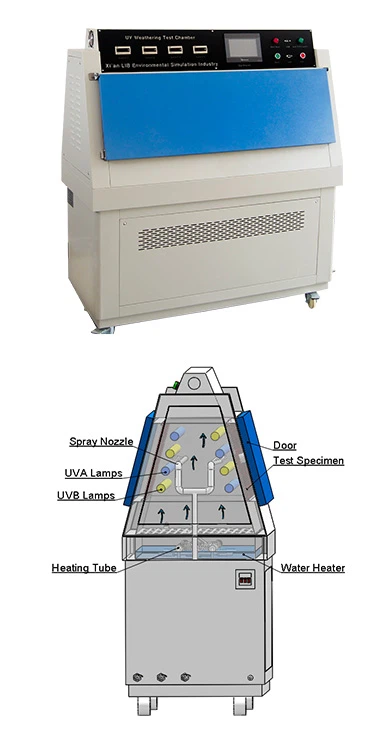
A UV weathering chamber uses fluorescent ultraviolet lamps to reproduce the most damaging wavelengths of sunlight, mainly UVA and UVB radiation. These lamps generate consistent spectral energy so materials receive the same exposure conditions during every test cycle.
Typical lamps used include UVA-340, UVB-313, and UVB-351, each designed to simulate different portions of the solar spectrum. The irradiance is precisely controlled within 0.15–5 W/m² at 340 nm or 313 nm, allowing laboratories to reproduce sunlight intensity according to specific test standards.
To create realistic aging conditions, the UV chamber also combines temperature, humidity, and condensation cycles. The chamber temperature can be controlled from ambient temperature up to 90 °C ±2 °C, while humidity can reach ≥95 % RH ±2 % RH. These conditions accelerate photochemical reactions that cause fading, cracking, or surface degradation.
An important parameter inside the chamber is the Black Panel Temperature (BPT). BPT represents the combined heat effect from hot air and UV radiation on the specimen surface. Monitoring BPT ensures that materials experience realistic solar heating conditions during testing.
Additionally, many UV chambers include a water spray or condensation system. Spray nozzles simulate rainfall or dew formation with a rate of approximately 0.8–1.0 ml/80 cm²/h and a flow of 0.3 L/min, reproducing outdoor moisture cycles that contribute to weathering.
To ensure international compatibility, UV aging tests are commonly conducted according to recognized standards such as:
1. ISO 4892-3 – Plastics exposure to fluorescent UV lamps
2. ASTM G154 – Standard practice for operating fluorescent UV weathering apparatus
3. ASTM D4329 – UV exposure testing for plastics
4. ISO 105-B02 – Color fastness to artificial light (textiles)
By combining ultraviolet light, temperature, humidity, and moisture cycles under these standards, the UV chamber delivers repeatable and accelerated aging results.
Applications and Test Methods of UV Chambers
UV weathering chambers are widely used to evaluate the durability and color stability of materials exposed to sunlight.
|
|
|
 |


1. Plastics and Polymer Materials
Plastics are highly sensitive to ultraviolet radiation. Prolonged exposure can cause surface cracking, chalking, discoloration, or mechanical strength reduction. UV chambers help manufacturers evaluate the long-term durability of products such as outdoor housings, automotive components, and packaging materials.
Testing commonly follows ASTM G154 or ISO 4892-3, using alternating cycles of UV irradiation and condensation. A typical cycle may include 8 hours UV exposure at 60 °C followed by 4 hours condensation at 50 °C.
2. Coatings and Paints
Paints and protective coatings must maintain gloss, adhesion, and color stability in outdoor environments. UV chambers simulate years of sunlight exposure to evaluate coating durability in a short period.
Testing standards include ASTM D4587 and ISO 11507, which assess gloss loss, blistering, cracking, and color changes after UV exposure.
3. Textiles and Dyes
For fabrics and dyed materials, UV exposure can cause fading and color instability. The UV chamber allows manufacturers to perform light fastness tests to determine whether fabrics meet quality requirements.
These tests commonly follow ISO 105-B02, which measures color changes after exposure to simulated sunlight.
4. Automotive and Outdoor Products
Automotive parts, outdoor furniture, construction materials, and electrical enclosures must withstand harsh environmental conditions. UV chambers simulate sunlight combined with heat and humidity to verify product durability before certification and market release.
Advantages of the LIB UV Chamber
LIB's UV Weathering Test Chamber is engineered to deliver stable, precise, and repeatable ultraviolet aging tests.
|
Model |
UV-SI-260 |
|
|
Internal Dimension (mm) |
450*1170*500 |
|
|
Overall Dimension (mm) |
680*1300*1500 |
|
|
Irradiation Source |
Fluorescent UV lamps (8) - 40 W |
|
|
Temperature Range |
Ambient ~ 90 ℃ ±2℃ |
|
|
Black Panel Temperature (BPT) |
35 ~ 80 ℃ |
|
|
Humidity Range |
≥95% RH |
|
|
Bandwidth |
290 ~ 400 nm |
|
|
Irradiance Control |
0.3~20 W/㎡ |
|
|
Distance of Specimen and lamp |
50 mm |
|
|
Heating Element |
Nichrome heater |
|
|
Controller |
Programmable color LCD touch screen controller |
|
|
Ethernet connection, PC Link,USB |
||
|
Water Supply System |
Automatic water supply, Water purification system |
|
|
Interior Material |
SUS304 stainless steel |
1. High-Stability UV Light Source
The chamber uses QUV fluorescent UV lamps, including UVA-340, UVB-313, and UVB-351, each rated at 40 W. These lamps maintain stable spectral output for up to 5000 hours, ensuring consistent irradiation during long test cycles.
2. Large Specimen Capacity
The flat aluminum specimen holder design can accommodate up to 52 samples simultaneously. Custom specimen holders are also available to support different material shapes and sizes.
3. Precision Irradiance Control
The chamber integrates a UV irradiance radiometer, such as the UV-SI-260, which continuously monitors and adjusts irradiation levels between 0.15 and 5 W/m². This ensures that exposure conditions remain accurate throughout the entire test.
4. Advanced Environmental Simulation
Ten spray nozzles (five on each side) create realistic humidity and rainfall effects. Combined with precise temperature and humidity control, the system reproduces outdoor weather cycles that accelerate material degradation.
5. Intelligent Control System
A programmable color touch-screen controller supports multi-step test programs, data recording, and computer connectivity. The system supports multiple languages and allows users to configure customized aging profiles based on specific testing standards.
FAQs on the UV Chamber
Many laboratories and manufacturers have common questions about UV weathering testing.
1. How long does a UV aging test take?
A UV test can simulate months or years of outdoor exposure within a few days to several weeks, depending on the test cycle and material properties.
2. What materials can be tested in a UV chamber?
UV chambers are suitable for plastics, coatings, rubber, paints, textiles, adhesives, automotive components, and construction materials.
3. Why is UV aging testing important?
UV radiation can significantly affect color stability, mechanical strength, and surface durability. Accelerated UV testing helps manufacturers improve product quality and ensure compliance with international standards.
4. What are the advantages of LIB UV equipment?
LIB UV Weathering Test Chambers offer three main advantages: strict adherence to ASTM G154 for reliable and standard-compliant results, use of US QUVA/B UV lamps for realistic UV simulation and easy replacement, and a three-year warranty ensuring long-term stable operation.
Any customization can be made. LIB offers a 3-year warranty and lifetime service. Any issues that cannot be resolved during the warranty period will be replaced free of charge. 24/7 English-speaking after-sales team. Fast shipping within 7-15 days.

Contact LIB Industry to learn how UV weathering testing can improve the durability and reliability of your materials and products.