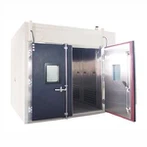
Packaging rarely stays indoors. Boxes sit on loading docks, bottles travel across continents, and printed labels bake in direct sun for weeks before a product ever reaches a shelf. If the material fades, cracks, or loses its seal along the way, the brand behind it pays the price. That is why more packaging manufacturers are turning to accelerated weathering equipment to see these failures in the lab, months before they ever happen in the real world.
This article explains what a xenon arc weathering light fastness tester can actually do for the packaging industry, walks through a real cable-testing project completed for Electricite De France, and shares customer feedback from a Russian university that uses LIB's XL-S-750 Xenon Arc Weathering Light Fastness Tester. The customer commented: "Good afternoon! We are satisfied with the purchase; there have been no complaints about the equipment. Thank you!" This feedback highlights the reliability and stable performance of LIB's xenon testing solution in practical laboratory applications.
|
|
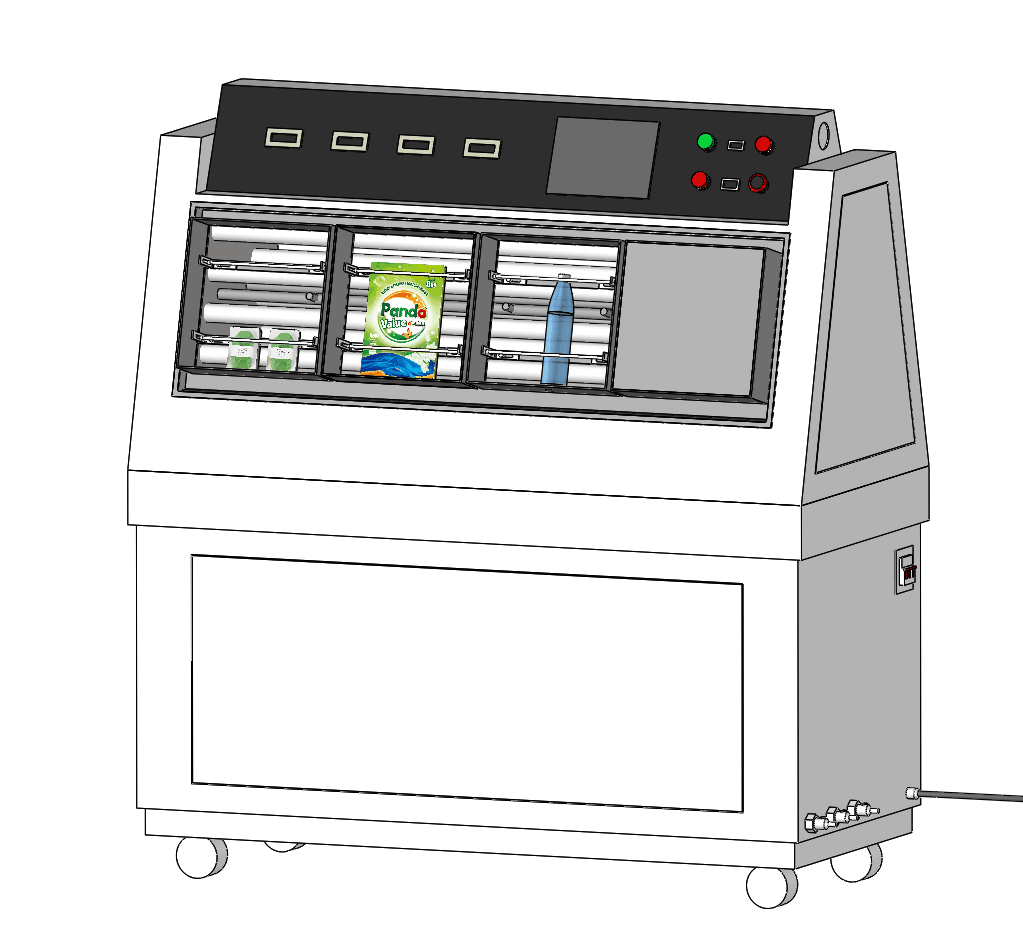 |
| XL-S-750 Xenon Arc Weathering Light Fastness Tester | UV-SI-260 UV Weathering Light Fastness Tester |
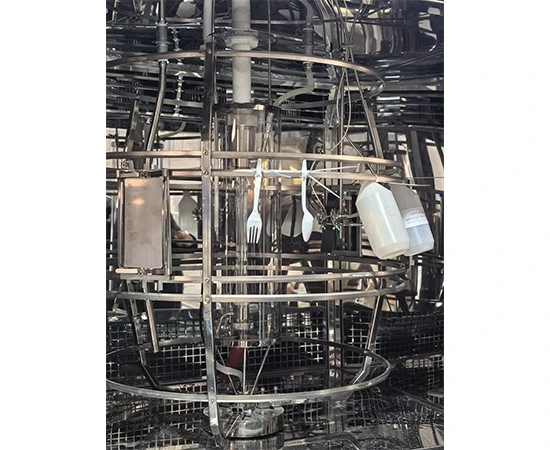
The article also compares xenon arc testing with UV testing and answers the questions packaging engineers ask most often about service, customization, and shipping from LIB Industry.
Common Environmental Tests for Packaging Materials
Packaging engineers typically run seven kinds of environmental checks before a material is approved for production.
1. Xenon arc weathering testing under ISO 4892-2 reproduces the full solar spectrum, including UV, visible, and infrared light, to judge how
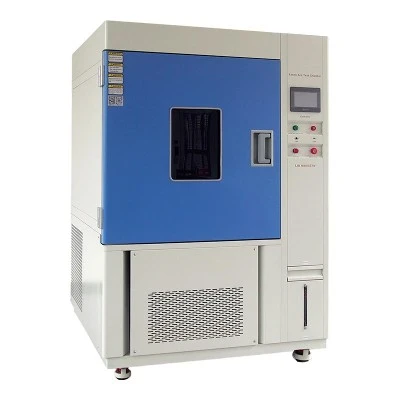
fast colors fade and coatings degrade.
2. UV-only testing narrows the focus to the 300 to 400 nm range, which is useful for materials that only need to survive indoor lighting or short outdoor exposure.
3. Temperature and humidity cycling between minus 40°C and 40°C, at relative humidity from 80% to 85%, checks whether flexible films and laminates stay intact through cold storage and humid transport.
4. Salt spray testing under ASTM B117 tells manufacturers whether printed coatings keep their flexibility and adhesion after exposure to corrosive salt fog.
5. Low temperature storage testing under ASTM D standards, usually down to minus 40°C, confirms packaging will not become brittle in cold warehouses.
6. Finally, IPX5 and IPX6 water ingress testing measures whether a package can survive a direct water jet without letting moisture reach the product inside.
LIB Industry has built its equipment specifically to cover this full test range. Its production line has shipped xenon arc weathering equipment to more than 60 countries, with engineering teams that have supported the packaging, coatings, cable, and electronics sectors for over 15 years. Clients working with LIB Industry include packaging converters, coating manufacturers, and cable producers across Europe, Asia, and North America, all of whom rely on the same equipment to certify materials against international standards before shipment.
| Standard | Application in Packaging |
|---|---|
| ISO 4892-2 | Xenon arc light exposure for plastics, films, and coatings |
| ASTM G155 | Xenon arc weathering cycle validation and material durability |
| ASTM B117 | Salt fog corrosion resistance for coated and metallic packaging |
| ASTM D4329 | UV exposure of plastics used in packaging structures |
| IEC 60529 | IPX5 and IPX6 water ingress protection rating |
How EDF Trusted LIB Industry for a Full Cable Test Program
In April 2023, Electricite De France contacted LIB Industry by email with a test standard and a pricing request. The project needed to follow EN 50483-6 for low-voltage aerial bundled cable, which meant the equipment had to reach both the required irradiance level and a cold chamber temperature of minus 40°C. Based on this need, LIB Industry recommended the XL-S-750C low temperature xenon test equipment, which met the irradiation requirement in the standard while also supporting the minus 40°C cold test. The customer received the finished equipment in November of the same year.
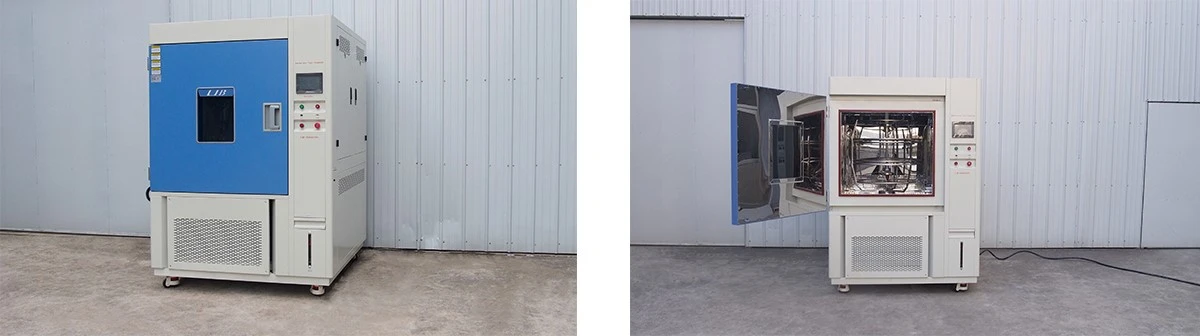
Beyond EN 50483-6, the same equipment supports the full set of standards cable manufacturers are asked to meet, including EN 50289-4- 17, IEC 62930, and ASTM G155.
1. For EN 50289-4-17 specifically, the test uses a xenon arc lamp fitted with borosilicate filters, delivering a typical irradiance of 43 W/m² plus or minus 15% across 300 to 400 nm, controllable to 43.0 plus or minus 0.2 W/m² at 340 nm when the irradiance control option is fitted.
2. Six specimens are suspended vertically on a rotating drum turning at 1 plus or minus 0.1 revolutions per minute.
3. Each 120 minute cycle runs 102 minutes of dry UV exposure at a black panel temperature of 60 plus or minus 3°C with 50 plus or minus 5% relative humidity, followed by 18 minutes of rain exposure without radiation at 50 plus or minus 5°C, repeating for a total of 720 hours across 360 cycles.
EDF's engineers came back satisfied with how closely the results tracked their product performance requirements. What stood out to them was the combination of accuracy and safety. The equipment carries CE and IEC compliance, precise temperature and irradiance control, and free customization to match different cable diameters and product standards. LIB Industry backs every unit with a 3-year warranty and lifetime technical support, plus on-site training so operators are confident running the equipment from day one. The stainless-steel interior resists corrosion over years of continuous use, and the after-sales team has a reputation for patient, detailed troubleshooting rather than a one-time installation call.
Popular Climate Test Chambers for Packaging and Cables

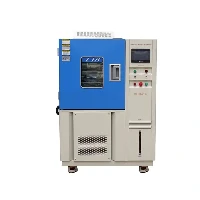
Accurate Sunlight Simulation, Reliable Weathering Results, EN 50289-4-17, IEC 62930, ASTM G155, EN 50483-6


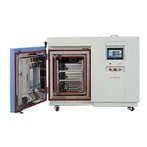
Reproduce Real Climate Conditions, IEC 60068-2-1, IEC 60068-2-2, IEC 60068-2-3, IEC 60068-2-30


Xenon Arc vs UV Weathering: Which One Should You Choose?
Xenon arc equipment and UV equipment solve different problems, and the numbers make the difference clear.
|
|
|
|
|---|---|---|
|
|
|
|
| Model | XL-S-750 | UV-SI-260 |
| Irradiation Source | 1 piece of 4500W xenon arc lamp | 8 pieces of fluorescent UV lamps |
| Irradiance Range |
35–150 W/m² at 300–400 nm 0.2–2 W/m² at 340 nm 0.2–2 W/m² at 420 nm |
0.15–1 W/m² at 340 nm 0.15–1 W/m² at 313 nm |
| BPT | 35–85°C ±2°C | 35–80°C |
| Humidity Range | 50–98% RH | ≥95% RH, no temperature control |
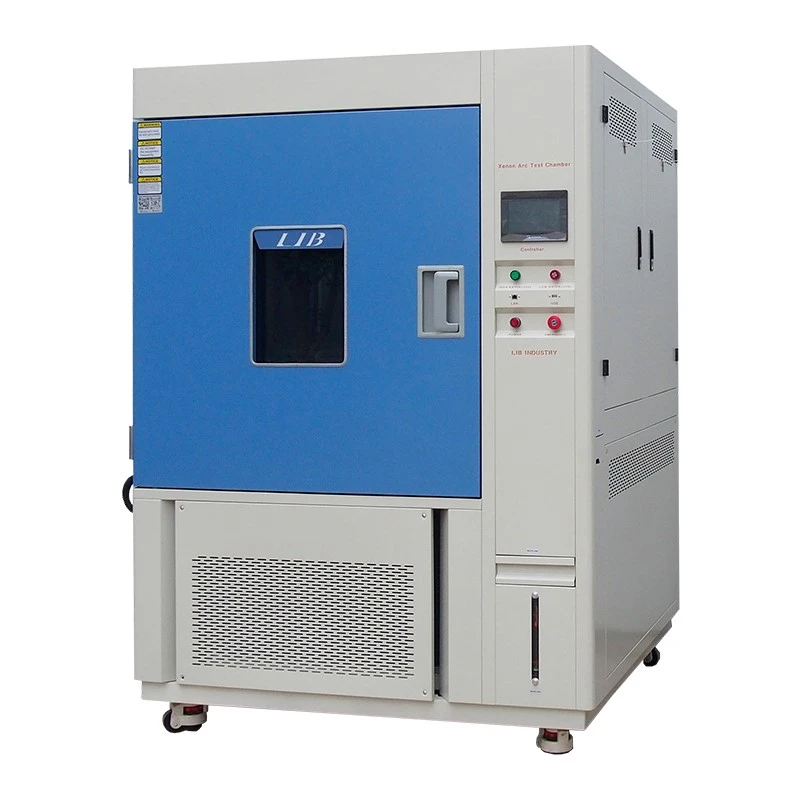

Xenon arc equipment follows ASTM G155 and ISO 4892-2 and is the closer match to natural sunlight, since it covers UV, visible, and infrared wavelengths together. This makes it the right choice when a package's real-world color and coating performance under full sun needs to be predicted accurately. UV equipment follows standards such as ASTM G154 and ISO 4892-3 and focuses only on the UV band. It costs less to run and is a practical choice when the packaging only faces indoor lighting or brief outdoor exposure and full humidity control is not required. For most outdoor packaging, labels, and cable jacketing, xenon arc testing gives the more realistic and defensible result.
FAQs on Xenon Arc Weathering Testing for Packaging
Q1: Can the test cycle be customized for our packaging standard?
Yes, LIB Industry programs the light, dark, and spray phases to match whatever cycle your product standard requires, at no extra cost.
Q2: How long does delivery take?
Standard equipment typically ships within 7 to 15 days, with full guidance provided for secure delivery and installation at your site.
Q3: What happens if the equipment develops a fault after installation?
Every unit includes a 3-year warranty and lifetime support, and if an issue cannot be resolved remotely, LIB Industry provides a free replacement.
Q4: Do you provide training for our lab staff?
Yes, on-site training is available so your team can run test programs independently from the first day of operation.
Q5: Is the equipment suitable for both plastic and metal packaging components?
Yes, the same equipment supports ISO 4892-2 xenon testing for plastics and films alongside ASTM B117 salt spray testing for metallic and coated components.
Need Help Choosing the Right Packaging Material Test Chamber?
Choosing the right environmental test chamber depends on your required test standard, material type, sample size, exposure condition, and testing purpose. LIB Industry provides environmental testing solutions for packaging materials and related products, including a Xenon Arc Weathering Light Fastness Tester for realistic sunlight simulation according to ISO 4892-2 and ASTM G155, a UV Weathering Test Chamberfor UV aging evaluation, a Temperature Humidity Test Chamber for climate cycling tests, a Salt Spray Test Chamberfor corrosion resistance testing, and water ingress test equipment for packaging sealing verification.
Share your required test standard, product material, sample dimensions, exposure duration, environmental conditions, and any special fixture requirements. Based on these factors, the LIB Industry team can help identify the appropriate environmental testing solution for your packaging materials, coatings, plastics, labels, cables, and other products.
References
LIB Industry Technical Team (info@libtestchamber.com) – Technical information, testing methods, product specifications, and application guidance for xenon arc weathering testing, UV weathering testing, temperature humidity testing, salt spray testing, water ingress testing, packaging durability evaluation, and environmental reliability testing.
Your Premium trial has ended