
If you're responsible for product reliability, you've likely encountered ASTM B117 at some point. It's the most widely referenced salt spray test standard globally-and for good reason. Whether you're coating automotive components, marine hardware, or electronic enclosures, this standard helps you predict how your products will hold up in real-world saline environments. But here's the critical question: can a salt spray fog test chamber actually perform ASTM B117 testing correctly?
This article explains how LIB's Salt Spray Fog Test Chamber fully meets ASTM B117 requirements-covering the specific test conditions, step‑by‑step methods, and how we ensure a stable, repeatable salt fog environment. You'll also see real feedback from Brazilian customers, a detailed comparison with generic chambers, and answers to the most common questions about service and shipping.
ASTM B117 Testing: What LIB's Salt Spray Fog Test Chamber Delivers
1. ASTM B117 Test Conditions: Exact Parameters You Must Maintain
ASTM B117 is not a pass/fail specification-it's a practice that defines how to operate salt spray apparatus. To generate valid results, your chamber must maintain these specific conditions:
| ASTM B117 Requirement | |
|---|---|
| Salt Solution | 5% sodium chloride (NaCl) |
| Water Quality | Distilled or deionized |
| pH Range | 6.5 – 7.2 (neutral) |
| Chamber Temperature | 35 ± 2 °C |
| Spray Pressure | 83 kPa |
| Deposition Rate | 1 – 2 mL/80 cm²·h |
| Nozzle Type | Quartz or corrosion‑resistant |
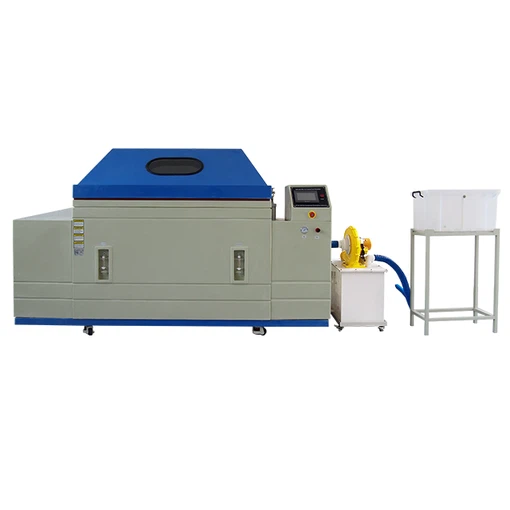
LIB's chamber meets every one of these parameters precisely. Our automatic brine stirring and filtration system keeps the 5% NaCl solution stable throughout the test, preventing pH drift. The PT‑100 Class A sensors maintain temperature within ±0.5 °C-well inside the ±2 °C tolerance-and the quartz nozzles generate a consistent fog at exactly 83 kPa.
2. ASTM B117 Test Method: Step‑by‑Step Execution
Running a valid ASTM B117 test follows a clear sequence:
① Preparation: Prepare fresh 5% NaCl solution using distilled water. Adjust pH to 6.5–7.2 using acetic acid or sodium hydroxide if needed.
② Specimen Placement: Mount samples on V‑groove or round‑rod holders at a 15–30° angle, ensuring no contact between specimens and no dripping from one sample onto another.
③ Equipment Setup: Set temperature to 35 °C and program the continuous spray cycle. Ensure the salt collector is positioned correctly to measure deposition.
④ Exposure: Run the test for the specified duration-common intervals include 24, 96, 240, or up to 1,000+ hours depending on your product requirements.
⑤ Evaluation: After exposure, remove samples, rinse with distilled water, and assess corrosion according to your own criteria.
LIB's 7‑inch touchscreen controller stores up to 120 programs with 100 steps each, making it simple to automate the entire sequence-including pre‑soak, spray, and post‑test drying phases-without manual intervention.
3. Ensuring a Stable Salt Spray Environment: How LIB Does It
Consistency is the backbone of ASTM B117. If temperature drifts or deposition varies, your results become meaningless. LIB's chamber uses multiple systems to lock in stable conditions:
① Saturated Air Barrel: Preheats and humidifies air before it enters the spray tower. This stabilizes salt concentration and prevents temperature shocks when atomized fog contacts the chamber interior.
② Precision Quartz Nozzles: Resist corrosion and maintain consistent droplet size, ensuring the deposition rate stays between 1–2 mL/80 cm²·h across the entire test area.
③ PID Control with PT‑100 Sensors: Real‑time feedback adjusts heating and humidification to keep temperature fluctuation within ±0.5 °C and deviation within ±2 °C-exceeding ASTM B117 requirements.
④ Automatic Safety Protections: Dry‑burn protection, low‑water alerts, and over‑temperature interlocks prevent equipment damage and test interruptions.
Brazilian Customers Are Satisfied with LIB's Cyclic Salt Spray Fog Test Chamber
Customers in Brazil's automotive, marine, and industrial coating sectors have put LIB's Cyclic Salt Spray Fog Test Chamber to work-and they're seeing real results.
One Brazilian testing lab uses our cyclic chamber to evaluate coating durability under alternating salt spray, humidity, and drying phases. They reported that the chamber's temperature stability (±0.5 °C) and deposition uniformity (±0.2 mL/80 cm²·h across different locations) gave them confidence that every specimen receives identical exposure-critical for batch‑to‑batch consistency.
What they value most:
1. Standards Compliance: The chamber supports ASTM B117, ISO 9227 (NSS, AASS, CASS), IEC 60068‑2‑11, and CSA requirements. For Brazilian manufacturers exporting globally, having a single chamber that meets multiple certifications-including CE, IEC, and CSA-simplifies audits and accelerates market access.
2. Ease of Sample Handling: Removable V‑groove and round‑rod holders adapt to various specimen shapes and sizes. Operators can load and unload samples in minutes, reducing downtime between tests.
3. Operational Safety: Built‑in over‑temperature, low‑water, and pressure alarms protect both operators and samples. The transparent lid with LED lighting allows visual inspection without opening the chamber.
4. Stable Salt Fog Delivery: The saturated barrel and quartz nozzles maintain consistent fog output, so operators don't need to constantly recalibrate mid‑test.
5. Customization Options: LIB offers tailored solutions-whether you need specific sample holders, a larger chamber size, or integration with your existing data system.
6. Cost‑Effectiveness: With a 3‑year warranty and lifetime technical support-plus spare‑part delivery within 7–15 days-our Brazilian customers know they're covered for the long haul. One customer noted that the automatic water replenishment and condensate recycling reduced refill frequency by roughly 80%, cutting operational costs significantly.
Salt Spray Fog Test Chamber vs Cyclic Salt Spray Fog Test Chamber-How to Choose
Not all salt spray chambers are created equal. Here's a direct comparison to help you decide:
| Feature |
|
|
|---|---|---|
| Primary Standards | ASTM B117, ISO 9227 (NSS/AASS/CASS), IEC 60068‑2‑11 | ISO 11997, ASTM D5894, SAE J2334, VDA 621‑415 |
| Test Environment | Constant salt fog (5% NaCl) at 35 °C | Alternating salt fog, humidity (up to 98% RH), drying, and temperature ramps |
| Temperature Control | Fixed at 35 ± 2 °C | Programmable from ambient to 60 °C or higher, with ramp rates |
| Humidity Control | Not required (saturated air only) | Active humidity control for wet and dry phases |
| Test Duration | Typically 24–1000+ hours continuous | Often 1–12 weeks of cyclic sequences (simulates years of outdoor exposure) |
| Application | Quality control, material screening, standard compliance | R&D, accelerated field simulation, complex coatings, automotive/marine |
| Sample Placement | Fixed holders, 15–30° angle | Same, but may require multiple positions for different phases |
| Maintenance | Regular solution refill, nozzle cleaning | Similar, plus humidity sensor calibration and water supply for wet phases |
| Cost | Lower initial investment | Higher due to additional control systems (humidity, drying) |
| LIB Model | LIB Salt Spray Fog Test Chamber (standard) | LIB Cyclic Salt Spray Fog Test Chamber (programmable with humidity and drying) |


The decision depends on your testing goals, industry requirements, and product life cycle.
|
Choose Continuous Salt Spray Testing when: ① You need to comply with ASTM B117 or ISO 9227 for routine quality control. ② Your product is a simple metal or coating where steady saline exposure is the main concern. ③ You want a low‑cost, quick, and repeatable screening test. ④ Your customers or regulators explicitly ask for ASTM B117 certification. |
Choose Cyclic Salt Spray Testing when: ① Your product will be exposed to fluctuating outdoor environments (e.g., automotive exterior, marine decks, aircraft components). ② You want to correlate accelerated test results with natural weathering data. ③ You need to evaluate complex assemblies, joints, or dissimilar metals where galvanic corrosion is a factor. ④ You follow automotive or aerospace standards that require cyclic methods (e.g., SAE J2334). ⑤ Your R&D team wants more realistic failure modes to improve product design. |
LIB offers both types of chambers, so you aren't forced into one approach. Our standard Salt Spray Fog Test Chamber is perfect for basic compliance testing, while our Cyclic model adds humidity and drying capabilities to match the most demanding international protocols. Both feature the same durable construction, precision sensors, and user‑friendly interface-plus a 3‑year warranty and lifetime support.
LIB Popular Salt Spray Fog and Climate Test Chambers for coatings and Mental

Controlled Temperature, Humidity & Salt Spray for Realistic Simulation, Highly Popular.

Temperature & Salt Spray Control Only, Precision Salt Spray Measurement, Standard Compliant.
Controlled SO₂, Temperature, Humidity & Salt Spray for Industrial Environment Simulation.

Realistic Sunlight Simulation, Water-Cooled Lamp for Stability & Durability, Top Choice for Coating Companies.

UV Light Simulation Test, Stable Light Source, High Uniformity of Light Exposure.

Large Test Pieces, High-Volume Testing; Flexible Customization of Size & Function.
FAQs on the Salt Spray Fog Test Chamber
Q1: What standards does LIB's Salt Spray Fog Test Chamber support?
A1: Our chamber is designed to meet ASTM B117, ISO 9227 (NSS, AASS, CASS), IEC 60068‑2‑11, and CSA requirements. It also complies with CE safety standards. If you need a specific standard, we can customize the chamber to suit your testing needs.
Q2: What kind of warranty and after‑sales support do you offer?
A2: Every LIB chamber comes with a 3‑year warranty covering manufacturing defects. We provide lifetime technical support-our English‑speaking support team is available 24/7. If remote troubleshooting doesn't resolve the issue, we dispatch a replacement unit free of charge. Spare parts are guaranteed to arrive within 7–15 days.
Q3: How is the chamber shipped, and what about customs clearance?
A3: We package the chamber in export‑grade wooden crates with anti‑moisture and anti‑shock protection. We handle all export documentation and can arrange shipping via air or sea freight. Our logistics team assists with customs clearance support to ensure smooth delivery to your lab.
Q4: Can I customize the chamber for specific sample sizes or test sequences?
A4: Absolutely. We offer customization options including larger chamber sizes, custom sample holders, and special software configurations. Just tell us your requirements-we'll design a solution that fits.
Q5: How easy is it to maintain the chamber?
A5: Very easy. Routine tasks-checking the salt solution level, cleaning the collector, and verifying pH-take less than 10 minutes daily. The quartz nozzles require replacement only every 2–3 years under normal use. The FRP interior resists corrosion, so no need for frequent deep cleaning.
Contact LIB Industry today to learn how our Salt Spray Fog Test Chamber can strengthen your product's market reputation and accelerate development timelines.


