In many laboratories, engineers and researchers must reproduce extreme environmental conditions-desert heat, tropical humidity, or freezing storage-to understand how products behave before they reach the market. Large environmental chambers can deliver these conditions, but they often occupy valuable floor space and slow down daily testing workflows.
A customer from Thailand's aerospace and aircraft manufacturing sector recently shared positive feedback after using the benchtop thermal humidity test chamber: "Now I am confident and understand how to use the climate chamber, especially the FIX mode, which is quite easy to use." This experience reflects how modern benchtop climate chambers combine professional environmental simulation with simple operation, allowing engineers to start testing quickly and efficiently.
This article explains how accurate a benchtop thermal humidity test chamber can be, how it achieves precise environmental control, and how LIB's benchtop systems support real-world testing standards across multiple industries.
Accuracy of a Benchtop Thermal Humidity Test Chamber
1. LIB Temperature and Humidity Control Precision
The accuracy of a benchtop thermal humidity test chamber depends mainly on its sensor quality and control system.
High-grade laboratory chambers typically achieve:
Temperature range: –70 °C to +150 °C
Temperature fluctuation: ±0.5 °C
Temperature uniformity: ±2 °C
Humidity range: 20 %–98 % RH
Humidity deviation: ±2.5 % RH
Most systems rely on PT100 Class A platinum resistance sensors, which can detect temperature changes with a resolution as small as 0.001 °C. Combined with PID-based control algorithms, the chamber continuously adjusts heating, cooling, and humidification to maintain stable conditions.
These precision levels meet common laboratory verification requirements defined in standards such as:
- IEC 60068-3-5 – Environmental testing chamber performance verification
- ISO 16750-4 – Environmental conditions and testing for electrical equipment in road vehicles
- ASTM E145 – Standard specification for gravity-convection and forced-ventilation ovens
2. How Benchtop Chambers Achieve Precise Environmental Simulation
Accurate environmental simulation requires more than just sensors-it depends on the entire control architecture.
A typical benchtop thermal humidity chamber uses several coordinated subsystems:
a. Compressor-Based Refrigeration System
A sealed compressor with eco-friendly refrigerant removes heat rapidly, enabling controlled cooling rates around 1 °C/min.
b. Electric Heating System
High-efficiency resistance heaters deliver heating rates of about 3 °C/min, ensuring stable ramp profiles for accelerated tests.
c. Closed-Loop Humidity Control
Steam humidifiers or ultrasonic systems inject moisture into the airflow, while condensers remove excess moisture to stabilize RH.
d. Optimized Airflow Circulation
Centrifugal fans and airflow baffles create laminar circulation so temperature and humidity remain uniform across all test samples.
These combined systems allow the chamber to simulate environments defined in international test standards such as:
-
IEC 60068-2-30 – Damp heat cyclic test
-
IEC 60068-2-78 – Damp heat steady state
-
MIL-STD-810H Method 507.6 – Humidity test procedures
3. Typical Applications and Standard-Based Tests
Because of their accuracy and compact size, benchtop thermal humidity chambers are widely used across multiple industries.
A. Electronics Reliability Testing
Electronic components must operate reliably under high temperature and humidity conditions. Tests commonly follow:
IEC 60068-2-30 – Cyclic humidity test
JEDEC JESD22-A101 – Steady-state temperature humidity bias test
IPC-TM-650 2.6.3.5 – Moisture resistance of printed circuit boards
These tests help identify corrosion, solder fatigue, or insulation failure.
B. Pharmaceutical Stability Studies
Pharmaceutical products require precise environmental conditions for stability evaluation. Regulatory testing follows:
ICH Q1A(R2) – Stability testing of new drug substances and products
USP <1079> – Good storage and distribution practices
Typical storage conditions include 25 °C / 60 % RH or 40 °C / 75 % RH.
C. Automotive Component Validation
Automotive electronics must survive extreme climates. Standards include:
ISO 16750-4 – Environmental testing for road vehicles
SAE J1455 – Environmental practices for heavy-duty vehicles
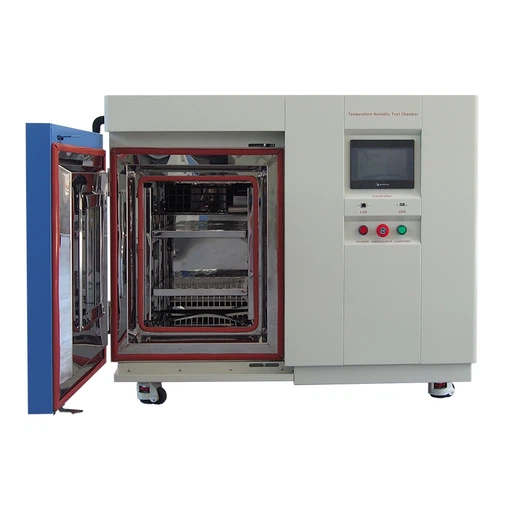
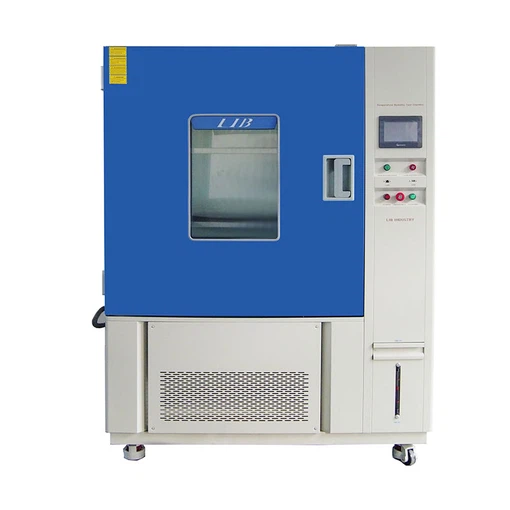


LIB Benchtop Thermal Humidity Test Chamber for Electronics Testing
One of the most widely used electronics environmental standards is IEC 60068-2-30 Damp Heat Cyclic Test.
1. Example Test Cycle (IEC 60068-2-30)
A typical humidity cycle includes:
Temperature increase from 25 °C to 55 °C
Relative humidity maintained at 95 % RH
Hold period of 12 hours
Cooling stage to 25 °C
Repeated cycles for 6–12 days
This cycle accelerates corrosion and moisture penetration in electronic assemblies.
2. LIB Benchtop Chamber Example: Model TH-50
The LIB TH-50 benchtop thermal humidity chamber can perform this standard cycle with the following capabilities:
|
|
|
||||||
| Model | TH-50 | TH-80 | |||||
| Internal dimension (mm) |
320x350x450 |
400x400x500 | |||||
| Overall dimension (mm) | 800x1050x950 | 900×1100×1000 | |||||
| Temperature range | -86 ℃ ~+150 ℃ | ||||||
| Temperature fluctuations | ± 0.5 ℃ | ||||||
| Humidity Range | 10%/20%~95 % | ||||||
| Temperature deviation | ± 2.0 ℃ | ||||||
| Temperature Sensor | PTR Platinum Resistance PT100Ω/MV A-class | ||||||
| Temperature Resolution | ± 0.001 ℃ | ||||||
| Exterior Material | Steel Plate with A protective coating | ||||||
| Interior Material | SUS 304 stainless steel | ||||||


The programmable controller allows engineers to load the IEC 60068-2-30 cycle and run automatic multi-day tests.
Key Advantages of LIB Benchtop Chambers
1. Quiet Operation
Noise levels below 65 dBA, allowing installation directly inside laboratories.
2. Compact Footprint
Units occupy less than 1 m², making them ideal for R&D benches.
3. High-Precision Control
PT100 Class A sensors ensure ±0.5 °C stability and ±2.5 % RH accuracy.
4. Advanced Programmable Control
A 7-inch touchscreen controller supports up to 120 test programs, each with 100 steps, enabling complex multi-stage environmental profiles.
LIB Thermal Humidity Chambers for Different Laboratory Needs
1. Benchtop Thermal Humidity Test Chamber
Benchtop thermal humidity test chambers are designed for laboratories with limited space. With typical capacities of 50 L–100 L, they can be placed directly on a laboratory bench while still delivering precise temperature and humidity control. These compact systems are commonly used for testing electronic components, sensor modules, small medical devices, and research prototypes, allowing engineers to perform environmental validation quickly without leaving their workstation.
2. Reach-In Thermal Humidity Test Chamber
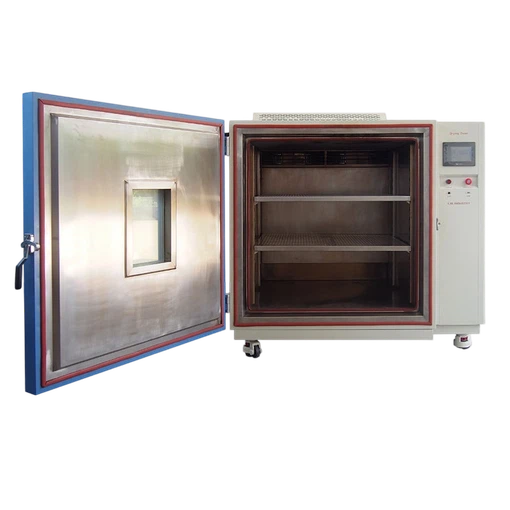
Reach-in chambers provide larger testing space for laboratories that need to evaluate bigger samples or multiple units at once. With capacities typically ranging from 150 L to 1000 L, and environmental ranges of –70 °C to +150 °C and 20 %–98 % RH, they are widely used in production QA labs to test automotive control modules, battery components, and industrial electronics under controlled environmental conditions.
3. Drive-In Thermal Humidity Test Chamber
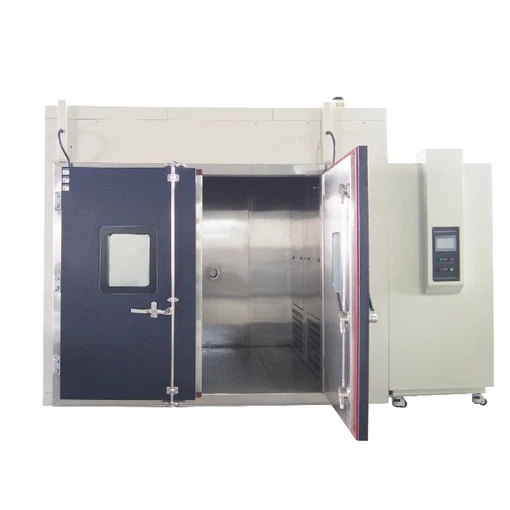
Drive-in chambers are large walk-in systems designed for testing complete products or multiple large assemblies simultaneously. They are commonly used in industries such as electric vehicles, aerospace, and telecommunications, where entire battery packs, avionics systems, or equipment cabinets must be validated under long-term temperature and humidity stress.
FAQs on the LIB Benchtop Thermal Humidity Test Chamber
Q1: How accurate is the LIB benchtop thermal humidity chamber?
LIB chambers typically maintain ±0.5 °C temperature stability and ±2.5 % RH humidity deviation, meeting the performance verification requirements of IEC 60068-3 standards.
Q2: Can the chamber run automated multi-step environmental cycles?
Yes. The programmable controller supports 120 programs with up to 100 steps each, allowing automated temperature-humidity cycling according to international test standards.
Q3: How long does shipping take?
LIB maintains an international spare-parts network. Standard delivery time for chambers or replacement parts is typically 7–15 days, depending on destination and configuration.
Q4: What service and support does LIB provide?
LIB offers:
- 3-year equipment warranty
- lifetime technical support
- calibration and maintenance advice
Engineers can receive assistance from English-speaking support specialists 24/7.
Precise environmental simulation is essential for product reliability, regulatory compliance, and accelerated development cycles. With compact design, high-precision control, and compatibility with global testing standards, LIB benchtop thermal humidity test chambers provide laboratories with powerful and efficient environmental testing capabilities.
Contact LIB Industry to learn how our benchtop, reach-in, and drive-in thermal humidity chambers can support your environmental testing programs.