Today's products are expected to operate reliably in some of the harshest environments on earth. Automotive ECUs must start at −40 °C in winter and continue working near 85 °C under the hood. Lithium batteries may run in tropical climates with 95 % RH. Photovoltaic modules are required to pass 1000-hour damp heat tests at 85 °C / 85 % RH. Without controlled environmental simulation, risks such as corrosion, seal failure, insulation degradation, and solder fatigue often remain hidden until costly field failures occur.
Recently, customer Keyhan shared feedback after commissioning the chamber in his laboratory:"We have been using the chamber since last week. It is overall good so far. I will keep you updated."From initial installation to continuous operation, the system showed stable temperature ramping, steady humidity regulation, and smooth overall performance. For testing laboratories, early-stage operational stability is essential. It ensures reliable data collection, reduces unexpected downtime, and builds confidence during long-duration tests such as 85 °C / 85 % RH damp heat exposure or −40 °C to +85 °C thermal cycling. Real-world user validation demonstrates that dependable environmental testing begins with accurate control and robust engineering design.
The LIB Environmental Chamber Temperature and Humidity Control recreates extreme climatic conditions with high precision and repeatability. It offers a temperature range from −70 °C to +150 °C and humidity control from 20 % to 98 % RH, with temperature fluctuation maintained within ±0.5 °C. Designed for automotive, battery, photovoltaic, aerospace, and defense applications, the chamber supports compliance with international standards such as IEC 60068-2-30 (Damp Heat Cyclic), IEC 61215 (PV Thermal Cycling and Damp Heat), SAE J2334 (Automotive Corrosion), and VW 80000 environmental validation requirements.
Environmental Chamber Temperature and Humidity Control Accuracy
Control accuracy is defined by sensor precision and system stability. LIB chambers use PT100 Class A temperature sensors with high resolution and stable signal output. Temperature control accuracy reaches ±0.5 °C, and humidity accuracy is maintained within ±2.5 % RH under steady conditions.
Uniformity is achieved through optimized air circulation. Dual centrifugal fans create bidirectional airflow, ensuring temperature variation inside the chamber remains within ±1.5 °C. This eliminates hot and cold zones, so both small PCB samples and large assemblies experience identical conditions.
Refrigeration systems ensure stable thermal transitions. The cascade refrigeration system supports wide ranges from –70 °C to +150 °C. Ramp rates reach 3 °C/min heating and 1 °C/min cooling in standard models. Pressure stability (5–15 bar standby, 15–25 bar running) ensures consistent cooling performance.
Humidity control depends on balanced dry-wet bulb calibration. Humidity is calibrated using a dry-wet bulb comparison method. A wet wick sensor ensures accurate measurement. Condensate recycling and heater resistance control (13Ω–26Ω normal range) keep humidity stable from 20 % to 98 % RH.
Perforated sample racks improve airflow consistency. Customized perforated stainless steel shelves allow vertical airflow penetration. This design reduces obstruction and enhances chamber-wide environmental balance.
Compliance validates real accuracy.
LIB chambers support testing according to:
1. IEC 60068-2-1 / 2 (Low & High Temperature)
2. IEC 60068-2-30 (Damp Heat Cyclic)
3. IEC 61215 (PV Thermal Cycle –40 °C to +85 °C, 200 cycles)
4. ISO 16750 (Automotive Environmental Testing)
5. ICH Q1A(R2) (Pharmaceutical Stability Testing 25 °C / 60 % RH, 40 °C / 75 % RH)
6. Accuracy is not just a number-it is verified performance under global standards.
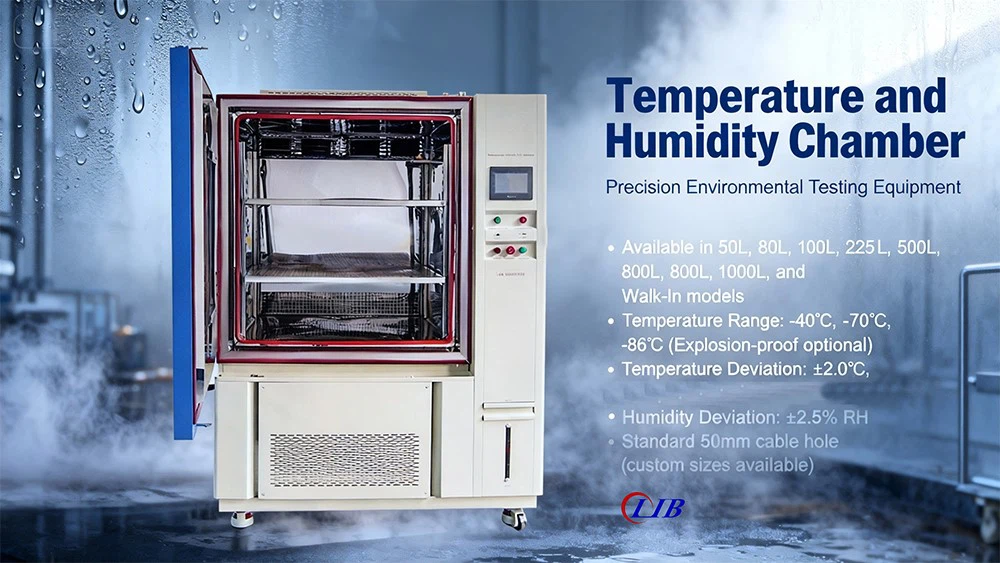
LIB Temperature Humidity Chambers for aging test
LIB Environmental Chamber Temperature and Humidity Control Advantages
|
|
Name | Temperature Humidity Chamber | ||||
|
Model |
TH-100 |
|||||
|
Internal dimension (mm) |
400*500*500 |
|||||
|
Overall dimension (mm) |
860*1050*1620 |
|||||
|
Capacity |
100L |
|||||
|
Temperature range |
-20℃ ~+150 ℃ |
|||||
|
Low type |
A: -40℃ B:-70℃ C -86℃ |
|||||
|
Humidity Range |
20%-98%RH |
|||||
|
Temperature deviation |
± 2.0 ℃ |
|||||
|
Heating rate |
3 ℃ / min |
|||||
|
Cooling rate |
1 ℃ / min |
|||||
|
Controller |
Programmable color LCD touch screen controller, Multi-language interface, Ethernet , USB |
|||||
|
Refrigerant |
R404A, R23 |
|||||
|
Exterior material |
Steel Plate with protective coating |
|||||
|
Interior material |
SUS304 stainless steel |
|||||
|
Standard configuration |
1 Cable hole (Φ 50) with plug; 2 shelves |
|||||
|
Timing Function |
0.1~999.9 (S,M,H) settable |
|||||

|
|
|
|
|
|
| Robust Workroom | Cable Hole | Temperature and Humidity Sensor | PID controller |


1. Factory multi-point calibration guarantees precision before delivery.
Nine temperature probes are distributed evenly inside the working area. Average values are compared to preset standards and adjusted via hardware parameters to ensure uniformity and display accuracy.
2. European refrigerant compliance ensures environmental responsibility.
According to the 2024 EU F-Gas Regulation, refrigerants must have GWP ≤150 for laboratory equipment. LIB uses compliant refrigerants. CO₂ refrigerant cannot be directly used because it requires a different system structure.
3. Robust structural materials enhance long-term stability.
The interior uses SUS304 stainless steel for corrosion resistance. The exterior A3 powder-coated steel resists impact and chemical exposure.
4. Observation without disturbance improves test integrity.
The observation window uses double-layer tempered glass with conductive anti-frost film. LED lighting allows clear monitoring without opening the door.
5. Programmable control improves efficiency.
A 7-inch color touchscreen supports 120 programs with 100 steps each. Ethernet and USB allow CSV export and real-time monitoring for ISO/IEC 17025 documentation.
6. Energy-efficient humidification reduces cost.
Closed-loop condensate recycling reduces water consumption by up to 70 %. Thick 100 mm polyurethane insulation lowers energy usage by 20–30 %.
LIB Environmental Chamber Temperature and Humidity Control Maintenance Guide
1. Regular heating system inspection ensures temperature accuracy.
Check heating strips every 6 months. Verify wiring connections and inspect solid-state relays (input 220V, output 0–400V). Clean dust from circulation motors and adjust blade balance if noise occurs.
2. Cooling system maintenance preserves performance.
Clean condenser and compressor surfaces using pressurized air. Monitor pressure gauge: 5–15 bar (stop), 15–25 bar (running). If pressure is <5 bar, refrigerant may need replenishment.
3. Humidity system upkeep guarantees reliable RH control.
Replace water filter annually. Clean water tank monthly. Inspect humidifier heater resistance (13Ω–26Ω normal). Replace yellowed or moldy wet wick immediately.
4. Electrical system inspection prevents downtime.
Check controller wiring, relays, transformer connections, and circuit boards. Remove dust regularly and tighten screws.
5. Sealing components protect stability.
Inspect sealing strips and rubber plugs every 2 years. Replace aged components to prevent air leakage and humidity loss.
Preventive maintenance directly protects control accuracy.
FAQs on Environmental Chamber Temperature and Humidity Control
Q1: How is the temperature sensor calibrated?
After assembly, nine probes are placed inside the chamber. Data is averaged and compared to standards. Hardware parameters are adjusted to achieve uniformity and precise display alignment.
Q2: Can CO₂ refrigerant be used under EU regulations?
No. Although EU rules require GWP ≤150, CO₂ systems use different design structures and cannot replace current refrigerants directly.
Q3: What is the observation window material?
Double-layer tempered glass with conductive anti-frost coating.
Q4: Is an embedded glass door available?
Yes. LIB supports full non-standard customization, including embedded glass doors and special access ports.
Q5: Does the chamber include audible and visual alarms?
Audible alarms are standard. Visual alarms are optional.
Temperature accuracy of ±0.5 °C. Humidity control within ±2.5 % RH. Uniformity under ±1.5 °C. Compliance with IEC, ISO, and ICH standards. Accuracy is not marketing language-it is measurable engineering performance.
Contact LIB INDUSTRY today for detailed specifications, customization consultation, or a live demonstration of our environmental chamber temperature and humidity control technology.