Electronic devices, automotive sensors, pharmaceutical packaging, and aerospace materials are constantly exposed to moisture changes during storage and operation. Excess humidity can cause corrosion, oxidation, insulation failure, adhesive degradation, and shortened product lifespan. For manufacturers and laboratories, controlling humidity accurately during environmental testing is critical to obtaining reliable and repeatable results.
Recently, LIB received positive feedback from a customer in Romania after successful installation of the Controlled RH 100% Laboratory Climate Chamber. The customer stated: "Hello, The chamber was successfully installed, as far as I know everything is ok, I don't have any complaints from my colleagues. If any issues arise, we will contact you." This feedback reflects the stable performance and reliable operation of the Controlled RH 100% Laboratory Climate Chamber in real laboratory use.
This article explains how a Controlled RH 100% Laboratory Climate Chamber maintains stable humidity conditions, how it compares with natural environmental testing, and how LIB provides small, reach-in, and walk-in humidity chambers for different testing applications while complying with international standards such as IEC 60068, MIL-STD-810, ISO 16750, ASTM, and ICH stability requirements.
How A Controlled RH 100% Laboratory Climate Chamber Controls Humidity
1. Precise Temperature And Humidity Control System
A Controlled RH 100% Laboratory Climate Chamber maintains humidity by balancing temperature, airflow, and water vapor generation inside a sealed workspace. LIB chambers use PT100 Class A sensors with temperature resolution up to ±0.001 °C and humidity accuracy within ±2.5 % RH. Through PID intelligent control, the chamber continuously adjusts heating, cooling, humidification, and dehumidification systems to keep conditions stable.
For example, when performing a damp heat test at 85 °C and 85 % RH according to IEC 60068-2-78, the chamber automatically regulates steam generation and refrigeration capacity to prevent overshoot or condensation instability. Multi-directional centrifugal airflow systems maintain temperature uniformity within ±1.5 °C, ensuring all test samples receive identical environmental exposure.
2. Controlled RH 100% Laboratory Climate Chamber Vs Natural Environmental Testing
Natural outdoor testing depends heavily on climate, season, and geographic conditions. Rainfall, sunlight, and humidity can change hourly, making long-term repeatability difficult. In contrast, a Controlled RH 100% Laboratory Climate Chamber creates stable and programmable environmental conditions regardless of external weather.
For example, achieving 95 % RH continuously outdoors for 500 hours is nearly impossible in many regions. Inside a laboratory chamber, humidity can be maintained steadily from 20 % RH up to 98 % RH or even near-saturation 100 % RH conditions for weeks without interruption. Accelerated testing also shortens product development cycles. A 1000-hour damp heat aging test following IEC 60068-2-67 or ISO 16750 can be completed continuously with no environmental fluctuation, helping manufacturers obtain faster validation results for automotive electronics, PCB boards, semiconductors, and battery systems.
3. Working Principle Of Humidity Generation And Regulation
The chamber humidity system mainly consists of a steam humidifier, refrigeration system, water recovery module, circulation fans, and PID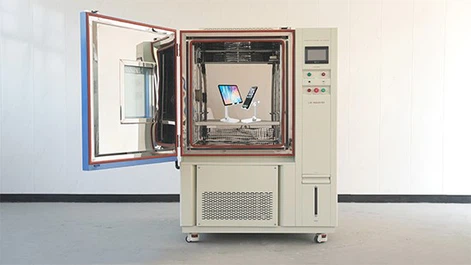 controller. During operation, purified water enters the humidification tank and is converted into water vapor through electric heating. The moisture is then distributed evenly through circulating airflow.
When humidity exceeds the target value, the refrigeration system condenses excess moisture through evaporator cooling, removing water vapor from the air. This closed-loop regulation allows the chamber to maintain stable humidity conditions even during rapid temperature changes between –40 °C and +150 °C.
LIB chambers also include water filtration and condensate recycling systems that can reduce water consumption by up to 70 %. Combined with 100 mm polyurethane insulation and variable-speed compressors, the chamber reduces energy consumption while maintaining stable humidity performance during long-term testing.
Differences Between LIB Small, Reach-In, And Walk-In Controlled RH 100% Laboratory Climate Chambers
LIB provides three major chamber configurations to meet different laboratory capacities and product sizes.
1. Small Controlled RH 100% Laboratory Climate Chamber
Small chambers are designed for laboratories with limited space and small sample testing. Typical capacities range from 50 L to 100 L. These chambers are commonly used for PCB boards, sensors, IC components, medical devices, and research samples.
Temperature ranges typically cover –70 °C to +150 °C with humidity control from 20 % RH to 98 % RH. Noise levels are generally below 65 dB(A), making them suitable for laboratories and office-based R&D environments.
2. Reach-In Controlled RH 100% Laboratory Climate Chamber
Reach-in chambers are the most commonly used configuration in industrial laboratories. Capacities usually range from 225 L to 1000 L. They support testing for automotive electronics, batteries, communication devices, plastics, and industrial assemblies.
Reach-in chambers provide larger airflow systems, faster temperature ramp rates up to 5 °C/min, and programmable multi-stage environmental cycles. Adjustable shelves, cable ports, and reinforced sample racks allow flexible testing for products with different weights and dimensions.
3. Walk-In Controlled RH 100% Laboratory Climate Chamber
Walk-in chambers are designed for oversized products and mass sample testing. They are widely used for vehicle components, photovoltaic systems, aerospace assemblies, and full-scale industrial equipment.
These chambers can reach room-sized dimensions and support multiple operators entering during installation or inspection. LIB walk-in chambers can maintain stable humidity up to 98 % RH across large internal spaces while supporting continuous operation for thousands of hours.
How To Choose The Right Chamber
If the laboratory mainly tests small electronic components or sensors, a benchtop chamber offers the best space efficiency and low operating cost. For routine product qualification and reliability testing, reach-in chambers provide the best balance between capacity and performance. For large equipment, high-volume testing, or automotive system validation, walk-in chambers are the preferred solution.
Popular Laboratory Climate Chambers
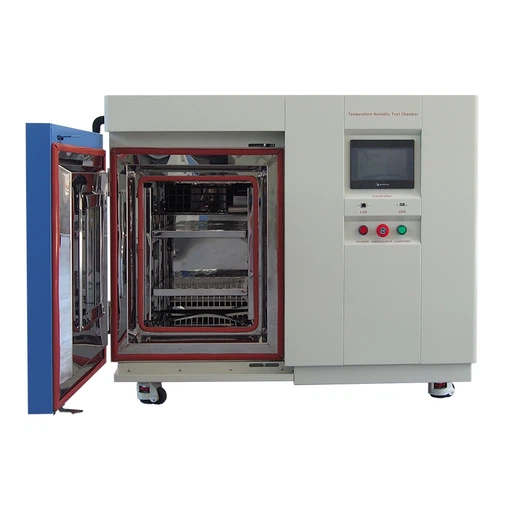
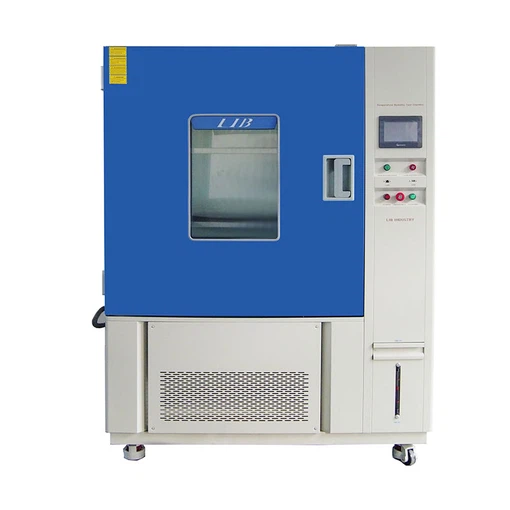
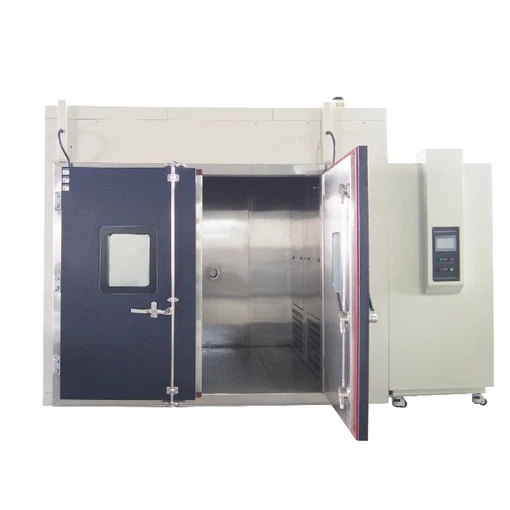


LIB Controlled RH 100% Laboratory Climate Chamber For Electronics Aging Testing
One of the most widely used humidity reliability standards for electronics testing is IEC 60068-2-78 Damp Heat Steady State Testing. This standard is commonly applied to PCB assemblies, semiconductors, connectors, automotive ECUs, sensors, and communication devices.
Typical IEC 60068-2-78 test conditions include:
Temperature: 40 °C ±2 °C
Relative Humidity: 93 % RH ±3 %
Test Duration: 48 h, 96 h, 240 h, 500 h, or 1000 h
Continuous damp heat exposure without interruption
For accelerated electronics reliability testing, many manufacturers also perform the 85 °C / 85 % RH test cycle according to JESD22-A101 and IEC 60068 standards. This test exposes products to high temperature and high humidity continuously for 1000 hours to evaluate corrosion resistance, insulation degradation, and long-term electrical reliability.
LIB recommends the TH-225 Controlled RH 100% Laboratory Climate Chamber for this application.
LIB TH-225 Model Specifications
|
|
Name | Controlled RH 100% Laboratory Climate Chamber | ||||
|
Model |
TH-100 |
|||||
|
Internal dimension (mm) |
400*500*500 |
|||||
|
Overall dimension (mm) |
860*1050*1620 |
|||||
|
Capacity |
100L |
|||||
|
Temperature range |
-20℃ ~+150 ℃ |
|||||
|
Low type |
A: -40℃ B:-70℃ C -86℃ |
|||||
|
Humidity Range |
20%-98%RH |
|||||
|
Temperature deviation |
± 2.0 ℃ |
|||||
|
Heating rate |
3 ℃ / min |
|||||
|
Cooling rate |
1 ℃ / min |
|||||
|
Controller |
Programmable color LCD touch screen controller, Multi-language interface, Ethernet , USB |
|||||
|
Refrigerant |
R404A, R23 |
|||||
|
Exterior material |
Steel Plate with protective coating |
|||||
|
Interior material |
SUS304 stainless steel |
|||||
|
Standard configuration |
1 Cable hole (Φ 50) with plug; 2 shelves |
|||||
|
Timing Function |
0.1~999.9 (S,M,H) settable |
|||||

Advantages Of LIB Controlled RH 100% Laboratory Climate Chambers
1. High Precision Environmental Control
PT100 Class A sensors and PID intelligent regulation ensure stable humidity and temperature conditions during long-duration reliability testing.
2. Excellent Airflow Uniformity
Dual centrifugal fans eliminate hot or wet spots, improving repeatability for multi-sample electronics testing.
3. Low Maintenance Humidity System
Automatic water filtration and condensate recycling reduce manual maintenance and extend humidifier service life.
4. Strong Data Recording Capability
USB and Ethernet connectivity support continuous data logging and automatic export of CSV or PDF test reports for ISO/IEC documentation.
5. Durable Industrial Construction
SUS304 stainless steel interiors and reinforced external structures support continuous 24/7 operation in demanding laboratory environments.
|
|
|
|
|
|
| Robust Workroom | Cable Hole | Temperature and Humidity Sensor | PID controller |


FAQs On The Controlled RH 100% Laboratory Climate Chamber
Q1: Can the chamber maintain humidity close to 100 % RH continuously?
Yes. LIB chambers can maintain humidity conditions up to 98 % RH continuously, and near-saturation humidity conditions can be achieved depending on temperature range and testing requirements.
Q2: Does LIB provide customized chamber sizes?
Yes. LIB supports customized benchtop, reach-in, and walk-in chamber designs according to sample size, temperature range, humidity range, and laboratory space requirements.
Q3: How long is the delivery time?
Standard models are typically delivered within 7–20 working days. Fully customized walk-in chambers may require additional production time depending on project complexity.
Q4: Does LIB provide installation and overseas support?
Yes. LIB provides remote technical guidance, English-language support, installation assistance, commissioning service, and training materials for global customers.
Q5: What transportation methods are available?
LIB chambers are exported worldwide using reinforced wooden packaging suitable for sea freight, air freight, and land transportation. Protective anti-vibration packaging helps ensure safe delivery during long-distance shipping.
Contact LIB Industry today to learn more about Controlled RH 100% Laboratory Climate Chambers, customized environmental testing solutions, and professional support for your laboratory reliability testing projects.