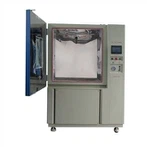
In shelf-life testing for pharmaceuticals, cosmetics, and food products, precision isn't optional-it's essential. Even slight deviations in temperature or humidity can alter stability, safety, and efficacy, leading to unreliable data or costly re-testing. That's why laboratories and QA teams rely on environmental test chambers that deliver long-term accuracy, repeatability, and full compliance with international standards.
This reliability is exactly what users experience with LIB's Temperature and Humidity Test Chamber. As a PhD researcher at Luleå University of Technology in Sweden noted during food shelf-life testing, the chamber is "very user-friendly" and performs consistently in real laboratory conditions. Features like real-time monitoring, data recording, and straightforward thermal cycling make daily testing efficient, while LIB's responsive service team provides ongoing support whenever questions arise. These real-world results reflect how the chamber integrates seamlessly into demanding research environments, delivering both technical performance and confidence.

Standards and Test Points for Shelf-Life Evaluation
Shelf-life testing for pharmaceuticals, cosmetics, and food must follow strict international standards to ensure safety, efficacy, and regulatory compliance. LIB's Temperature and Humidity Test Chambers fully support these protocols, providing reliable and repeatable environmental conditions.
1. Pharmaceutical Stability Standards
ICH Q1A(R2): Defines long-term (25 °C ± 2 °C / 60 % RH ± 5 % RH), intermediate (30 °C ± 2 °C / 65 % RH ± 5 % RH), and accelerated (40 °C ± 2 °C / 75 % RH ± 5 % RH) storage conditions for stability testing.
ASTM D4332: Specifies environmental exposure for medical and pharmaceutical products.
2. Cosmetics Stability Standards
ISO 16217: Prescribes temperature–humidity cycles for assessing product integrity over time.
IEC 60068-2-78: Evaluates long-term damp heat exposure, simulating storage in humid climates.
3. Food Shelf-Life Standards
ISO 22000: Food safety management and environmental monitoring.
ASTM F1980: Accelerated aging for packaged foods to estimate shelf life.
|
|
|


Key Test Points Based on Standards
1. Temperature: Long-term and intermediate tests use moderate ranges (25–30 °C), while accelerated degradation studies typically employ 40 °C ± 2 °C, not arbitrary extremes.
2. Humidity: Moderate relative humidity is maintained according to product type - 60–65 % RH for pharmaceuticals, 40–75 % RH for cosmetics, with accelerated tests up to 75 % RH.
3. Duration: Long-term holds can last weeks to months, reflecting actual shelf-life conditions.
4. Critical Endpoints: Real-time monitoring of active ingredient potency, color, viscosity, odor, microbial growth, and packaging integrity ensures accurate assessment.
By strictly following these standards, LIB's chambers allow R&D and QA teams to replicate real-world storage conditions, generate regulatory-compliant data, and confidently predict product performance for market release.

Temperature and Humidity Test Chamber for Shelf-Life Test
How LIB Chambers Maintain Stability for Shelf-Life Testing
Accurate shelf-life studies demand minimal deviation in temperature and humidity. LIB's Temperature and Humidity Test Chamber achieves this through a combination of mechanical precision, intelligent control, and optimized airflow:
1. Temperature Stability: ±0.5 °C fluctuation with maximum deviation ±2.0 °C ensures minor variations do not skew results. Unlike systems relying on liquid nitrogen, LIB's mechanical refrigeration maintains continuous stability without sudden thermal shocks.
2. Humidity Control: 20 % to 98 % RH with ±2.5 % RH accuracy ensures that moisture-sensitive products like powders, creams, or foods are tested under reliable conditions.
3. Uniform Air Circulation: Multi-directional centrifugal fans and precision baffles eliminate hot or cold spots. Every sample experiences consistent temperature and humidity, whether on the top shelf or bottom rack.
4. High-Precision Sensors: PT100 Class A temperature probes with ±0.001 °C resolution and advanced wet-bulb humidity sensors guarantee repeatable measurements over weeks-long tests.
5. Customizable Sample Fixtures: Shelves, hanging racks, and perforated trays can be tailored to product weight, size, and packaging. Cable holes or sensor ports can be positioned for real-time monitoring.
|
|
Name | Temperature Humidity Chamber | ||||
|
Model |
TH-100 |
|||||
|
Internal dimension (mm) |
400*500*500 |
|||||
|
Overall dimension (mm) |
860*1050*1620 |
|||||
|
Capacity |
100L |
|||||
|
Temperature range |
-20℃ ~+150 ℃ |
|||||
|
Low type |
A: -40℃ B:-70℃ C -86℃ |
|||||
|
Humidity Range |
20%-98%RH |
|||||
|
Temperature deviation |
± 2.0 ℃ |
|||||
|
Heating rate |
3 ℃ / min |
|||||
|
Cooling rate |
1 ℃ / min |
|||||
|
Controller |
Programmable color LCD touch screen controller, Multi-language interface, Ethernet , USB |
|||||
|
Refrigerant |
R404A, R23 |
|||||
|
Exterior material |
Steel Plate with protective coating |
|||||
|
Interior material |
SUS304 stainless steel |
|||||
|
Standard configuration |
1 Cable hole (Φ 50) with plug; 2 shelves |
|||||
|
Timing Function |
0.1~999.9 (S,M,H) settable |
|||||

This combination ensures LIB chambers faithfully replicate the required test environment for pharmaceuticals, cosmetics, and food, minimizing re-runs and maximizing confidence in results.
》》》For more technical information and details about our Temperature and Humidity Chamber, please feel free to email us at info@libtestchamber.com.
Real-World Example- Food Shelf-Life Testing Procedure
Accelerated shelf-life testing helps food manufacturers predict product stability and optimize packaging. LIB chambers make this process straightforward and efficient.
 |
|

|
|
|
|
|
|
| Robust Workroom | Cable Hole | Temperature and Humidity Sensor | PID controller |


Step 1: Program Test Conditions
Set temperature range (e.g., 25 °C ±0.5 °C) and humidity (75 % RH ±2 %).
LIB Advantage: Intuitive PID touchscreen controller supports up to 120 programs with 100 steps each, allowing multi-stage testing like pre-conditioning, aging, and post-storage evaluation without reprogramming.
Step 2: Configure Sample Racks
Place packaged snacks, beverages, or dairy products on adjustable shelves.
LIB Advantage: Perforated stainless steel racks ensure uniform airflow around every sample. Customizable hole sizes and shapes accommodate sensor probes for continuous monitoring of internal temperature or moisture.
Step 3: Initiate Thermal and Humidity Cycling
Apply cyclic or ramped conditions to simulate storage in varying climates (e.g., +25 °C to +45 °C, 20–90 % RH).
LIB Advantage: Mechanical refrigeration and high-accuracy sensors deliver stable cycles without liquid nitrogen, reducing the risk of thermal overshoot or sample damage. Ramp rates can be customized up to 20 °C/min for rapid evaluation.
Step 4: Long-Term Holding
Maintain samples at target temperature and humidity for several weeks to observe degradation or microbial growth.
LIB Advantage: Multi-day or multi-week holds remain precise due to uniform circulation, automated water recovery (reduces refill frequency up to 70 %), and low noise operation (<65 dB(A)) for lab comfort.
Step 5: Data Collection and Reporting
Record temperature, humidity, and event logs.
LIB Advantage: Ethernet and USB connectivity allow real-time monitoring and one-click report export in ISO-compliant CSV or PDF formats. Full traceability ensures regulatory readiness.
By following this procedure, food companies can validate packaging, ingredient stability, and microbial safety efficiently, with minimal manual intervention.
》》》To receive customized solutions and pricing for the Temperature and Humidity Chamber, please contact us at info@libtestchamber.com.
FAQs on LIB Temperature and Humidity Chambers
Q: Can I test multiple products at once without affecting uniformity?
A: Yes. LIB's laminar airflow and multi-level perforated shelving ensure all samples experience consistent conditions.
Q: Are LIB chambers compatible with international testing standards?
A: Absolutely. They support ICH Q1A(R2), ASTM D4332, ISO 16217, IEC 60068-2-78, ISO 22000, ASTM F1980, and HACCP protocols.
Q: How quickly can the chamber reach target conditions?
A: Ramp rates are up to 3 °C/min for heating and 1 °C/min for cooling, with optional customization up to 20 °C/min, ensuring faster cycles for accelerated shelf-life studies.
Q: How is long-term stability maintained?
A: PT100 Class A probes, high-precision humidity sensors, and mechanical refrigeration maintain temperature ±0.5 °C and humidity ±2.5 % RH over extended periods.
Q: Can the chamber be customized for different sample types?
A: Yes. Shelves, hanging racks, sliding trays, and sensor/cable ports can be tailored for pharmaceuticals, cosmetics, or food products of any size or packaging configuration.
Any customization can be made. LIB offers a 3-year warranty and lifetime service. Any issues that cannot be resolved during the warranty period will be replaced free of charge. 24/7 English-speaking after-sales team. Fast shipping within 7-15 days.
LIB Temperature and Humidity Test Chambers empower laboratories and production facilities to conduct reliable shelf-life testing of pharmaceuticals, cosmetics, and food products. With precise environmental control, customizable configurations, and compliance with international standards, these chambers minimize risk, reduce test time, and maximize confidence in results.
Contact LIB Industry today for a live demo, application consultation, or to discuss customization options. Empower your team with the precision, speed, and reliability they deserve.