
When you're looking at a metal bracket from a coastal streetlight or a circuit board from a car's engine bay, do you really know how long it will last? Salt, moisture, heat, and dry air work together to destroy materials far faster than any single factor alone. A basic salt spray test often gives you a false sense of security-because the real world is never just wet or just dry. It cycles between all of them.
That's why choosing the right salt spray test machine for your laboratory is not about picking the cheapest or the smallest. It's about matching the machine to your real test needs, the standards you must meet, and the types of failures you want to catch before your product reaches the customer.
How a Salt Spray Test Machine for Laboratory Use Works
1. Basic Principle: Turning Salt Water into a Controlled Corrosive Mist
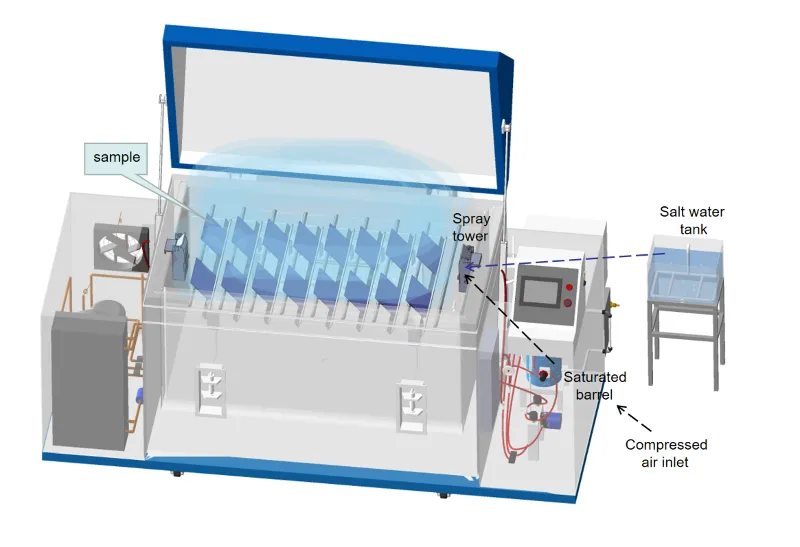
A salt spray test machine heats a 5% sodium chloride (NaCl) solution and pushes it through a quartz nozzle at 83 kPa pressure. The nozzle breaks the liquid into a fine fog, which settles on your test samples at a rate of 1–2 mL per 80 cm² per hour. The chamber keeps the temperature at 35 ± 2 °C, with fluctuation within ±0.5 °C. This steady, repeatable environment accelerates corrosion so you can see in days or weeks what would take months or years outdoors.
2. Salt Spray Machine vs. Natural Corrosion Testing
Natural corrosion testing means leaving samples outside for 6 to 24 months-slow, expensive, and hard to compare across seasons. A salt spray test machine compresses that time to 48 to 1,000 hours. But there's a catch: traditional continuous salt fog does not include drying or humidity cycles. That's why cyclic chambers exist. For example, a real coastal environment has salt spray, then morning dew, then hot sun drying the surface, then more salt. A basic salt spray machine misses the drying phase entirely. A cyclic salt spray chamber adds temperature cycling (10 °C to 90 °C, deviation within ±2 °C) and humidity control (30% to 98% RH) to match real-world stress far better.
3. Which Standards and Industries Require Salt Spray Testing?
Different industries follow different standards. Here are the most common ones you must check before buying: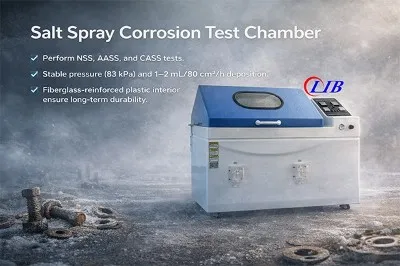
ISO 9227 – Covers Neutral Salt Spray (NSS, pH 6.5–7.2), Acetic Acid Salt Spray (AASS, pH 3.1–3.3), and Copper-Accelerated Acetic Acid Salt Spray (CASS, with 0.26 g/L CuCl₂). Used for general metals, coatings, and decorative finishes.
ASTM B117 – The most widely used basic salt spray standard in North America.
ASTM G85 – Includes cyclic salt spray with preheated air at 47 ± 1 °C.
JIS Z 2371 – Japanese standard for salt spray testing.
DIN 50021 – German standard for different salt spray methods.
SAE J2334 – Automotive cyclic corrosion test used by Ford, G.M., and others.
Company standards – VW, Toyota, Honda, Nissan, Renault, BMW, Jaguar, Land Rover, Volvo, and Peugeot all have their own cyclic test profiles.
Industries that rely on these tests include automotive (brake lines, fasteners, connectors), marine (hull fittings, deck hardware), electronics (enclosures, PCB coatings), aerospace (landing gear components), and fire safety devices (sprinkler heads, alarms).
LIB Installs a Cyclic Salt Spray Test Machine for Quanta Computer in Taiwan
Quanta Computer, based in Taiwan, needed to test painted and plated coatings on electronic enclosure parts used in outdoor network equipment. They originally ran basic NSS tests per ISO 9227, but field returns showed unexpected edge creep and blistering after hot‑humid cycles followed by dry periods. Their existing machine could not reproduce those conditions.
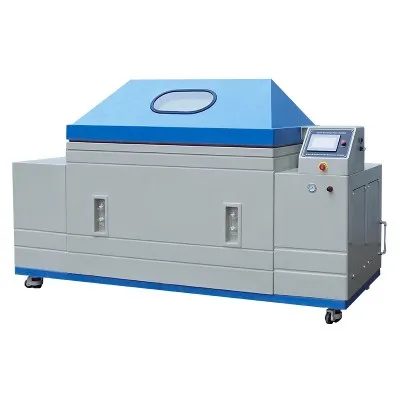
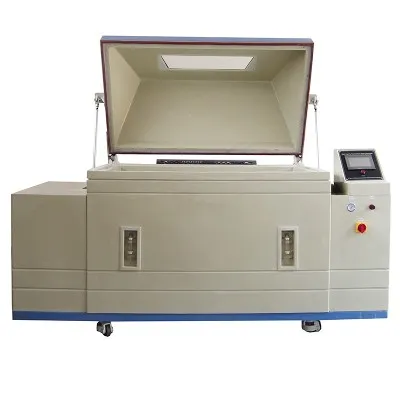
LIB installed a Cyclic Salt Spray Test Chamber that runs full multi‑phase sequences: salt spray mode at 1–2 mL/80 cm²/hr, humidity mode up to 98% RH, and drying mode with warm air to form salt crystals. The chamber meets ASTM G85, ISO 11997, and SAE J2334 in one unit. Quanta's lab head reported three immediate benefits:
① Lighting uniformity – Dual hanging spray towers eliminated dead spots, so every sample position receives the same fog density. No more retesting because of uneven deposition.
② Sample loading convenience – The pneumatic-assisted door opens hands‑free, making it easy to load tall or heavy fixtures. Removable V‑groove holders and round rods fit different part shapes without custom adapters.
③ Accelerated cycle switching – Integrated salt spray, air circulation, refrigeration, and humidity systems switch phases automatically without manual intervention. One operator can run a 7‑day cyclic test without weekend visits.
Quanta now uses LIB's cyclic chamber to qualify all outdoor‑rated enclosures, and their field failure rate for coating‑related issues dropped by more than 40% within six months.
|
Model |
SC-010 |
SC-016 |
SC-020 |
|
Internal dimensions (mm) |
800*1450*680 |
1000*1600*800 |
1000*2000*900 |
|
Overall dimensions (mm) |
1400*2500*1720 |
1600*2650*1840 |
1600*3050*1940 |
|
Interior Volume (L) |
800 |
1280 |
1800 |
|
Temperature Range |
+10 ℃ ~ +90 ℃ |
||
|
Temperature Fluctuation |
± 0.5 ℃ |
||
|
Temperature Deviation |
± 2.0 ℃ |
||
|
Humidity Range |
30% ~ 98% RH |
||
|
Humidity Deviation |
+ 2%, - 3% |
||
|
Salt Fog Deposition |
1~2ml / 80cm2 · h |
||
|
External Water Solution Tank |
340*230*230(18L) |
||
|
View Window Size(mm) |
800*300 |
||
Standard Salt Spray Machine vs. Cyclic Salt Spray Machine: How to Choose
| Feature |
Standard Salt Spray Machine |
Cyclic Salt Spray Machine |
|---|---|---|
| Test modes | Continuous salt fog only | Salt spray, humidity (30–98% RH), drying, temperature cycling (10–90 °C) |
| Standards met | ISO 9227 (NSS, AASS, CASS), ASTM B117, JIS Z 2371, DIN 50021 | All basic standards + ISO 11997, ASTM G85, SAE J2334, VW, Ford, Toyota, Honda, Nissan, Renault, BMW |
| Deposition rate | 1–2 mL/80 cm²/hr at 83 kPa | Same, but with programmable cycling |
| Temperature control | 35 ± 2 °C, fluctuation ±0.5 °C | 35 ± 2 °C for salt mode; 10–90 °C for thermal cycles |
| Humidity control | Not available | 30% to 98% RH, deviation ±2% |
| Drying phase | No | Yes, with warm air to crystallize salt |
| Automation | Manual or basic timer | Fully automated touchscreen, 120 programs × 100 steps, remote monitoring |
| Door operation | Manual or simple latch | Pneumatic‑assisted, hands‑free |
| Best for | Basic coating screening, QC pass/fail | R&D, field‑simulation, automotive, marine, electronics with cyclic stress |
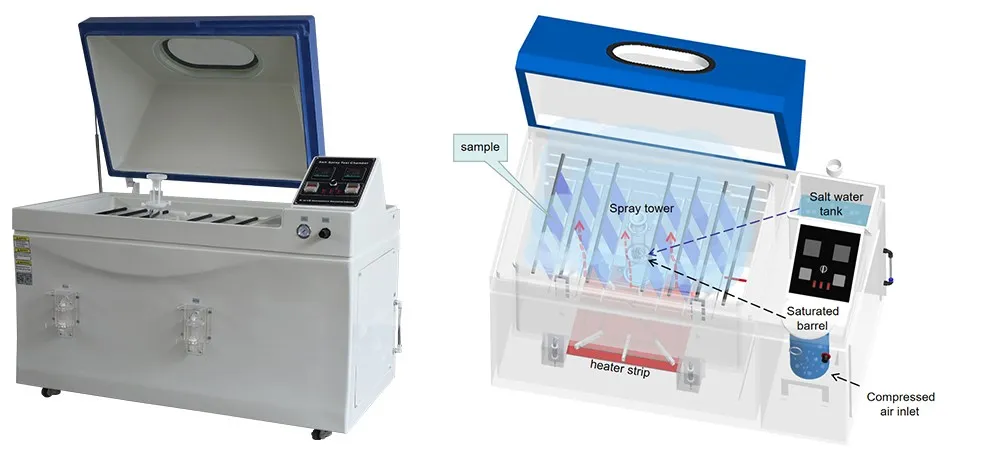
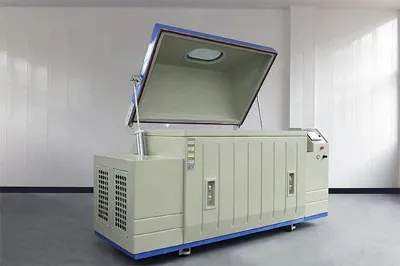
How to choose: If you only need to check whether a coating survives continuous salt fog (e.g., simple QC for zinc plating), a standard salt spray machine is enough and costs less. But if your product faces wet-dry cycles, temperature changes, or high humidity (e.g., under‑hood automotive parts, outdoor telecom boxes, marine electronics), you need a cyclic machine. The cyclic chamber gives you real‑world accuracy and lets you run all standards in one box.
Popular salt and Climatic chambers

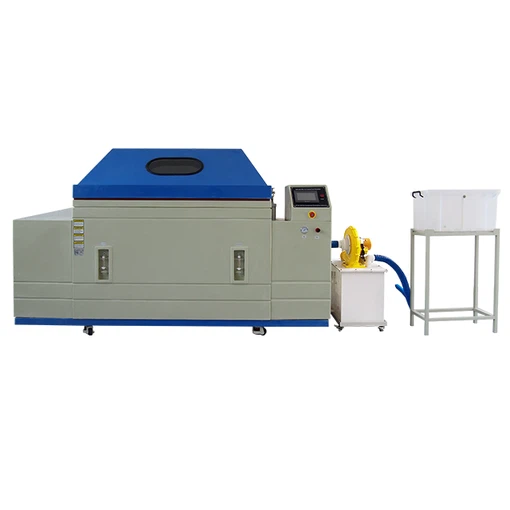
ASTMB117 Fog Corrosion Salt Spray Test Machine
Temperature & Salt Spray Control Only, Precision Salt Spray Measurement, Standard Compliant.

Cyclic Salt Corrosion Test Machine
Controlled Temperature, Humidity & Salt Spray for Realistic Simulation, Highly Popular.
ASTM G85 Salt And SO2 Spray Test Machine
Controlled SO₂, Temperature, Humidity & Salt Spray for Industrial Environment Simulation.

Walk-in Salt Spray Test Machine
Large Test Pieces, High-Volume Testing; Flexible Customization of Size & Function.

UV Light Simulation Test, Stable Light Source, High Uniformity of Light Exposure.

Xenon Arc Chamber Weatherometer
Realistic Sunlight Simulation, Water-Cooled Lamp for Stability & Durability, Top Choice for Coating Companies.
FAQs on the Salt Spray Test Machine
Q1: What is the typical delivery time for LIB salt spray chambers?
A1: Standard models ship within 15–20 working days after order confirmation. Custom cyclic chambers with additional refrigeration or high‑humidity systems take 25–30 days. All shipments use export‑grade wooden crates with foam padding.
Q2: Do you offer installation and training?
A2: Yes. LIB provides free remote installation support and video tutorials. For on‑site training, we can arrange a technician for a separate fee. Many customers learn to operate the touchscreen (multilingual, 120 programs) within two hours.
Q3: What warranty and after‑sales support do you provide?
A3: Every chamber comes with a 3‑year warranty and lifetime technical support. If remote troubleshooting fails, we dispatch a replacement unit free of charge. Spare parts (nozzles, sensors, pumps) reach most global locations within 7–15 days via DHL or FedEx.
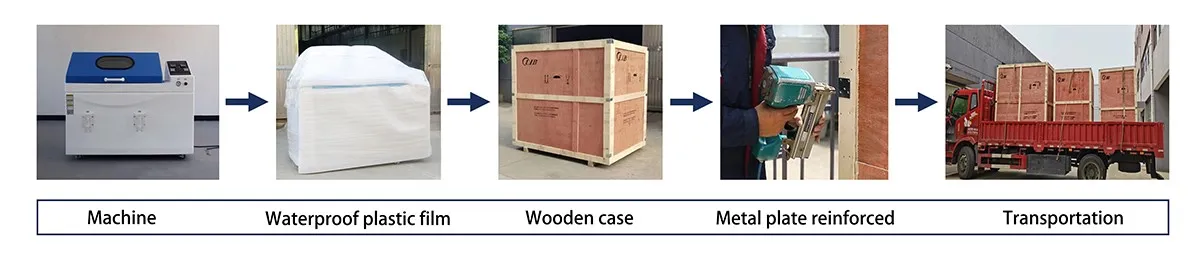
Q4: How do I transport the chamber into my lab?
A4: Standard chambers (under 200 kg) have height‑adjustable castors and fit through a standard 90 cm doorway. Larger cyclic chambers with pneumatic doors may require disassembly of the door hinge, which our manual explains in 10 steps. We also offer a pallet with swivel wheels for tight corridors.
Q5: How often do I need to calibrate sensors?
A5: PT‑100 Class A sensors should be verified every 12 months. You can perform a simple one‑point check with a certified thermometer, or send the chamber to a local calibration lab. LIB also sells a portable calibration kit for under $300.
Q6: Can I run both NSS and CASS tests on the same machine?
A6: Yes. Both standard and cyclic models allow you to change the salt solution. For CASS, you add 0.26 g/L CuCl₂ to the acetic acid salt solution. The chamber's internal surfaces (glass fiber reinforced plastics or SUS304 stainless steel) resist copper corrosion. Just rinse the tank and nozzles thoroughly between test types.
Contact LIB Industry today to configure a Salt Spray Test Machine that matches your exact standards, sample types, and laboratory space.


