
When products are exposed to dust, water, and harsh outdoor environments, their performance and longevity can be compromised. From automotive sensors to electronic enclosures, dust infiltration and water ingress can lead to malfunctions, short circuits, and even mechanical wear. Testing for IP66 ensures that products are dust-tight and resistant to powerful water jets, preventing costly failures in real-world applications.
LIB's IP66 Test Equipment provides a reliable, standards-compliant solution for engineers and manufacturers. Designed for precision, repeatability, and optional MIL-STD compliance, the equipment simulates dust and water exposure while maintaining controlled airflow, temperature, and particle concentration. This ensures accurate evaluation of product durability and adherence to IEC 60529 and ISO 20653 standards.
What Is IP66 Testing?
IP66 testing is part of the Ingress Protection (IP) rating system, defined by IEC 60529 and ISO 20653. This system classifies how well enclosures protect against solids and liquids:
- The first digit "6" signifies complete protection against dust; the enclosure is "dust-tight."
- The second digit "6" indicates resistance to high-pressure water jets, ensuring protection from splashing or powerful streams.
IP66 testing evaluates products' ability to maintain functionality under such conditions. Dust particles, often smaller than 50 μm, can infiltrate mechanical components, clog filters, or interfere with electronics. Water ingress may cause corrosion or short circuits, particularly in automotive, defense, and electronics industries.
During IP66 dust proof testing, controlled dust chambers are used to expose products to fine particles, simulating desert conditions or dusty industrial environments. Talcum powder or fine silica dust is dispersed via vertical air circulation to ensure uniform coverage. For water resistance, high-pressure jets (100 kPa, 100 L/min) are directed onto the enclosure, replicating real-world exposure.
Testing under these standards helps manufacturers ensure that their products can reliably operate outdoors or in harsh industrial settings, preventing premature failures and increasing customer trust.
|
IP66 Test Equipment for Dustproof and Waterproof Performance Testing |
||
|
|
1. Reliable IP66K Test Devices 2. Efficient IP6X Dust Ingress Test Chamber 3. Comprehensive IP6X IP5X Ingress Test Chamber 4. Precision IPX6K Test Chamber 5. Durable IPX5 IPX6 Water Jetting Test Chamber |
|
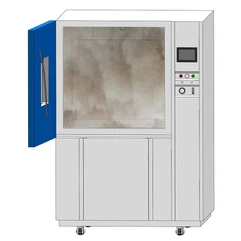
How to Use IP66 Test Equipment
IP66 testing is designed to check two key aspects of a product: dust resistance and water resistance. By evaluating these points, engineers can ensure that enclosures are fully sealed, preventing damage to internal components. This testing also verifies compliance with regulatory standards like IEC 60529 and ISO 20653 before market release.
Step 1: Dust Proof Testing
Place the product inside the IP66 test chamber.
Fill the chamber with controlled dust, typically talcum powder (~50 μm).
Maintain a dust concentration around 2 kg/m³ with vertical air circulation for even exposure.
Expose the product for a predetermined duration, recording temperature and dust levels to ensure consistency.
 |
 |
| Name | IP66 Dust Proof Tester |
|
Workroom dimension (mm) |
800*800*800 D*W*H |
|
External dimension (mm) |
950*3150*1800 D*W*H |
|
Interior Volume (L) |
510 |
|
Diameter of Turntable (mm) |
600 |
|
Turntable loads |
20kgs Max |
|
Turntable Rotation Speed |
0~7r/min (Adjustable) |
|
Internal Diameter of IPX5 Nozzle |
6.3 mm |
|
Internal Diameter of IPX6 Nozzle |
12.5 mm |
|
Water Flow Rate IPX5/ IPX6 |
12.5L/min ±5% / 100L/min ±5% |
|
Controller |
Programmable color LCD touch screen controller |
|
Ethernet connection, PC Link, USB |
Step 2: Water Jet Testing
Configure the test chamber nozzles for IPX6 water jet parameters (12.5–100 L/min, 100 kPa).
Rotate the turntable if necessary to expose all surfaces to high-pressure water jets.
Monitor water flow rate, pressure, and chamber temperature to maintain test integrity.
After testing, inspect the enclosure for leaks, dust ingress, or water damage and perform functional checks.
Through this two-step approach, IP66 test equipment provides a complete assessment of both dust and water resistance.
|
|
|
| Model | R56-800C |
|
Workroom dimension (mm) |
800*800*800 D*W*H |
|
External dimension (mm) |
950*3150*1800 D*W*H |
|
Diameter of Turntable (mm) |
600 |
|
Turntable Rotation Speed |
0~7r/min (Adjustable) |
|
Internal Diameter of IPX5 Nozzle |
6.3mm |
|
Internal Diameter of IPX6 Nozzle |
12.5mm |
|
Water Flow Rate IPX5/ IPX6 |
12.5L/min ±5% / 100L/min ±5% |
|
Water Supply System |
Water tank, booster pump, Automatic water supply, Water purification system |
|
Standard |
IEC 60529, ISO20653 |
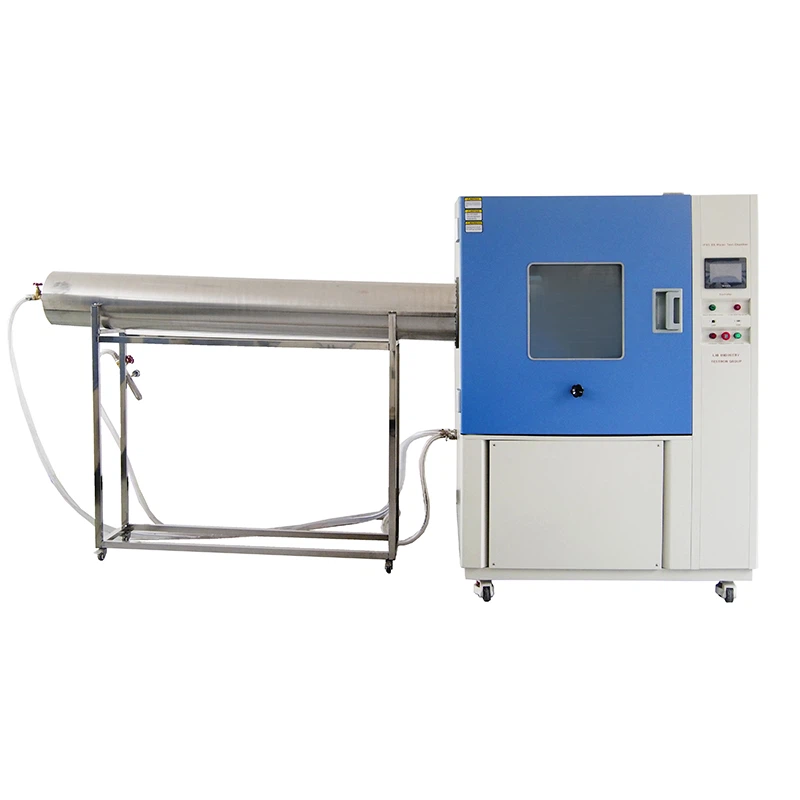

Advantages of LIB IP66 Test Equipment
LIB's IP66 Test Equipment offers several key advantages for manufacturers:
 |
 |
|
| Test Area | LAN and USB | Controller |

👆IP6x Dust Test Equipment
Standards Compliance: Supports IEC 60529, ISO 20653, and optional MIL-STD-810H Methods 510.7/510.8 for sand and dust testing.
Precise Control: Adjustable airflow (1.5–29 m/s), dust concentration (0.18–10.7 g/m³), and particle sizes (50–850 μm) for dust and sand simulations.
Temperature Stability: Heating tubes maintain 35°C or 45°C as needed, even during high dust or sand concentrations.
Durable Construction: SUS304 stainless steel interior resists corrosion; powder-coated A3 steel exterior ensures long-term durability.
Programmable Operation: PID touchscreen controller supports 120 programs with up to 99 segments each, with Ethernet and USB connectivity for real-time monitoring and data logging.
Operational Efficiency: Built-in lighting, dust recycling, and a double-door workroom reduce operator intervention and increase repeatability.
Versatility: Suitable for small electronics, automotive components, and military-grade equipment.
These advantages ensure reproducible, reliable testing results that match real-world conditions, supporting product development and regulatory approval processes.
|
|
|
|
|
|
Workroom |
View Window |
Internal Power
|
Build-in Lighting |
|
|
|
 |
 |
| Turnbale | Spray Nozzle | IPX5 IPX6 Water Jetting Outlet | Built-in waterproof power supply |


👆IPX6 Water Test Equipment
IP66 Test Equipment: Q&A
Q1: If the high temperature exceeds 80°C, will it affect the lifespan of the air duct or other components?
A1: According to IEC 60529 standards, the dust must circulate throughout the chamber. The sand and dust test chamber is designed so that temperatures above 80°C do not impact airflow ducts. Insulation layers and heating tubes are optimized for heat retention, and components are selected for high-temperature durability, ensuring stable operation.
Q2: How does the Sand and Dust Test Chamber maintain a temperature of 35°C or 45°C? Does it rely on continuous operation of the heating tube?
A2: Yes, the chamber relies on the heating tube's continuous operation. The control system adjusts power output to maintain the target temperature, ensuring test accuracy and reliability.
Q3: For small test items, such as headphones, are there professional recommendations for their placement during dust testing?
A3: Per IEC 60529, small test items can be placed naturally or suspended to accommodate different sizes and shapes. LIB provides a horizontal beam on the top of the chamber for hanging lightweight items, improving exposure and convenience.
Q4: During vacuum operations in the Sand and Dust Test Chamber, is it permissible to drill holes directly on the enclosure? Can the required tools be standard accessories of the equipment?
A4: IEC 60529 requires holes at the weakest points of the test sample to simulate dust ingress. The specific location varies by product, so users typically provide their own tools. LIB can provide a small auxiliary drill as an optional accessory.
Q5: How does the MIL-STD Dust Test Chamber achieve a wind speed of 29 m/s, and what is the specific design?
A5: To meet MIL-STD-810H Method 510.8, the chamber ensures sand particles hit the specimen at 18–29 m/s in parallel flow. Design features include:
- Extended air ducts with flow-straightening plates for uniform laminar flow.
- High-power centrifugal fans with air or water cooling to maintain stable output.
- Noise-reduction and vibration-damping structures to ensure smooth operation at high wind speeds.
Testing for IP66 using LIB's equipment ensures that products are fully protected against dust and water ingress, meeting international standards and reducing the risk of failure in the field. With programmable controls, precise airflow, and optional military-grade compliance, manufacturers can confidently validate the durability of automotive, electronics, and defense components.
Any customization can be made. LIB offers a 3-year warranty and lifetime service. Any issues that cannot be resolved during the warranty period will be replaced free of charge. 24/7 English-speaking after-sales team. Fast shipping within 7-15 days.
Contact LIB Industry now to discuss a tailored IP66 testing solution for your product and elevate your quality assurance process.


