
When rain strikes, it doesn't always fall gently. From light drizzle to high-pressure car wash jets, electronic and automotive components are constantly challenged by water exposure. A single failure due to water ingress can cause short circuits, corrosion, or even large-scale product recalls. So how do we know whether an enclosure truly survives these wet conditions-and is an IPX5 or IPX6 rating really enough to guarantee waterproof safety?
LIB IPX5 and IPX6 Rain Jet Test Chambers provide an answer. Designed to reproduce realistic rainfall and water-jet exposure according to IEC 60529, ISO 20653, and DIN 40050-9, these systems allow engineers to evaluate product sealing integrity under controlled, repeatable conditions. They ensure your design meets not only certification standards but also real-world rain performance.
What Is the Standard Test for IPX5 and IPX6 and Can It Truly Simulate Rain?
IP ratings (Ingress Protection) classify how well an enclosure resists dust and water. Defined first in IEC 60529, later expanded by ISO 20653 and DIN 40050-9 for automotive use, they provide uniform criteria recognized worldwide. The second digit in the IP code-from 0 to 9K-represents water protection.
IPX5 simulates rain jets striking a product from all directions. The test uses a 6.3 mm nozzle, spraying 12.5 L/min ± 5 % of water at 30 – 100 kPa from a distance of 2.5 – 3 m for at least 3 minutes.
IPX6 intensifies the challenge, applying a 12.5 mm nozzle, 100 L/min ± 5 % flow, and 100 ± 5 kPa pressure under the same distance and duration.
Both tests are designed to simulate heavy rain, car washing, or strong hose spray, but they do not represent full submersion. Real rainfall often varies in droplet size, wind direction, and duration; these tests standardize those variables so that products can be compared reliably across manufacturers.
The goal is reproducibility, not meteorology. By ensuring consistent jet impact, angle, and flow rate, the IPX5/IPX6 test defines the minimum sealing level required for outdoor electronics, lighting fixtures, and vehicle components.
What Is the Difference Between IPX5 and IPX6 Rain Jet Test Chambers?
While both chambers operate on similar principles, the key differences lie in water intensity, pressure range, and specimen handling.
IPX5 testing evaluates a product's resistance to moderate water jets-similar to heavy rainfall or road splash. IPX6 simulates powerful pressure jets like those from vehicle cleaning equipment or highway rain at high speeds. To perform IPX6 correctly, the chamber must sustain higher water flow, stronger pumps, and larger nozzles while maintaining stable pressure.
The IPX6 chamber typically includes reinforced piping, high-capacity pumps, and robust fixtures to prevent specimen displacement during testing. Both systems require precision-machined stainless-steel nozzles and closed-loop flow control to guarantee test accuracy within ± 5 %.
| Feature | IPX5 Test Chamber | IPX6 Test Chamber |
|---|---|---|
| Nozzle Diameter | 6.3 mm ± 0.1 mm | 12.5 mm ± 0.2 mm |
| Flow Rate | 12.5 L/min ± 5 % | 100 L/min ± 5 % |
| Pressure | 30 – 100 kPa | 100 ± 5 kPa |
| Spray Distance | 2.5 – 3 m | 2.5 – 3 m |
| Typical Use | Electronics, Lighting Enclosures | Automotive, Heavy-Duty Systems |
| Purpose | Rain Simulation | High-Pressure Water Jet Resistance |
In short, IPX5 keeps water out, while IPX6 resists aggressive jets. Together, they define whether a product can handle anything from a storm to a power wash.
| IPX5 IPX6 Rain Jet Test Chamber for Waterproof Testing | ||
|
|
1. High-Precision IPX5/IPX6 Water Jetting Test Chamber 2. Water-Saving IPX6K Test Chamber 3. High-Efficiency IP6k9k Test Machine 4. Sustainable IP68 Test Machine 5. IP6X IP5X Dust Ingress Test Chamber 6. Advanced IPX3 Waterproof Tester |
|
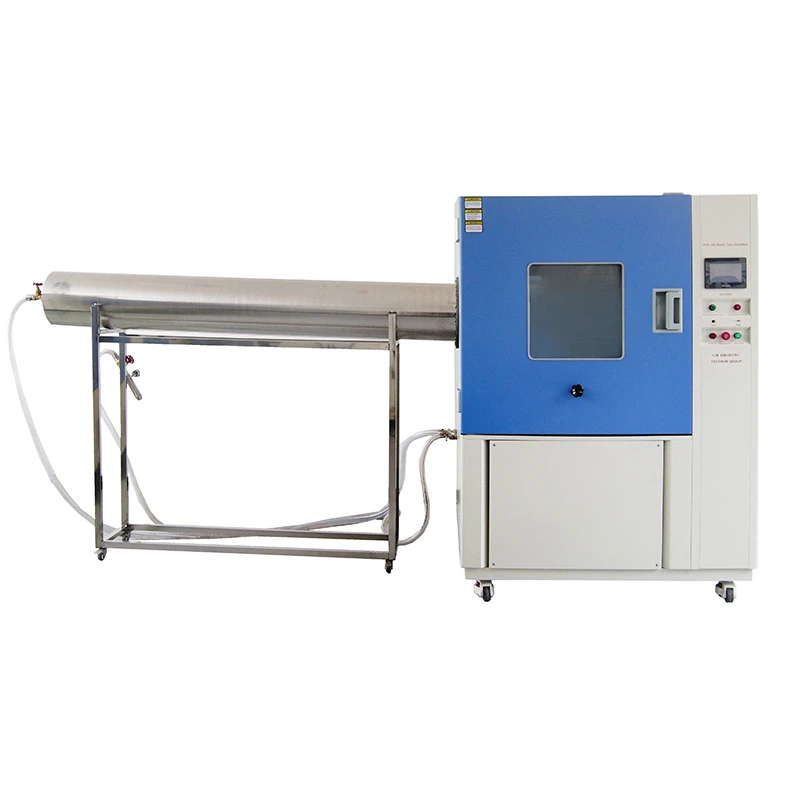
How to Test Automotive Materials Using the LIB IPX5 and IPX6 Rain Jet Test Chambers
For automotive engineers, waterproof testing ensures that control modules, connectors, and lighting assemblies survive real-world water exposure. For example, a printed circuit board (PCB) must be evaluated for coating integrity, connector sealing, and operational stability while powered on. A minor leak can cause signal errors or corrosion within days.
|
|
|
 |
|

|
|
|
|
|
|
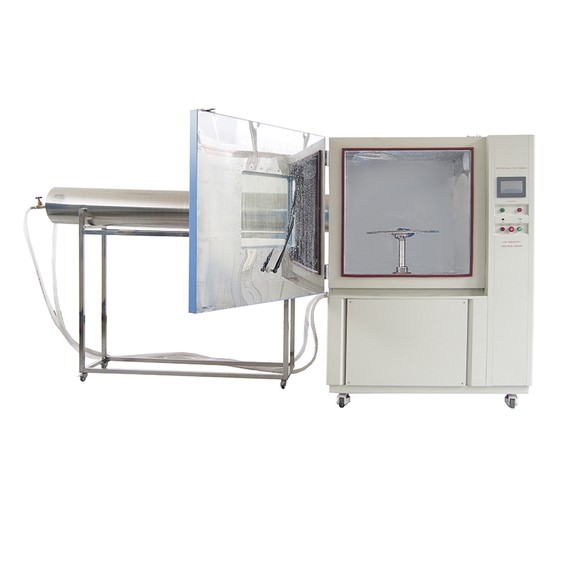
Workroom |
View Window |
Internal Power
|
Build-in Lighting |
|
|
|
 |
 |
| Turnbale | Spray Nozzle | IPX5 IPX6 Water Jetting Outlet | Built-in waterproof power supply |


Step 1 – Preparation and Mounting
The test begins with preparing the specimen. The sample is inspected for surface condition, sealing, and electrical readiness before testing. It is then secured on a rotating turntable, adjustable to 350–500 mm height, ensuring that water jets strike the product at the correct angle and distance.
LIB Advantage: A modular fixture system with adjustable clamps and cable ties safely holds small or irregular specimens even under 100 kPa pressure, preventing vibration or movement during high-flow testing.
Step 2 – System Setup and Parameter Adjustment
Before testing, the operator sets the nozzle type (6.3 mm for IPX5 or 12.5 mm for IPX6), adjusts spray distance to 2.5–3 m, and calibrates the flowmeter and pressure gauge. The PID-controlled pump stabilizes flow automatically to achieve 12.5 L/min or 100 L/min, depending on the test level.
LIB Advantage: The controller allows pre-programmed test sequences and automatic pressure regulation, eliminating manual fluctuation and ensuring test repeatability.
Step 3 – Water Jet Exposure Test
Once parameters are set, the spray system activates and directs water jets toward the specimen from all angles. The turntable rotates 0–7 r/min to provide uniform exposure. The standard test duration is at least 3 minutes or 1 minute per surface area of 1 m², whichever is longer.
LIB Advantage: The double-layer glass door with LED illumination allows operators to clearly observe jet coverage and any leakage in real time, without interrupting the test.
Step 4 – Post-Test Drying and Inspection
After the spray cycle, the sample is removed and air-dried at room temperature. Technicians then perform visual inspection, functional check, and electrical testing to detect any ingress or short circuit. For sensitive components, insulation resistance and continuity are verified immediately after drying.
LIB Advantage: The chamber's SUS 304 stainless-steel interior ensures corrosion-free operation, allowing continuous testing cycles without contamination risk between samples.
Step 5 – Data Recording and Reporting
All parameters-pressure, flow rate, duration, and nozzle type-are automatically logged by the controller. The system generates a complete digital test report for traceability and certification.
LIB Advantage: The integrated data logger exports reports directly via USB or Ethernet, simplifying quality documentation and ISO audit compliance.
This structured five-step process ensures that every test accurately reproduces real-world rain exposure for automotive sensors, lighting, connectors, battery housings, and electronic control modules, delivering precise, repeatable, and globally recognized waterproof validation.
IPX5 and IPX6 Rain Jet Test Chamber Q&A
Q1: What makes the LIB IPX5/IPX6 Water Jet Test Chamber reliable for long-term use?
A1: Its stainless-steel interior and durable components resist corrosion and wear, reducing maintenance and ensuring consistent performance over time.
Q2: What kind of support and uptime guarantee do LIB offer?
A2: Every chamber comes with a 3-year warranty, lifetime maintenance, and free replacement if on-site issues cannot be resolved remotely. LIB's 24/7 English-speaking technical team guarantees a 2-hour response time and on-site spare-parts delivery within 7–15 days.
Q3: Can I power and monitor my device under test during the spray test?
A3: Yes. The chamber includes a built-in power port for energizing samples and a transparent, impact-resistant window with LED illumination, enabling simultaneous observation and performance monitoring.
Q4: Does LIB provide customization?
A4: Absolutely. LIB offers tailored turntable sizes, optical access ports, and programmable controllers to suit specific testing standards or product configurations.
Q5: How does LIB ensure compliance with global standards?
A5: All LIB chambers conform to IEC 60529, ISO 20653, and DIN 40050-9, ensuring tests meet the world's strictest ingress-protection requirements for electronics, vehicles, and industrial systems.
Is IPX5 or IPX6 Enough for Your Product?
For light rain or moderate splashes, IPX5 is often sufficient. But for automotive or outdoor electronics exposed to pressure washing, wheel spray, or underbody water, IPX6 certification is the safer benchmark. Reliable testing equipment-built to match international standards-ensures those ratings are more than just numbers.
Any customization can be made. LIB offers a 3-year warranty and lifetime service. Any issues that cannot be resolved during the warranty period will be replaced free of charge. 24/7 English-speaking after-sales team. Fast shipping within 7-15 days.
Contact LIB Industry today to configure your IPX5/IPX6 Rain Jet Test Chamber and ensure your products meet the world's toughest waterproofing standards-reliably, accurately, and efficiently.


