When electronic devices, automotive components, or aerospace materials are exposed to sudden temperature changes, their structural integrity and functionality can be at risk. Extreme conditions such as rapid altitude changes, launch environments, or automotive start-stop cycles can cause cracks, delamination, or electrical failures. Testing under controlled, rapid thermal shock conditions ensures products survive real-world scenarios without compromise.
Air-to-water thermal shock chambers provide a solution for such high-demand testing. These chambers immerse or circulate liquids to rapidly expose samples to extreme temperatures, achieving precise and repeatable results. Unlike air-only systems, liquid-assisted thermal shock delivers ultra-fast ramp rates and consistent temperature distribution, making it ideal for thermally sensitive electronics and high-density PCBs.
LIB Air-to-Water Thermal Shock Chambers combine precision, repeatability, and global standards compliance. They support R&D, QA, and certification teams in verifying product durability while reducing test time and operational costs.
Introduction to Air-to-Water Thermal Shock Chamber
Understanding Air-to-Water Thermal Shock
Air-to-water thermal shock chambers are specialized devices used to test how products respond to sudden and extreme temperature changes. These chambers are widely applied in electronics, automotive, aerospace, and military industries.
Why Air-to-Water Testing Matters
By immersing samples in hot and cold liquid baths, engineers can quickly identify potential failures such as micro-cracks, delamination, or changes in electrical performance. This ensures products remain reliable in harsh environments.
Air-to-liquid testing provides extremely fast temperature changes, uniform heat distribution, and accurate reproduction of thermal stress. It is particularly effective for high-density electronics and delicate materials, where conventional air-based tests may be insufficient.
What products need air-to-Water thermal shock testing?
Air-to-water thermal shock testing is critical for products that encounter extreme temperature swings during normal use. These include:
- Semiconductors and microelectronic devices – tested according to IEC 60068-2-14 Nc, JESD22-A106B, MIL-STD-883J Method 1011.9, MIL-STD-202 Method 107, and LV124.
- Automotive electrical and electronic components – tested to ISO 16750 standards to ensure road durability.
- Aerospace hydraulic and electronic components – subjected to MIL-STD thermal shock methods for launch and flight conditions.
- Polymer composites and high-density PCBs – where micro-cracking or delamination may occur under rapid thermal cycling.
By following these international and military standards, manufacturers can guarantee products meet global reliability requirements.
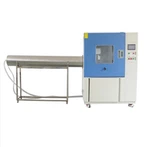
| Air-to-Water Thermal Shock Chamber for Product Testing | |
|
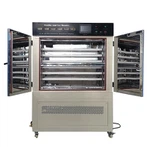
Thermal Shock Chamber |
1. Effective 2-Zone And 3-Zone Vertical Thermal Shock Test Chamber 2. Advanced 2-zone Luft-Luft-Thermoschockkammer 3. Air To Air Thermal Shock Chamber 4. Useful Temperature Humidity Chamber 5. Small Benchtop Temperature Humidity Chamber 6. High-Precision Walk in Temperature Chamber |

How does an LIB air-to-Water thermal shock chamber work?
LIB air-to-water thermal shock chambers use independent hot and cold baths to create rapid temperature cycling according to LV 124 standard:
 |
Air to Liquid Thermal Shock Chamber |
 |
Liquid to Liquid Thermal Shock Chamber |
|
Model |
TSI-038
|
|||||||||
|
Basket Useful Dimensions (mm)
|
2400*1200*1300 D*W*H
|
|||||||||
|
Salt Water Tank Dimensions (mm)
|
3000*2000*1600 D*W*H
|
|||||||||
|
Overall Dimension (mm)
|
3600*2800*3800 D*W*H
|
|||||||||
|
Loading Capacity |
200 kg |
|||||||||
|
Parameters |
Pre-heat Room |
Upper limit Temperature |
+220℃ |
|||||||
|
Heating Time |
Ambient ~ + 180℃, within 30 minutes |
|||||||||
|
Splash Water
|
Splash Water Temperature
|
0 to +4 ℃ (Adjustable)
|
||||||||
|
Cycle Duration
|
30 minutes
|
|||||||||
|
Splash Nozzle
|
Water Flow Rate
|
3 to 4 liters per splash nozzle
|
||||||||
| Number |
4 pieces
|
|||||||||
|
Distance between nozzle and DUT
|
300 to 350 mm
|
|||||||||
|
Splashing Time
|
3 seconds
|
|||||||||
|
Number of cycles
|
100
|
|||||||||
| Controller | Programmable color LCD touch screen controller | |||||||||
| Cooling system | Mechanical compression refrigeration system | |||||||||
| Exterior material | A3 Steel Plate with protective coating | |||||||||
| Viewing window | Interior lighting , double-layer thermo stability silicone rubber sealing | |||||||||
Sample immersion or fluid circulation – The chamber uses water or specialized liquids in hot and cold tanks. Samples are either immersed directly or exposed via circulating fluid.
Rapid temperature transfer – Fluids allow ultra-fast ramp rates, reaching temperature extremes in seconds, much faster than air-only systems.
Stable environmental control – Advanced PID controllers maintain set temperatures with deviations ≤ ±0.5 °C in the hot bath and ±3.0 °C in the cold bath.
Fluid conservation system – Enhanced seals, condensation pipes, and vapor recovery prevent liquid loss and reduce operational costs.
This design ensures samples experience true thermal shock with minimal human intervention while preserving test accuracy.
Why is air-to-water thermal shock testing important for electronics?
Testing electronics under thermal shock conditions ensures devices function reliably in extreme environments. Typical points of concern include:
Structural integrity – Detect micro-cracks or delamination in solder joints and PCB layers.
LIB Advantage: Rapid fluid-based temperature changes reveal subtle failures that air-only testing may miss.
Electrical performance – Ensure no functional failure occurs due to thermal expansion or contraction.
LIB Advantage: Independent hot and cold tanks maintain precise temperatures, preventing uneven stress that could produce false results.
Material compatibility – Verify that polymers, composites, or encapsulants withstand rapid thermal cycles.
LIB Advantage: Liquid immersion guarantees uniform exposure, reducing hot or cold spots for accurate assessment.
Step 1: Pre-stabilize hot and cold baths to desired temperatures (e.g., +150 °C and –75 °C).
Step 2: Transfer samples into the cycle via basket or conveyor system, ensuring ultra-fast exposure to both extremes.
Step 3: Monitor recovery time, which is typically ≤5 minutes to the preset temperature, allowing multiple cycles in a shorter period.
This process validates products under real-world conditions like aerospace launches, automotive engine cycles, or military-grade electronics use.
LIB air-to-Water thermal shock chamber service policy
LIB supports long-term operation and reliability:
Warranty: 3 years, with free replacement for unresolved issues during this period.
After-sales support: 24/7 English-speaking service team.
Shipping: Fast delivery within 7–15 days.
Maintenance: Minimal; enhanced sealing, vapor recovery, and condensation systems reduce downtime and operational costs.
LIB ensures users do not compromise between speed, precision, and practicality-choosing the chamber that fits specific testing requirements.
Air-to-water thermal shock chambers are essential tools for high-reliability product testing. Whether you need ultra-fast thermal transitions, high-density electronics testing, or robust automotive and aerospace component validation, these chambers provide reproducible, standard-compliant results. By adhering to standards such as IEC 60068-2-14 Nc, MIL-STD-883J Method 1011.9, MIL-STD-202 Method 107, JESD22-A106B, IEC 60749-11, EIAJ ED-4701/307, and ISO 16750, manufacturers can ensure that every product withstands thermal extremes and performs reliably worldwide.
Any customization can be made. LIB offers a 3-year warranty and lifetime service. Any issues that cannot be resolved during the warranty period will be replaced free of charge. 24/7 English-speaking after-sales team. Fast shipping within 7-15 days.
Contact LIB Industry today to find the perfect solution for your thermal shock testing needs.